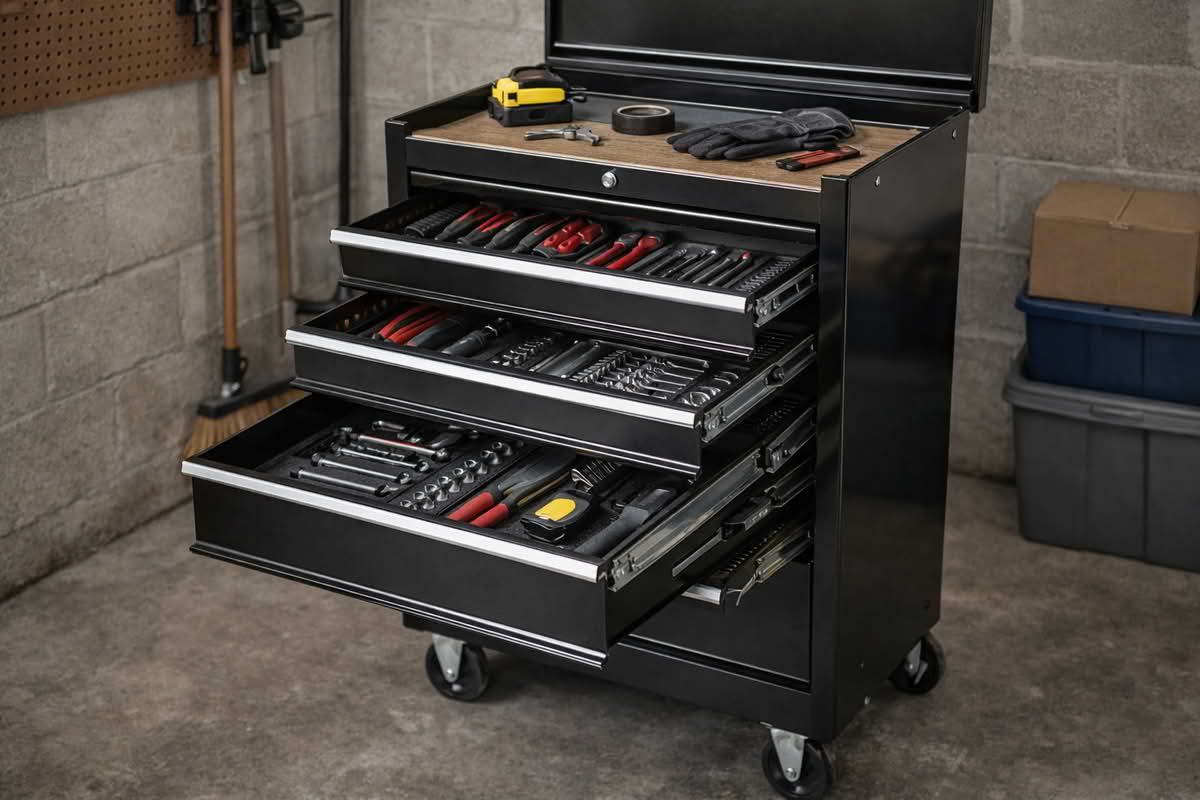
Rolling Tool Chest Buying Guide for Garage Organization, Workshop Storage, and Growing Tool Kits
A rolling tool chest often enters the picture when portable tool storage stops being enough. At that point, the problem is no longer just carrying tools to the job. It is keeping a growing collection organized, visible, and protected in a way that still supports actual work. That makes rolling chests highly useful, but also easy to buy badly. Many shoppers focus on total drawer count, exterior size, or a workshop-style appearance without thinking carefully about how the storage will function once real tools, batteries, sockets, pliers, screwdrivers, measuring tools, and power-tool accessories actually move in. A chest that looks substantial can still be frustrating if the drawer layout is wrong, the top area is poorly used, or mobility matters less than the bulk you end up living with every day. The best rolling tool chest is not necessarily the largest or heaviest-looking unit. It is the one that matches the size and shape of your actual collection, fits your garage or workshop realistically, and reduces tool clutter without becoming oversized furniture for a kit that is still relatively modest.
What a rolling tool chest needs to do well
A rolling tool chest should do more than simply hold a lot of tools. Its real job is to make a growing tool collection easier to understand, easier to access, and easier to maintain over time. That means it should help separate tool categories, reduce the pileup effect that happens in bags and boxes, and create a storage pattern you can live with once the novelty of the purchase disappears. A good chest turns clutter into a system. A poor one just spreads clutter across more drawers.
Visibility is the first major requirement. Tools that disappear into deep drawers or mixed layers may technically be stored, but they are not really organized. A rolling chest should make it easier to see what you own, spot missing items, and return tools to a logical place after a project. This matters because the value of chest-style storage is not just capacity. It is repeatability. When the same drawer consistently holds pliers, sockets, layout tools, fasteners, or cordless-tool accessories, the workshop or garage becomes less mentally noisy.
The second requirement is support for tool variety. Most homeowner and garage kits are not made entirely of one tool type. They include awkwardly shaped hand tools, small organizers, measuring tools, drill bits, chargers, batteries, and a changing mix of project-specific items. A useful rolling chest should accommodate that variety without forcing too many categories into the same drawer. That is why internal layout usually matters more than exterior size alone. A slightly smaller chest with better drawer usefulness can outperform a bigger one whose storage pattern does not match real tool shapes.
A good rolling chest should improve visibility and retrieval, not just increase total storage volume.
Drawer organization matters because tool storage only helps when it reduces searching and re-sorting.
The best chest layouts support mixed tool types rather than assuming every drawer will hold the same category of gear.
Real value comes from creating a system you can maintain, not just from owning more metal drawers.
Another overlooked quality is work-surface usefulness. Many rolling tool chests also become informal project stations for laying out parts, setting down tools mid-task, charging batteries, or staging hardware. That makes top-surface design more relevant than buyers sometimes realize. A chest that serves as a temporary work zone can add practical value in smaller garages or workshops where bench space is limited. But that benefit only helps if the chest still fits the room and does not become too large to move or place comfortably.
Mobility is also part of the category’s purpose, even if the chest will not move daily. Being able to reposition storage within a garage, workshop, or project area can matter more than many buyers expect. The chest may need to roll closer to a workbench, move aside for a vehicle, or shift during a reorganization of the space. A good chest should not feel like permanently immovable furniture unless your workflow actually calls for that degree of permanence.
The strongest rolling tool chest purchase is usually the one that makes your tool collection feel more legible. If it turns scattered piles, mismatched boxes, and overloaded bags into a clear working layout, it is likely doing the right job.
A useful rolling tool chest should create a clear, maintainable storage pattern for hand tools, accessories, and growing garage gear.
Size, drawer layout, and mobility tradeoffs
The biggest mistake in this category is assuming that more drawers or more overall size automatically means better storage. In practice, the usefulness of a rolling chest depends less on quantity than on drawer proportions and how well those proportions match the tools you actually own. A chest filled with shallow drawers may be great for sockets, screwdrivers, and pliers, but awkward for power-tool batteries, bulkier hand tools, or small organizers. A chest with only a few deep drawers may hold larger items well but make it harder to sort and retrieve smaller tools efficiently. The right layout usually mixes both, and the right balance depends on the collection.
Compact rolling chests often make a lot of sense for homeowners because they create a real organization upgrade without taking over the whole garage. They can store the core kit, keep tools visible, and still leave room for vehicles, shelving, or general household storage. Their tradeoff is growth. A compact chest may feel excellent at first and then tighter than expected once your tool collection expands into cordless systems, more sockets, bigger hand-tool assortments, and project-specific accessories. That does not make it the wrong choice. It simply means the chest should be matched to both present use and plausible near-term growth.
Mid-size chests tend to sit in the practical middle. They often provide enough drawer variety and enough future room to support growing garage use without tipping too far into oversized workshop furniture. This is why they appeal strongly to homeowners who are building a serious but not full-time workshop-style setup. Larger heavy-duty chests can be excellent when the tool collection is already substantial, but they also introduce real tradeoffs in footprint, cost, and overall room control. A bigger chest is only better when the storage demand consistently uses that extra space.
Drawer layout matters more than raw drawer count because different tools require different storage shapes.
Compact chests are easier to fit into shared garages, but they may leave less room for collection growth.
Mid-size chests often offer the most balanced storage path for homeowners with expanding tool kits.
Larger chests make the most sense when the tool collection already justifies the added footprint and cost.
Mobility should be judged realistically. Some buyers imagine frequently rolling the chest to different work zones, while others will mostly leave it parked in one area and move it only when reorganizing the garage. If the chest will travel often within the space, caster quality, handle placement, and overall loaded weight matter more. If it will mostly stay put, drawer stability, top-surface utility, and footprint may matter more than mobility features. The same product category can therefore serve two different ownership styles: active rolling storage and semi-stationary workshop storage.
Another overlooked tradeoff is access in a crowded space. A very wide or deep chest may offer excellent storage once fully opened, but if your garage layout makes full drawer extension awkward around vehicles, shelves, or workbenches, the chest may be less practical than expected. Buyers should consider not only where the chest will sit, but how much clearance it will need during normal use. A slightly smaller chest that fits the room properly often delivers more real convenience than a larger model that constantly competes with the surrounding space.
Security and drawer retention can matter too, though mainly through everyday quality of use rather than theft anxiety alone. Drawers should open and close with enough stability that loading them feels reasonable and the chest does not seem flimsy under normal tool weight. This is particularly important once metal tools, socket rails, batteries, and organizers accumulate. A chest that looks fine when empty but feels strained when filled can become disappointing quickly.
The core tradeoff is simple: compact chests buy space efficiency, mid-size chests buy broader practicality, and large chests buy room for serious collections at the cost of footprint and often mobility ease. The right choice depends on whether your tool storage problem is modest clutter, active growth, or already workshop-scale accumulation.
Choosing for homeowners, growing garages, and heavier workshop use
For most homeowners, the best rolling tool chest is one that replaces scattered storage without forcing the garage to reorganize itself around the chest. That usually means a model with enough drawer variety for hand tools, measuring tools, sockets, small organizers, and a few larger accessories, but not so much width or depth that it takes over shared garage space. If your current problem is that tools live in several different bags, shelves, and random bins, a well-chosen rolling chest can create a much calmer system. The key is keeping the chest proportional to the actual collection.
Growing garages create the strongest case for mid-size rolling chests. Once your tool setup expands into cordless batteries, specialty hand tools, more hardware, and project categories that deserve their own drawers, a small chest may stop feeling like enough. At that point, a slightly larger system can create meaningful breathing room and make the difference between organized growth and merely rearranged clutter. Buyers in this phase should think less about what fits today and more about what the next few years of realistic tool accumulation are likely to look like.
Heavier workshop users are a different category. If the chest will support a broader mechanical kit, deeper hand-tool inventory, more repetitive workshop work, or a semi-permanent work zone, then larger and more robust storage becomes easier to justify. In that context, bigger drawers, more total volume, and stronger overall structure can be the correct answer because the collection and workflow truly use them. The mistake would be applying that logic to a smaller homeowner kit that does not actually need that scale.
Homeowners usually do best with a chest that organizes scattered tools without dominating the garage or workshop.
Growing garage setups often justify a mid-size chest because future tool additions tend to arrive faster than expected.
Heavier workshop users can justify larger systems when the collection and workflow genuinely need more dedicated storage volume.
The best chest matches both your current tool layout problem and the realistic pace at which the collection will expand.
Another useful question is whether the chest will be your primary storage system or part of a layered setup. Some buyers will still keep portable kits, wall storage, or parts organizers nearby, using the chest as the central base. Others expect the chest to absorb nearly everything. That distinction changes what “enough storage” really means. If the chest only needs to hold the core working tools, a smaller system may work well. If it must absorb batteries, chargers, specialty tools, organizers, and overflow categories, capacity needs rise quickly.
Buyers should also think about bench space. In smaller garages, a rolling chest often competes with or supplements a workbench. If the top surface will be used frequently for small staging tasks, charging, or light project layout, that can add real value. But if the chest becomes the only horizontal space in the garage, it may also gather clutter fast. A good choice should support the way you work, not simply create a flat place for everything without a drawer to accumulate.
The lowest-regret purchase is usually the one that feels a little more intentional than theatrical. If the chest fits the garage, supports the tool categories you actually own, and leaves room for growth without swallowing the room, it will likely remain useful much longer than a larger unit chosen mainly because it looked more workshop-ready.
Final Recommendations — choose the chest that matches your real collection, not your imagined one
A good rolling tool chest should make your garage or workshop feel more organized, more usable, and easier to maintain without overwhelming the space. For most readers, the best choice is the one that balances drawer usefulness, footprint, and future growth realistically. Bigger is only better when your tool collection and workspace actually support it. Otherwise, proportional storage usually creates the lower-regret outcome.
Choose a compact rolling tool chest if your goal is to organize a modest but growing homeowner kit without sacrificing too much garage space.
Choose a mid-size chest if your collection already includes cordless tools, deeper hand-tool categories, and a growing need for structured drawer organization.
Choose a larger or heavier-duty chest only when your workflow and tool volume truly justify the added footprint and storage complexity.
Prioritize drawer layout, room fit, and tool visibility over buying the biggest cabinet for a collection that does not yet need it.
The lowest-regret rolling tool chest is usually the one that makes your tools easier to find, easier to return, and easier to grow with. If it fits the garage, supports your actual project habits, and keeps your most-used tools in a clear predictable system, it will provide more long-term value than a larger unit bought mainly because it seemed like the safer workshop-style choice.