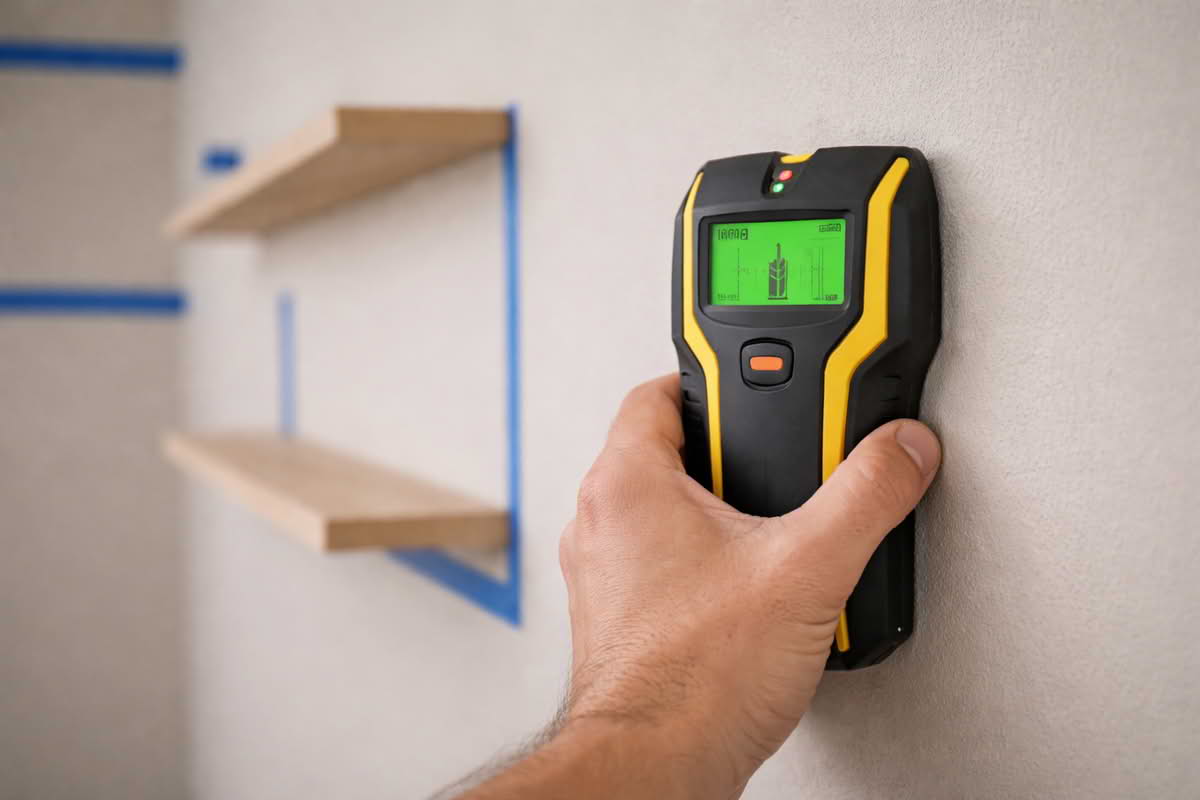
Stud Finder Buying Guide for Shelves, TVs, Wall Hardware, and Home Installation Work
A stud finder is one of those tools that looks minor until you need to mount something that cannot afford a bad guess. Shelves, televisions, heavy mirrors, grab bars, wall cabinets, curtain hardware, and storage systems all become more stressful when you are relying on tapping, vague wall clues, or the hope that an anchor alone will be enough. At the same time, stud finders are easy to buy badly. Some are overly basic for inconsistent wall conditions, while others advertise more sensing modes than most homeowners will ever use without actually making everyday scans easier to trust. The real challenge is not choosing the most advanced-looking model. It is choosing one that gives you enough confidence on your walls, with your projects, and under the kinds of conditions real homes create: layered paint, textured drywall, patch repairs, crowded utility runs, and imperfect framing. The best stud finder is the one that reduces hesitation and false readings without becoming a complicated device you avoid using.
What a stud finder needs to do well
A stud finder only has one real job: help you place fasteners where the wall can support what you are mounting. That sounds simple, but in actual home use the task is less straightforward than it appears. Walls can include uneven drywall thickness, repairs, texture, old fastener holes, corner framing irregularities, plumbing runs, wiring, metal plates, or insulation effects that make readings feel less obvious. This is why the best stud finder is not just the one that senses something inside the wall. It is the one that helps you interpret what you are sensing with enough consistency that you are willing to trust the mark you make.
Most frustration with stud finders comes from false confidence or false ambiguity. Some tools react too eagerly and seem to detect structure everywhere. Others feel so vague that users revert to tapping on the wall and guessing anyway. A useful stud finder should narrow the decision rather than widen it. That means it needs a scanning method that is readable, a display or indicator system that makes sense quickly, and enough consistency across repeated passes that you can confirm stud edges or center points without treating every scan as a fresh mystery.
This matters because many homeowner projects are not lightweight enough to forgive uncertainty. Floating shelves, television mounts, garage storage rails, bathroom accessories, and wall cabinets all have a different risk profile than a single picture hook. A tool that can reliably help you locate framing or confirm where not to drill is valuable not because it feels technical, but because it reduces the chance of damaging the wall or creating a mount that slowly loosens over time.
A good stud finder should provide repeatable, interpretable readings rather than isolated flashes of uncertain information.
Consistency across several passes matters more than whether the tool feels highly technical.
The best models reduce hesitation before drilling into walls that may contain framing, wires, or plumbing-adjacent complications.
Useful wall scanning is about confidence and confirmation, not just detection.
Ease of calibration is another practical factor. A stud finder that requires careful setup every time but gives little feedback can make ordinary mounting jobs feel more complicated than they should. On the other hand, a tool that calibrates quickly and clearly tends to become part of normal project workflow. This is important for household use, where projects are often intermittent and users may not remember a complicated procedure from the last time the tool came out of the drawer. Simplicity is not a luxury here. It is part of accuracy because a tool that is easier to use correctly will usually be used more correctly.
Another overlooked quality is how well the tool helps identify stud center rather than just the general area of a stud. For light-duty hanging, rough location may be enough. For heavier hardware, the difference between “somewhere near framing” and a confident centerline matters. Better stud finders often distinguish themselves by helping the user move from detection to placement more cleanly. That reduces both wall patching and fastener disappointment.
The strongest stud finder purchase is usually the one that turns repeated passes into a clear conclusion. If it helps you understand what is behind the wall well enough to drill with less doubt, it is doing far more than beeping when something changes.
A practical stud finder should help confirm framing location clearly enough that shelf and hardware installation feel less like educated guesswork.
Scan depth, wall type, and sensor tradeoffs
The biggest buying decision in this category usually comes down to how much wall complexity you need the tool to handle. Basic stud finders can be perfectly adequate on ordinary interior drywall when the main goal is occasional shelf brackets, picture groupings, or straightforward wall hardware. They tend to be simpler and easier to live with, which is part of their appeal. But once wall surfaces become less predictable or the projects become more demanding, more capable sensing can start to matter. This is where depth modes, multiple sensors, or broader wall-scanning functions become relevant.
Scan depth is one of the easiest specifications to misunderstand. Greater depth sounds automatically better, but it only helps when your walls or projects genuinely require it. A tool that can read deeper through thicker material may be more useful around layered drywall, older repairs, tile-adjacent installation zones, or walls with additional complexity. At the same time, depth features can add cost and sometimes more interpretation work. For many homeowners, the real issue is not maximum depth in theory. It is whether the tool reads their most common walls clearly enough to avoid frustration.
Sensor style also affects behavior. Some stud finders emphasize basic stud edge detection, while others lean toward broader wall-scanning behavior that can help identify multiple hidden elements. The appeal of multi-sensor or wall-scanner models is obvious: more information seems safer. Sometimes it is. But more information is only useful if it is presented clearly enough that the user can act on it. A more capable wall scanner can be excellent for trickier installations, but it can also feel like unnecessary complexity if the normal job is simply hanging a shelf on standard drywall.
Basic stud finders can work well for ordinary drywall and lighter household mounting when wall conditions are fairly predictable.
Deeper scan capability becomes more useful as wall construction, surface layers, or installation stakes become more complex.
Multi-sensor and wall-scanner models are most valuable when the added information helps solve real uncertainty rather than just adding features.
The right balance depends on your walls and projects, not on the assumption that more modes always mean more confidence.
Deep-scan and utility-aware features can be especially helpful in remodeling-adjacent work or in homes where wall conditions are inconsistent from room to room. Patches, added layers, textured finishes, or older building quirks can make basic detection less predictable. In that environment, a more capable tool may save time and reduce unnecessary exploratory holes. But for simple homeowner use on common drywall, those same features may be used rarely enough that they do not change ownership much.
Display clarity is just as important as sensing depth. A stud finder that provides edge indicators, center guidance, or clear directional prompts often feels much easier to trust than one with vague icon changes or abrupt signals. This matters because many wall projects already involve anxiety about drilling in the wrong place. The tool should calm that process, not add another layer of interpretation pressure. In practical terms, a simpler display that is consistently understandable may be better than a richer one that feels ambiguous.
Battery type, form factor, and grip design also deserve some attention. Since stud finders are typically used one-handed against a wall while the other hand marks, steadies, or holds a bracket, the tool should feel stable and easy to slide. A bulky design can be fine if it improves clarity, but a tool that feels awkward against the wall can make repeated passes less smooth. These physical details do not usually dominate feature comparisons, yet they shape whether the device feels helpful or fussy during actual projects.
The central tradeoff is simple: basic models favor speed and simplicity, while deeper or broader-sensing models favor versatility on more complicated walls. The better choice comes from knowing whether your projects demand more hidden-wall certainty or mostly just reliable stud location on ordinary surfaces.
Choosing for basic home use, heavy mounting, and trickier walls
For basic home use, the best stud finder is often the one that helps you complete common wall tasks without turning them into a diagnostic event. If your projects are mostly curtain rods, shelves, mirrors, small cabinets, and general wall-mounted hardware, a straightforward stud finder that is easy to calibrate and easy to read is often the right answer. The ownership goal here is not maximum technical range. It is dependable confirmation on standard interior walls with the least friction possible.
Heavy mounting changes the equation. Once the project involves televisions, garage storage tracks, heavier shelving, grab bars, or other installations where placement quality matters more, the value of clearer center detection and stronger scan confidence goes up. The tool does not need to become industrial, but it does need to reduce ambiguity. For this kind of work, paying more for clearer signals, broader scan ability, or more useful sensing depth can be a rational move because the consequences of guessing wrong are higher.
Trickier walls create a third use case. Homes with repairs, texture, patchwork, layered surfaces, or mixed remodeling history often make basic stud finders feel less dependable. If you already know your walls are not straightforward, a deeper or more capable model may save time and avoid the repetitive rescanning that makes wall projects more tiring. Likewise, if your projects often happen near bathrooms, kitchens, utility zones, or places where hidden infrastructure is more likely, broader scanning support can be worth more than it would be in a simple bedroom wall.
Basic home-use buyers usually benefit most from a simple stud finder that is fast to calibrate and easy to trust on ordinary walls.
Heavier mounting projects justify better center finding and higher scan confidence because placement errors matter more.
Homes with patches, texture, or inconsistent wall construction often benefit from deeper or more capable scanning tools.
The right stud finder depends on how much uncertainty your walls create before the tool even enters the project.
Another practical distinction is whether the stud finder will be an occasional-use safety tool or a repeat-use installation tool. Some homeowners only pull it out a few times a year, which argues for simplicity and intuitive use. Others use it regularly for shelving, smart-home installations, workshop organization, and room-by-room upgrades. In that case, a more capable model can make sense because the benefits accumulate over time. The tool should fit your project rhythm, not just the importance of one future job.
It is also worth thinking about how you verify results. A stud finder does not replace good habits. Marking both edges, rescanning, measuring likely stud spacing, and paying attention to wall context still matter. A better stud finder helps those habits converge more quickly. That is one reason ownership regret often comes from tools that appear functional but never quite inspire confidence. If each project still feels like a wall gamble, the tool is not really solving the problem you bought it to solve.
The lowest-regret path is usually to buy for the level of uncertainty you actually live with. If your walls are simple and your projects are ordinary, simplicity is often enough. If your projects are heavier or your walls are trickier, more sensing support can earn its keep. The point is not to own the most advanced scanner. It is to own the one that helps you place hardware with less doubt and fewer unnecessary holes.
Final Recommendations — choose the stud finder that gives you usable confidence
A good stud finder should make wall installation work feel more certain, not more technical. For most readers, the best choice is the one that provides repeatable scans, understandable feedback, and enough wall-reading ability for the kinds of mounts and surfaces they actually deal with. More features only matter when they solve real wall uncertainty. Otherwise, simplicity is often the better long-term ownership choice.
Choose a basic stud finder if your walls are fairly standard and your projects center on ordinary shelves, mirrors, and household hardware.
Choose a stronger center-finding or deeper-scan model if you regularly mount heavier items where placement confidence matters more.
Choose a broader wall-scanner style tool if patches, layered walls, or trickier installation zones are part of your normal project reality.
Prioritize repeatability, easy interpretation, and calibration clarity over buying the most feature-rich model for occasional use.
The lowest-regret stud finder is usually the one that helps you stop guessing. If it turns repeated passes into a clear decision, works well enough on your actual walls, and feels simple enough to use every time you need it, it will provide more real value than a more complicated tool chosen mainly because it sounded more advanced.