Laser Level Buying Guide for Hanging, Layout, Remodeling, and Home Installation Work
A laser level can look like an optional upgrade until you spend enough time trying to align shelves, picture groupings, cabinets, tile lines, curtain rods, or wall-mounted hardware with a traditional bubble level and a pencil. What it really buys is not just precision. It buys speed, repeatability, and fewer awkward layout errors across wider spaces. But the category is also easy to overbuy. Many shoppers are drawn to brighter beams, more planes, or larger kits without asking whether those features fit the kinds of home projects they actually do. In real use, the right laser level depends on visibility, mounting options, self-leveling behavior, and whether the tool feels easy to position in ordinary rooms rather than ideal jobsite conditions. The best choice is rarely the one with the longest feature list. It is the one that makes home layout work calmer, more legible, and less dependent on constant measuring corrections.
What a laser level is most useful for
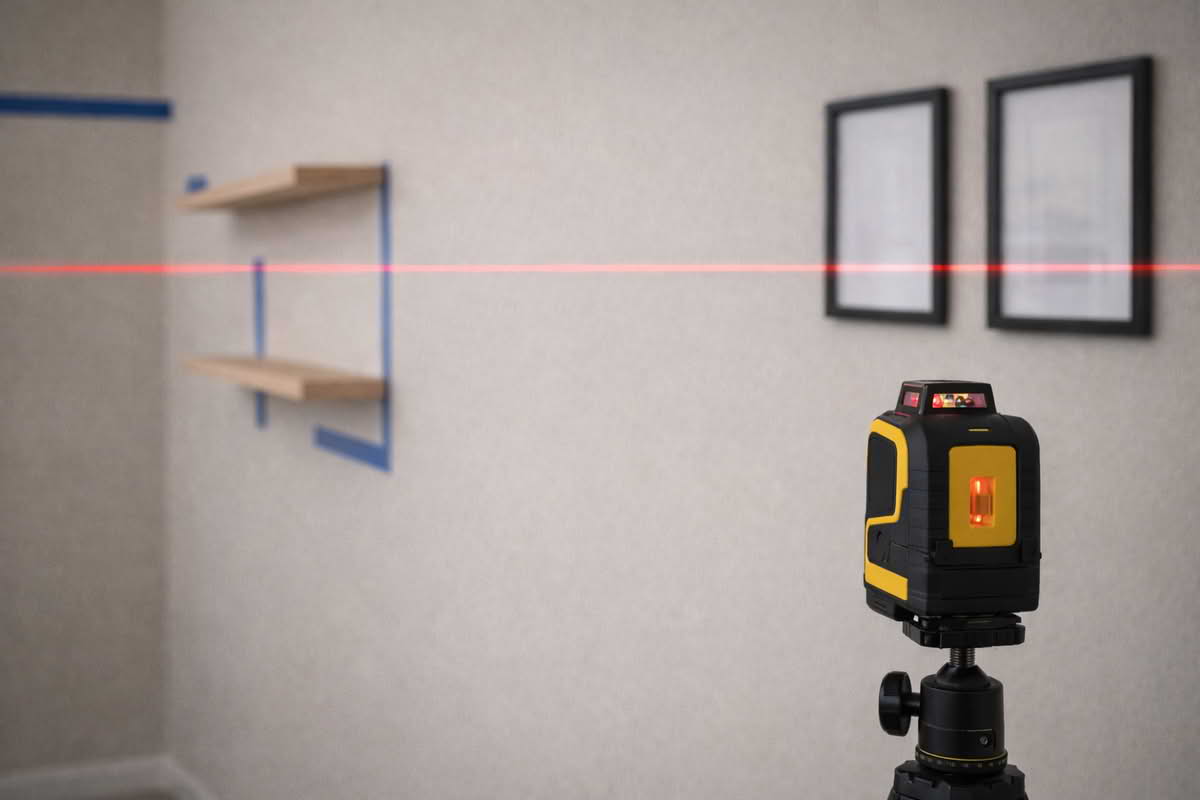
A laser level is most valuable when a project needs alignment across distance rather than just at one point. That makes it especially useful for hanging multiple frames, installing shelves, setting cabinet lines, laying out tile courses, aligning fixtures, marking consistent heights around a room, and checking straight visual relationships before drilling into a wall. In these situations, a traditional level can still work, but it usually requires more measuring, more repositioning, and more opportunities for small errors to stack up. The laser level changes the workflow by turning the reference line into something visible in the room instead of something you have to keep rebuilding one segment at a time.
This is why the category feels so practical once you use it. The benefit is not only that it can be more accurate. It is that it simplifies decisions. When you can see the line where hardware, trim, tile, or shelves need to land, you spend less time translating measurements into marks and more time confirming whether the plan actually looks right. That is particularly useful in homes, where walls, floors, and existing surfaces are not always as square or level as they appear at first glance.
Laser levels also help reveal when common assumptions fail. A shelf line that looks visually centered may not align with surrounding trim. A row of art that seems straight by eye may drift across the wall once a true reference line is visible. This is one of the reasons the tool has strong homeowner value. It does not just help with big remodeling jobs. It helps avoid the kind of small but persistent misalignment that tends to bother you every time you see it afterward.
Laser levels are strongest when a project needs alignment across a wider area rather than only at one point.
They are especially useful for shelves, art layouts, cabinets, tile, and wall-mounted hardware.
The main value is not only precision, but also faster and calmer layout workflow.
A visible reference line reduces repeated measuring and lowers the chance of compounding small errors.
The category is less important when jobs are small enough that a short level already solves the problem cleanly. That is why buyers should think in terms of layout pattern rather than feature excitement. If your projects frequently involve multiple anchor points, wider wall spans, or installation decisions that benefit from visual confirmation across space, a laser level can feel transformative. If your projects are mostly one-off hardware fixes in small areas, the value may be more occasional.
Ease of setup matters as much as function. A laser level that technically offers many lines but is awkward to mount, difficult to position, or slow to trust may not feel better than simpler tools in actual use. The best models tend to make it easy to get a line onto the work quickly and clearly. That immediacy is a large part of why the category works.
The strongest laser level purchase is usually the one that makes repeated layout work less mentally tiring. If the tool helps you mark, check, and commit with fewer cycles of doubt, it is doing far more than projecting a line.
A useful laser level turns alignment into something visible across the room, reducing repeated measuring and layout guesswork.
Beam type, visibility, and mounting tradeoffs
The first major choice in this category is usually beam type. For many home users, cross-line laser levels are the most practical entry point because they project horizontal and vertical reference lines that cover the most common hanging, alignment, and installation tasks. They tend to strike a strong balance between usefulness and complexity. More elaborate multi-plane models can be helpful in larger remodeling or layout workflows, but they also cost more and may be unnecessary if the work is mostly interior homeowner projects.
Visibility is the next major factor. The beam has to be easy enough to see under real room conditions, not just in dim demonstration settings. This is where buyers often become interested in green versus red lasers. Brighter visibility can be genuinely helpful, especially in larger rooms or brighter spaces, but it should still be judged against the actual environments where the tool will be used. Some homeowners need stronger visual clarity because their projects happen in daylight-heavy rooms, garages, or open-plan areas. Others mostly work indoors under controlled light, where a simpler option may still perform well enough.
Mounting options matter because a laser line is only useful if it can be placed where the project needs it. A laser level that is easy to rest, clamp, tripod-mount, or magnetically position often feels more useful than one with technically strong beam specs but awkward placement. This is especially true in home projects, where surfaces are not always arranged around ideal tool setup. Kitchen layouts, stairwells, laundry rooms, closets, and bathroom remodel areas often make positioning part of the challenge.
Cross-line models usually offer the most practical balance for common home alignment and installation work.
Beam visibility should be judged by real room conditions, not only by specification claims.
Mounting flexibility often determines whether the tool feels genuinely convenient in everyday use.
A brighter or more complex laser is only better when the project environment actually makes those advantages matter.
Self-leveling behavior is another important usability factor. A laser level should make setup easier, not create uncertainty about whether the projected line can be trusted. Tools that settle quickly and clearly communicate when they are out of range usually create a better ownership experience than those that leave the user guessing. This matters because laser levels are often used in moments where layout confidence is the whole point. If the setup process feels ambiguous, the value of the tool drops sharply.
Power source and battery type can also shape ownership. Rechargeable convenience is appealing, but so is being able to keep a tool ready without worrying about a forgotten charge if use is occasional. Buyers should think about whether the laser level will live in an active tool system or sit for stretches between projects. A tool that matches your storage and usage rhythm is usually more satisfying than one chosen mainly because its power format sounded more modern.
Size and footprint deserve attention too. A compact laser level can be easier to place on narrow ledges, shelves, ladders, and temporary supports. Larger models may offer more reach or more projection options, but they can also become harder to position naturally in smaller homes and finished interior spaces. As with many tools, the broader lesson is that more capability only helps when it does not create more setup friction than the project justifies.
The main tradeoff pattern is straightforward: simpler cross-line models favor usability, brighter beams favor visibility in tougher conditions, and broader mounting support favors adaptability. The best choice depends on where the tool will actually be used and how much setup complexity you are willing to tolerate in exchange for broader capability.
Choosing for homeowners, remodeling, and more demanding layout work
Most homeowners will get the best value from a laser level that is easy to deploy, easy to see indoors, and useful for everyday alignment tasks such as hanging shelves, centering artwork, mounting televisions, aligning wall features, and setting repeated heights around a room. In that context, a compact self-leveling cross-line model often makes the most sense. It gives you the core advantage of projected layout lines without requiring jobsite-style setup habits or a larger tool system to feel worth owning.
Remodeling users should think more carefully about visibility, mounting flexibility, and line range. Once projects include cabinet installation, tile layout, repeated room-to-room alignment, or larger renovation work, a basic homeowner model may still help, but stronger beam visibility and easier tripod or bracket support start to matter more. The tool becomes part of a wider workflow instead of just a convenience for occasional wall projects. In that environment, spending more for faster setup and more adaptable positioning can make practical sense.
Buyers doing more demanding layout work should also consider how often the laser will be used alongside other measuring tools. If it becomes part of a repeat pattern of room planning, flooring, trim alignment, or installation layout, then better visibility and stronger support options can pay off over time. But if the tool mainly appears for a few focused projects per year, then the lower-regret path may be to buy for simplicity and clarity rather than capability depth.
Homeowners usually benefit most from a compact self-leveling model that handles shelves, art, and general wall layout with minimal setup friction.
Remodeling users should give more weight to visibility, mounting options, and room-scale adaptability.
Demanding layout users can justify broader feature sets when the tool becomes a repeated part of project workflow.
The best laser level depends on whether your work is occasional alignment or frequent room-scale installation planning.
There is also a difference between wanting the tool to save time and wanting it to replace judgment. A laser level can make reference lines clear, but it still works best when paired with practical checking and thoughtful placement. That means the most useful model is not necessarily the one that projects the most lines. It is the one that encourages you to work quickly without making you doubt whether the setup is still correct. In ordinary home use, trust and simplicity often matter more than feature density.
Another practical ownership question is storage and readiness. A laser level that fits neatly in a drawer, cabinet, or small tool bag and can be set up quickly is more likely to become part of your normal project flow. A bulkier kit with more accessories may offer more theoretical flexibility, but it can also create just enough setup resistance that you return to simpler tools for smaller jobs. This is one of the quietest forms of buying regret in the category.
The lowest-regret buying path is to choose the model that will actually get used when alignment matters, not the one that seems most complete in a feature comparison. If the beam is visible enough, the setup feels intuitive, and the mounting options fit your rooms and projects, the tool will likely earn its place quickly.
Final Recommendations — choose the laser that makes layout easier, not more complicated
A good laser level should simplify alignment, speed up layout decisions, and reduce the measuring-and-rechecking cycle that slows many home projects down. For most readers, the best choice is one that balances visibility, self-leveling confidence, and flexible positioning without adding more setup complexity than the project really needs. The right laser level is the one that supports your layout habits rather than trying to turn every task into a full jobsite.
Choose a compact cross-line laser level if your projects center on shelves, art, fixtures, and ordinary homeowner layout tasks.
Choose a brighter or more visible model if your work often happens in larger or brighter rooms where standard beams become harder to see.
Choose a tripod-ready or more flexible mounting setup if remodeling and repeated room-scale layout are a regular part of your projects.
Prioritize fast setup, reliable self-leveling, and practical mounting over buying the most feature-heavy model for occasional use.
The lowest-regret laser level is usually the one that gets you from idea to reference line without friction. If it is easy to position, easy to trust, and visible enough in the spaces where you actually work, it will provide more real value than a more elaborate model chosen mainly because it looked more advanced on paper.