Laser Distance Measurer Buying Guide for Room Planning, Flooring, Painting, and Layout Work
A laser distance measurer can look like a niche upgrade until you try to measure a room alone, check wall lengths behind furniture, estimate flooring coverage, or plan a paint project without dragging a tape measure across every surface. What it really changes is not just speed. It changes how easily one person can capture room dimensions, confirm longer spans, and avoid the awkwardness of holding a tape in one hand while trying to read or write with the other. But this is also a category where feature lists can become misleading quickly. Longer stated range, extra functions, and app connectivity do not always improve ordinary home use. In practice, the most important questions are whether the device is accurate enough, easy to read indoors, simple to reference from a wall or corner, and fast enough to trust during real planning work. The best choice is usually not the one with the longest specification sheet. It is the one that makes room measurement and layout simpler without becoming another gadget that feels harder to use than a tape.
What a laser distance measurer does best
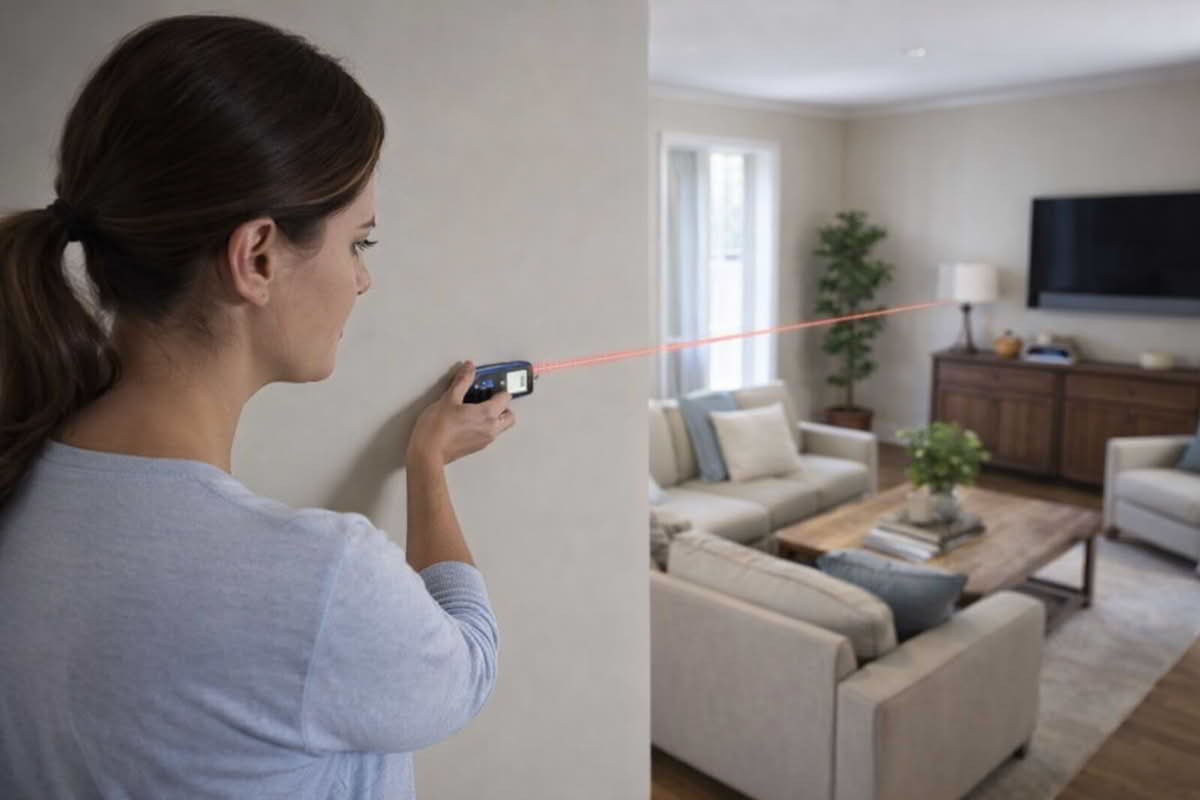
A laser distance measurer is most useful when you need longer straight-line measurements quickly and repeatedly, especially in spaces where using a traditional tape measure alone is awkward. That makes it especially practical for room planning, flooring estimates, paint calculations, furniture placement, remodel prep, cabinet spacing, and any project where one person needs to capture dimensions without a second set of hands. In these situations, the tool does not merely replace a tape measure. It changes the workflow by letting you measure from one wall to another in seconds instead of managing blade extension, hook placement, and reading position manually.
This matters because many home measuring tasks are not difficult in theory. They are difficult in posture, reach, and repetition. Measuring across a bedroom, hallway, garage wall, or open living area can be annoying with a standard tape, especially if furniture blocks the easiest route or the span is just long enough that the blade wants to sag or collapse. A laser distance measurer solves that by turning one end of the room into a target rather than a physical anchor point. That benefit becomes more noticeable the more often you measure spaces rather than boards.
The category is also strong for estimate-driven work. Flooring, paint, blinds, wall treatments, shelving layout, and furniture planning all benefit from faster repeated room dimensions. The tool is not only about precision. It is about reducing friction. If it becomes easier to confirm wall length, ceiling height, or room depth several times in a row, it becomes more likely that you will verify your numbers instead of relying on one rushed measurement and hoping it was right.
Laser distance measurers are strongest when one person needs to capture room-scale dimensions quickly.
They are especially useful for flooring, painting, planning, remodeling, and layout work.
The biggest advantage is often speed and ease of repeated measurement rather than extreme precision alone.
They work best when the task involves spaces, walls, and spans rather than small object measurement.
This also explains where the tool is less useful. For short measurements, quick board layout, or small assembly work, a tape measure is often simpler. A laser distance measurer becomes more valuable as the span gets longer, the room gets more awkward, or the number of repeated measurements increases. That means the right buyer is not necessarily the one doing the most advanced work. It is often the buyer who measures rooms and spaces often enough to feel the limitations of tape-only workflow.
Another advantage is consistency of reference. Many laser distance measurers allow you to measure from the front, rear, or a set reference edge of the device, which can make planning cleaner once you understand how the tool handles its starting point. This is one of the category's quiet strengths. A good device does not just give a number. It gives the number in a way that makes it easier to repeat the same method across the project.
The strongest purchase in this category is usually the one that makes room-scale measurement more natural. If the device lets you move through a space quickly, trust what you are seeing, and capture numbers without awkward tape management, it is doing exactly what the category is supposed to do.
A useful laser distance measurer speeds up room planning by making longer wall-to-wall dimensions easier to capture accurately without a second person.
Range, accuracy, and feature tradeoffs
The biggest buying mistake in this category is assuming that longer maximum range automatically means a better device. In practice, most homeowners do not need extreme range nearly as often as they need reliable indoor readability, quick measurements, and a display that is easy to interpret. A tool designed for very long distances can be appealing on paper, but if your real work involves rooms, garages, basements, closets, and ordinary indoor layouts, the more meaningful question is whether it performs calmly and clearly under those normal conditions.
Accuracy matters, but mainly in the context of use. For room planning and most household estimation work, the device needs to be dependable enough that repeated readings stay consistent and believable. What buyers usually regret is not a lack of theoretical precision. It is a tool that gives slightly unclear readings, takes too long to settle, or feels difficult to position against a wall or corner. Practical accuracy comes from the whole experience: clear reference point, readable display, stable measurement behavior, and enough confidence that the same wall measured twice does not suddenly feel ambiguous.
Display readability and button simplicity shape ownership more than many people expect. A laser distance measurer is often used while turning toward the wall, stepping around furniture, or writing dimensions into a notebook or app. If the screen is cluttered or the controls are overcomplicated, the tool can start to feel like a small calculator project instead of a measuring tool. This is why simpler devices often outperform more feature-heavy ones for normal household work. Extra functions only help when they save effort rather than create more interface decisions.
Longer stated range only matters when your real spaces and projects actually require it.
Practical accuracy depends on repeatable readings and clear reference handling, not just precision claims.
Readable displays and straightforward controls often matter more than broader feature lists in normal home use.
The best device should help you move through measurements quickly rather than slowing you down with extra modes.
Units, memory, and calculation features can be useful, but they should be judged carefully. Storing recent measurements, switching units cleanly, or helping with area and volume calculations can save time in flooring, painting, or room planning. But if those functions are buried behind confusing menus, they stop being practical advantages. The best feature set is usually the one that matches the kinds of measurements you repeatedly take. A few well-executed functions are often more valuable than a long list of modes that you rarely use with confidence.
App-connected models are another good example of conditional value. Sending dimensions to a phone or integrating with project notes can be genuinely helpful for renovation planning, multi-room measuring, or design-heavy workflows. But not every buyer needs that extra layer. For many households, it is enough that the device stores recent measurements and displays them clearly. Connectivity becomes more compelling when the tool is part of a larger planning habit rather than a stand-alone measuring convenience.
Durability and body shape matter too. Unlike tape measures, laser distance measurers rely more on screen clarity, lens protection, and overall interface stability than on raw blade toughness. A device that feels easy to hold flat against a wall, simple to slip into a pocket or pouch, and durable enough to survive normal DIY use will often provide better long-term value than one that looks more advanced but feels delicate or awkward to position. Since many measurements happen in corners, against trim, or along floors and baseboards, the physical shape of the tool is more important than it first appears.
The central tradeoff pattern is straightforward: longer range buys theoretical reach, richer features buy more workflow options, and simpler tools buy speed and clarity. The better choice comes from knowing whether your real work is mostly everyday indoor measuring or something more documentation-heavy and repeat-driven.
Choosing for home planning, renovation, and more frequent layout work
For most homeowners, the best laser distance measurer is one that makes room dimensions, wall lengths, and furniture planning easier without requiring a learning curve every time it comes out of storage. That usually points toward a compact, indoor-friendly model with a clear display, reliable repeat readings, and simple reference handling. In this use case, the tool is there to reduce the hassle of measuring rooms, checking fit, estimating materials, and planning layouts. It does not need to behave like a surveying instrument. It needs to feel quick and dependable enough that you reach for it instead of defaulting to a tape for everything.
Renovation and remodeling users should think more carefully about repeat measurement workflow. Once projects involve multiple rooms, material takeoffs, cabinetry spacing, flooring layout, paint estimation, and repeated planning passes, features such as memory, area calculation, and slightly stronger overall range can start to matter more. In that context, the device becomes part of a broader project process rather than a convenience tool for occasional use. Spending more can make sense if it improves speed and reduces transcription mistakes across repeated measurements.
More frequent layout users may also benefit from app-connected or more feature-rich models, but only when the measurement data will actually be reused digitally. If you regularly sketch rooms, track dimensions for product buying, or coordinate several layout decisions at once, app support or deeper memory features can feel worthwhile. If your typical pattern is still “measure wall, note number, move on,” then simpler ownership often wins. The value of extra connectivity depends on whether it reduces your work or simply adds one more thing to manage.
Most homeowners usually do best with a compact, straightforward laser measurer built for quick indoor room and wall dimensions.
Renovation users should give more weight to memory, repeated-measurement convenience, and planning-friendly functions.
App-connected models make the most sense when dimensions are regularly reused in digital planning or documentation.
The best category depends on whether the device will be an occasional convenience or a repeat-use project tool.
There is also an important difference between occasional confidence and repeated productivity. Some homeowners only need the tool a few times a year for furniture placement, room repainting, or storage planning. For them, simplicity is a major virtue. Others work through ongoing room improvements, closet redesigns, garage planning, or remodeling stages where the tool gets used weekly for a period of time. In that case, slightly better ergonomics, stronger memory support, or a more comfortable display may pay off more than the category seems to suggest at first glance.
Lighting conditions should also influence the decision. Since many laser distance measurers are primarily indoor tools, buyers should be careful not to overvalue outdoor-style range if their work is overwhelmingly inside the house. A device that is calm and readable indoors is often the smarter ownership choice. Similarly, if most measurements involve shorter rooms and walls, a compact model may be the lower-regret path because it is easier to keep handy and less likely to feel like an overbuilt specialty device.
The lowest-regret purchase is usually the one that matches your measuring rhythm. If you need a faster way to measure spaces, compare fit, and plan projects without managing a tape alone, a simpler reliable device often wins. If the tool becomes part of broader renovation planning, then features that support repeated documentation can justify themselves. The key is to buy for the measurement life you actually have, not for the most complex project scenario you can imagine.
Final Recommendations — choose the measurer that makes room dimensions easier to trust
A good laser distance measurer should make longer indoor measurements faster, easier to repeat, and easier to record without turning the process into a menu-driven chore. For most readers, the best choice is a compact, clear, indoor-focused device that balances dependable readings with simple controls. Extra range and extra features only matter when they genuinely improve your planning workflow.
Choose a compact indoor-focused laser distance measurer if your main tasks are room planning, furniture fit, paint estimates, and simple renovation measurements.
Choose a more feature-rich model if repeated room calculations, stored measurements, and renovation planning are regular parts of your workflow.
Choose app-connected options only when you are likely to reuse dimensions digitally instead of simply writing them down once.
Prioritize display clarity, repeatable readings, and easy reference handling over buying the longest-range device for occasional home use.
The lowest-regret laser distance measurer is usually the one that feels fast and trustworthy in the rooms you actually live and work in. If it reduces awkward tape use, helps you confirm dimensions without hesitation, and fits naturally into your project planning habits, it will deliver more real value than a more advanced model chosen mainly because it looked more capable in a specification list.