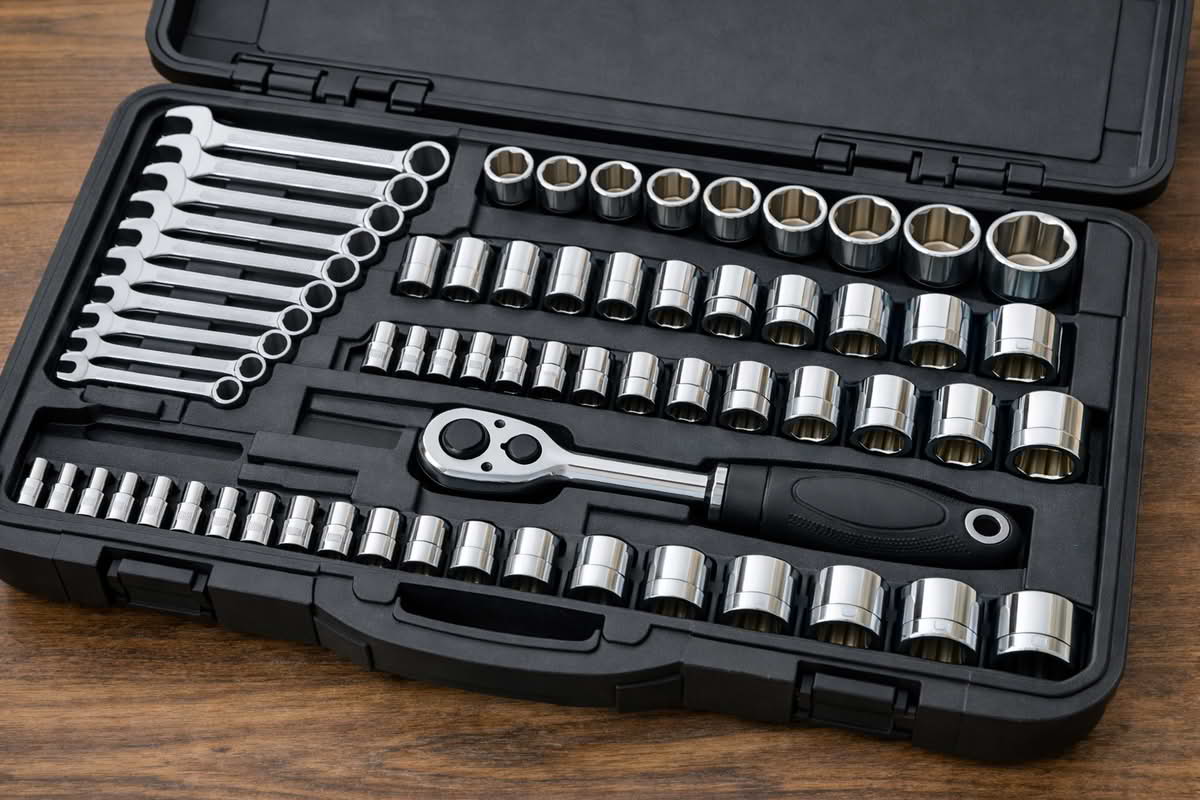
Wrench and Socket Set Buying Guide for Home Repairs and Light Mechanical Work
Wrench and socket sets are some of the easiest tool purchases to misread because they sit between simple household use and more demanding mechanical work. Many buyers know they need “something for bolts,” but that broad idea often leads to one of two regrets: buying a tiny homeowner set that runs out of sizes immediately, or buying a much larger mechanic-style kit that takes up space, includes tools they rarely use, and still may not be organized well enough for quick home repairs. The best choice depends on what kinds of fasteners you actually deal with, how much torque you expect to apply, and whether the set will live in a hallway closet, garage cabinet, or vehicle trunk. This guide focuses on size coverage, drive format, wrench style, and long-term usefulness so you can choose a set that handles real bolts and nuts without turning into clutter, filler, or an expensive overcorrection.
What a practical home set should cover
A practical wrench and socket set should begin with the assumption that most households do not need a full shop inventory, but they do need more than a token handful of sizes. The typical home user reaches for these tools when dealing with furniture hardware, appliance feet, hose fittings, bike adjustments, outdoor equipment, utility carts, shelving systems, and occasional automotive-adjacent tasks such as battery terminals or simple accessory installation. That means the set should offer real size progression rather than a few isolated sockets chosen mainly to justify the word “included.”
For general home use, useful coverage usually matters more than maximum depth. A set that includes a sensible run of common sizes in either sockets, combination wrenches, or both is much more valuable than a set with a high piece count built around duplicate accessories, adapter clutter, or multiple extensions that do not solve the core problem. Buyers often see dozens of pieces and assume capability is being added with every number. In reality, a large share of those counts may come from hex bits, driver accessories, duplicate deep and shallow sockets in limited sizes, or small filler items that are unlikely to matter for ordinary home maintenance.
Another common oversight is system consistency. If a set includes sockets but very few matching wrench sizes, or if the ratchet feels noticeably weaker than the sockets it is paired with, the kit may be less useful than it appears. Wrenches and sockets often solve slightly different access problems around the same hardware. A socket works best where there is enough surrounding clearance and good alignment. A wrench becomes important where access is narrower, side-loaded, or partially blocked. A balanced set recognizes that these tools complement each other rather than compete.
A good home-oriented set should cover a meaningful range of common bolt and nut sizes instead of relying on a small handful of token pieces.
Piece count matters less than whether the included sizes actually solve normal household and light garage tasks.
Sockets and wrenches are more useful together when their coverage feels balanced rather than random.
A weak ratchet or incomplete size range can make an otherwise promising set feel unfinished in real use.
Buyers also need to think about measurement system reality. Some households mostly encounter metric hardware through furniture kits, bicycles, imported equipment, and many modern consumer products. Others still run into SAE sizes on older equipment, outdoor gear, or U.S.-sized fasteners. This is why many people regret choosing a set that is too narrow in one direction. If you do not already know that your tasks are overwhelmingly metric or overwhelmingly SAE, broader dual-system coverage is usually the safer low-regret path for general ownership.
The best sets also acknowledge that fastener work is often inconvenient rather than technical. You are rarely standing at the perfect angle with ideal clearance. You may be reaching behind a washing machine, tightening hardware on a storage rack, or adjusting something near the floor in poor light. In those situations, readable markings, secure socket fit, and a case that makes sizes easy to identify become more important than packaging language about professional performance. A useful set lowers friction. It should make awkward jobs more manageable instead of forcing you to puzzle through clutter or gamble on a close-enough size.
A practical wrench and socket set is defined less by total piece count than by useful size coverage, readable organization, and tools that work together logically.
Long-term usefulness comes from whether the set fills recurring gaps. If it handles home assembly, equipment adjustments, small repairs, and light maintenance without immediate supplementation, it is doing its job. If it looks impressive in the case but repeatedly leaves you missing one common size, reaching for pliers instead of the right wrench, or struggling with a flimsy ratchet, the set is not truly broad. It is simply crowded.
Drive size, wrench style, and storage tradeoffs
Once the basic question of coverage is clear, the next layer is tool format. Socket sets are usually organized around drive size, and that matters because drive size affects both access and torque. Smaller drive systems are easier to use in tighter spaces and tend to suit lighter-duty hardware well. Larger drive systems offer more leverage and durability for tougher fasteners, but they also bring more bulk. The wrong choice is often not exactly “too small” or “too large.” It is choosing a format that does not match the type of work you actually do most often.
For many households, smaller and mid-range socket formats are the most practical because they strike a balance between storage, accessibility, and sufficient turning force for everyday jobs. A large heavy-duty setup may feel reassuring, but it can be unnecessary for routine household work and awkward in cramped spaces. At the same time, very compact systems can feel undersized if your tasks regularly involve stubborn hardware, outdoor equipment, or maintenance that needs more leverage. The safest path for general ownership is often a set that feels capable without being workshop-heavy.
Wrench style matters too. Combination wrenches are usually the most sensible household choice because they provide an open end for quick placement and a box end for more secure turning. Ratcheting combination wrenches can make repeated turning much easier in confined spaces, especially where a socket and ratchet cannot swing freely. But they are not always the best starting point if budget or space is limited, because a ratcheting mechanism adds cost and sometimes bulk. Their value grows when your tasks involve repeated hardware work rather than occasional one-off tightening.
Socket depth is another tradeoff that buyers often ignore until the wrong hardware shows up. Standard sockets work for many jobs, but deeper sockets help when bolts extend farther through nuts or when studs protrude enough to interfere with shallow designs. A set does not need deep coverage in every size for light home use, but a few thoughtfully included deeper options can prevent frustrating dead ends. The same goes for extensions and universal-style access accessories. They are useful when they solve real clearance issues, but they become filler when piled into a kit mainly to inflate the count.
Drive size shapes both access and torque, so the right choice depends on how demanding your typical fastener work actually is.
Combination wrenches are usually the most versatile household format because they balance placement speed and turning security.
Ratcheting wrench styles are helpful in tight spaces, but they are most valuable when repetitive hardware work is common.
Deep sockets and extensions are useful when they solve real clearance problems, not when they exist only to increase item count.
Ratchet quality deserves special attention because it influences the entire ownership experience. A poor ratchet can feel loose, skip under load, or operate with too much slop in confined spaces. Those problems are not just annoying. They also reduce confidence and can make hardware work feel imprecise. A homeowner set does not need exotic refinement, but it does need a ratchet that feels dependable, engages consistently, and does not become the weakest link in the kit.
Storage format has long-term consequences as well. Hard cases can protect tools and keep sizes organized, but only when the layout is clear and pieces return to their positions easily. Some cases look neat in photos yet become frustrating once sockets start falling out or size markings are hard to read. Soft pouches or rails can save space, though they may be less intuitive for occasional users who want everything visible at once. For most households, the best storage system is the one that makes it easy to confirm a missing size, grab the correct tool quickly, and put the set away without turning clean-up into a second chore.
This is where many regrets begin. Buyers focus on the metal tools but underestimate the cost of poor organization. A wrench and socket set is often used under mild stress, during repairs that are already inconvenient. If the case is confusing, the labels are faint, or the sizes are hard to distinguish, the set stops feeling helpful and starts feeling like one more obstacle. Good storage is not cosmetic. It is part of the working tool.
Choosing between homeowner and mechanic-oriented sets
The biggest decision is often not whether to buy a set, but what kind of set you are actually buying. Homeowner-oriented kits and mechanic-oriented kits may overlap in appearance, yet they serve different ownership paths. A homeowner set should prioritize common repair and assembly sizes, manageable case size, and quick access for irregular but recurring use. A mechanic-style set usually assumes more frequent hardware work, broader fastener variety, and greater willingness to store and manage a heavier kit with more specialized pieces.
Many buyers drift toward mechanic-style sets because they look more serious and seem like better long-term value. Sometimes that is true, especially for readers who regularly work on bikes, lawn equipment, trailers, or vehicle-adjacent tasks. But it is also easy to overbuy. A large mechanic-style set can become dead weight if most of your real tasks involve furniture, appliance adjustments, shelving hardware, and light home maintenance. In those situations, extra size range and accessory depth may go mostly untouched while the bulk and complexity remain.
The better question is not, “Could I ever use these extra tools?” It is, “Will I use them often enough to justify the extra cost, space, and complexity?” That framing tends to lead to better decisions. If your repairs are occasional and household-focused, a compact or mid-size set with solid fundamentals is often the smarter answer. If you regularly deal with stubborn fasteners, equipment maintenance, or repeat repair work, a broader mechanic-style kit may be worth it because it reduces the need for future supplementation.
Choose a homeowner-oriented set when your jobs are mostly assembly, fixture adjustment, equipment setup, and light maintenance.
Choose a broader mechanic-style set when you already know your tasks involve more demanding hardware and repeated fastener work.
A larger kit is only better value when its added sizes and accessories are likely to be used often enough to matter.
Storage space and case manageability should influence the decision just as much as tool count.
Another practical distinction is where the set will live. A garage cabinet or workshop shelf can absorb a larger case without much friction. A townhouse closet, apartment entry cabinet, or utility nook may not. That storage reality shapes whether a bigger set stays accessible or slowly becomes a “someday” tool you avoid because it is awkward to retrieve. Accessibility matters because the most useful wrench and socket set is the one you will actually pull out when a repair appears, not the one that remains technically impressive but inconvenient to reach.
It is also helpful to think about upgrade path. Some buyers eventually add separate ratcheting wrench sets, deeper socket assortments, breaker-style leverage tools, or compact travel kits. In that case, the first purchase should still have a stable role. A well-chosen homeowner set can remain the fast-grab household kit even after more specialized tools are added. A broader mechanic-style set can become the main maintenance case if that kind of work is routine. The weak option is a middling set that tries to look universal but ends up too incomplete for mechanical tasks and too bulky for quick home use.
The lowest-regret mindset is to buy for your real maintenance life, not for your imagined most ambitious weekend. If you mostly tighten, assemble, adjust, and occasionally repair, choose a set built for efficient access and useful size coverage. If you already know that your routine includes more serious hardware work, buy broader on purpose. Either way, a good set should feel coherent. It should solve a pattern of problems, not just collect shiny pieces in one box.
Final Recommendations — choose coverage you will use, not just size you can store
A good wrench and socket set should handle your likely repairs with enough coverage, organization, and turning confidence that you do not immediately outgrow it or resent storing it. For most readers, the safest choice is a balanced home-oriented or light mechanic-style set that emphasizes useful socket and wrench sizes, a dependable ratchet, and storage that makes the right tool easy to find. The wrong purchase is usually not the cheapest or the smallest. It is the one that mismatches your real repair pattern.
Choose a compact or mid-size homeowner set if your tasks are mostly furniture, fixtures, appliances, shelving, and light equipment adjustments.
Choose a broader mechanic-oriented set if bikes, outdoor equipment, vehicle-adjacent work, or repeated hardware maintenance are already part of your routine.
Prioritize size coverage, readable organization, and ratchet quality over inflated piece counts and accessory-heavy packaging.
Think about where the set will live, because accessible storage matters almost as much as the tools themselves.
The lowest-regret set is usually the one that feels slightly more focused and slightly less theatrical. If it covers your common sizes, stores cleanly, and earns repeated use without forcing workarounds, it will remain valuable far longer than a bigger case chosen mainly because it looked comprehensive on the shelf.