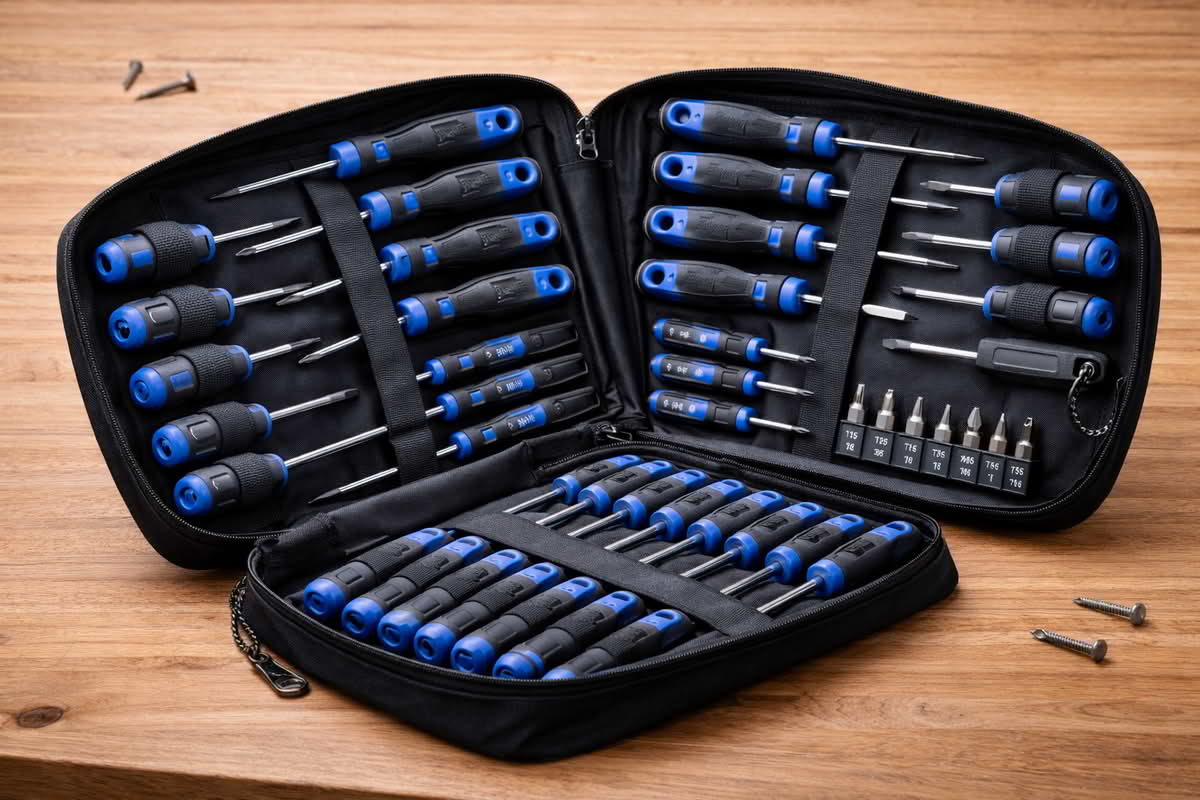
Screwdriver Set Buying Guide for Home Repairs, Furniture, and Everyday Use
Screwdriver sets are easy to underestimate because they seem interchangeable until one slips, strips a screw head, or simply fails to fit the fastener in front of you. Many buyers assume any inexpensive set will cover normal household work, but the real differences show up in tip accuracy, handle comfort, shaft reach, storage, and the range of screws that modern homes actually contain. A set that looks complete on a shelf can still become frustrating if it leaves out the sizes you need for furniture, appliance covers, electronics, light fixtures, or outlet plates. The best choice is rarely the one with the most drivers or the lowest price. It is the set that covers common screw types cleanly, feels secure under pressure, and reduces the chance of stripped fasteners and mid-project workarounds. This guide focuses on what matters in practice, where common screwdriver sets go wrong, and how to choose a set that stays useful rather than becoming a drawer full of avoidable compromises.
What a useful screwdriver set needs
A useful screwdriver set begins with tip coverage that matches real household tasks. For most readers, that means not only Phillips and slotted drivers, but also a practical range of Torx, square, and smaller precision-friendly sizes when the set is intended to handle more than furniture assembly. Modern homes contain far more screw variety than many buyers expect. Cabinet hardware, appliances, electronics housings, thermostat covers, toys, battery compartments, door hardware, and flat-pack furniture can all require different driver sizes and profiles. A set that only covers the obvious basics often feels fine until a small repair turns into a delay because the right tip is missing.
The first priority is not sheer quantity. It is whether the included drivers or bits are the sizes you are most likely to need. A household set usually benefits from medium Phillips sizes, a couple of useful flatheads, and a few smaller drivers for trim, outlets, and hardware. If the set is designed as a more complete option, Torx and square-drive coverage becomes more valuable. Precision drivers matter if you expect to open small battery doors, eyeglass-style hardware, electronics covers, or compact appliances, but they are less important in a general household set if their inclusion comes at the cost of better full-size tools.
A good household set should cover the screw types most often found in furniture, fixtures, hardware, and minor repair work.
Useful size range matters more than a high driver count.
Tip fit and labeling often matter more in practice than packaging claims about versatility.
A screwdriver set should reduce project interruptions, not create new ones.
Another overlooked factor is shaft length. Short drivers work well in tight spaces and storage-friendly sets, but longer shafts help reach recessed screws, appliance backs, and awkward hardware positions. Sets that include some variation in length tend to handle real homes better than sets built around one uniform format. The same logic applies to handle size. Smaller handles can feel nimble for light tasks, but they may become uncomfortable or slippery when more torque is needed. Larger handles offer better grip and leverage, though they can be clumsy in narrow spaces.
Clarity also matters. Many cheap sets make it harder than necessary to identify the right tool quickly. Faint stamping, inconsistent labeling, or crowded cases turn a simple repair into a search exercise. That friction seems minor until you use the set repeatedly. A well-organized set lowers the odds of grabbing the wrong driver, damaging a fastener, or wasting time moving through nearly identical pieces that are hard to distinguish under normal home lighting.
A useful screwdriver set balances tip variety, length options, and clear organization so common home repairs do not stall over one missing size.
The best screwdriver sets also account for how people actually work. Most household users are not standing at a workbench with perfect lighting and sorted hardware trays. They are kneeling near a baseboard, leaning behind furniture, or working on a loose hinge with one hand stabilizing the part. In those situations, secure grip, visible size markings, and drivers that seat confidently in the screw head matter more than promotional language about professional quality. The more the tool reduces wobble and second-guessing, the more useful the set becomes over time.
Handle, tip, and format tradeoffs
Screwdriver sets usually fall into a few common formats: fixed-driver sets, multi-bit systems, ratcheting sets, and mixed kits that blend full-size and precision tools. Each format solves different problems, and each comes with tradeoffs. Fixed drivers are straightforward, quick to grab, and often more comfortable when you repeatedly use the same sizes. They are a strong fit for households that value speed and simplicity. The downside is storage bulk. Once a set grows large, it can take up more room than many casual users want to dedicate to screwdrivers alone.
Multi-bit sets are usually more compact and often make sense for apartments, basic home storage, and buyers who want versatility without a large case. Their weakness is convenience under repeated use. Swapping bits is slower than grabbing a dedicated driver, and cheaper systems sometimes hold bits loosely or make them difficult to access. A multi-bit design only works well when the bit retention is solid, the handle feels balanced, and the most-used sizes are easy to locate quickly.
Ratcheting screwdriver sets can reduce effort during long runs of screws, furniture assembly, or repetitive hardware work. For some buyers, they are the most practical all-around option because they combine compact storage with better efficiency. But a ratcheting mechanism introduces complexity. If it feels sloppy, reverses inconsistently, or lacks grip strength, the entire set becomes less satisfying. The usefulness of a ratcheting driver depends heavily on execution, not just the presence of the feature.
Tip quality is where many sets quietly succeed or fail. A screwdriver that technically matches the fastener but seats poorly can cam out, chew up the head, or demand unnecessary pressure to keep it stable. This is one reason cheap sets often create regret. They may offer a lot of pieces, but the machining or shape consistency can be weak enough that the tools feel vague in use. For light tasks, that may seem tolerable. For repeated jobs, it becomes exhausting and increases the chance of damage.
Fixed-driver sets are fast and intuitive, but they require more storage space.
Multi-bit sets save space, but convenience depends on good retention and clear organization.
Ratcheting systems help with repetitive tasks, but low-quality mechanisms quickly become annoying.
Tip fit is one of the biggest long-term value differences between a satisfying set and a frustrating one.
Handle design matters just as much as tip quality. Smooth, narrow handles may look sleek, but they can become tiring when more torque is required. Overly bulky handles can create the opposite problem, especially in tight spaces or for smaller hands. The best sets usually land somewhere in the middle: enough contour and texture to feel controlled, enough size to generate turning force, and enough comfort to stay usable over longer sessions without hot spots or slipping.
Magnetic tips or magnetic bit holders can also improve real-world usability, especially for cabinet screws, outlet covers, and awkward mounting points. They do not replace good fit, but they reduce the chance of dropping screws or fighting alignment with one hand. This feature becomes more valuable as work gets more confined. It is particularly helpful for occasional users who may not have the hand positioning habits that make screw placement easy.
The broader tradeoff is between simplicity and flexibility. A straightforward fixed-driver set often creates the fewest small frustrations. A well-designed ratcheting or multi-bit set may offer better storage efficiency and broader coverage. The right answer depends on how often you reach for screwdrivers, what types of jobs you do, and whether speed or compactness matters more in your space. A good set should fit your workflow naturally. If the format adds extra decisions or repeated fiddling, its theoretical versatility may not help much in practice.
Choosing for home work, precision, or electrical jobs
Not every screwdriver set is trying to solve the same problem, and many disappointing purchases happen because buyers choose a set that belongs to the wrong use case. For general household work, the best set usually emphasizes common full-size drivers or a compact multi-bit system with strong everyday coverage. This type of set should handle furniture assembly, loose hinges, drawer slides, outlet covers, switch plates, appliance panels, and general hardware without asking you to improvise. It does not need to specialize. It needs to stay competent across the small jobs that come up repeatedly.
Precision sets are different. They matter for electronics, battery compartments, eyeglass-style screws, hobby gear, smart-home devices, and smaller appliances. Buyers sometimes choose precision-heavy kits because they look sophisticated or complete, then realize the set is weak for normal household tasks. Precision drivers are valuable when you actually need them, but they should not replace a strong general-purpose set unless your use is heavily device-oriented. In many homes, they work best as a second layer rather than the core screwdriver purchase.
Insulated sets belong to another category entirely. They are relevant when buyers intentionally need drivers designed for electrical-adjacent work and want the correct tool type rather than a general household set. For most casual users, insulated drivers are not a reason to compromise broader coverage or handle quality unless electrical tasks are a regular part of the intended use. This is a common point of overbuying. People often purchase specialized sets based on imagined future needs, then live with daily inconvenience in exchange for rare-case features they almost never use.
General home-use sets should prioritize common fasteners, comfortable handles, and quick access.
Precision sets are best when small devices and detailed hardware are a real recurring need.
Insulated sets make sense for deliberate electrical use, not as the default choice for all households.
One well-matched set is usually better than one overly specialized set that misses everyday tasks.
Storage space should shape the decision more than many buyers realize. In a small apartment, a compact multi-bit or ratcheting system may deliver the best balance of range and footprint. In a larger home with a garage or utility cabinet, a full fixed-driver set is easier to live with and often faster in repeated use. If the set will be shared among household members, a clearly organized case can matter more than squeezing out a little more compactness. Sets that are hard to put away tend to lose pieces, and once a screwdriver set becomes incomplete, its real value drops quickly.
There is also a regret question worth asking before purchase: what kind of failure would annoy you most? Some buyers mainly want to avoid missing sizes. Others care more about stripped screws, slippery handles, or a cluttered case. Once you identify the failure mode that would bother you most, the better format often becomes clearer. For example, if convenience matters most, fixed drivers may beat a denser multi-bit kit. If compact storage matters most, a well-designed ratcheting set may be the better compromise. If you frequently handle devices and small screws, adding a precision set may solve more problems than choosing an oversized mixed kit.
Long term, the most useful ownership path is often a layered one. Start with a strong general-purpose set, then add a precision or insulated set later if your actual use justifies it. That approach usually creates less waste and less daily friction than trying to buy one large “covers everything” case up front. Specialized screwdrivers should earn their way into your storage. Your first set should be the one that makes routine tasks easy, not the one that tries to anticipate every uncommon scenario.
Final Recommendations — choose the set that reduces frustration, not just cost
A good screwdriver set should make ordinary repairs feel smoother, not merely cheaper. For most readers, the best option is a general household set with strong tip coverage, comfortable handles, clear organization, and either fixed drivers or a compact multi-bit system that does not slow you down. The wrong purchase is usually not too small or too simple. It is a set that looks versatile but performs poorly once real screws, tight spaces, or repeated tasks enter the picture.
Choose a general household set first if you mainly handle furniture, fixtures, hardware, and light repairs.
Choose a compact multi-bit or ratcheting format if storage space is limited and everyday coverage still feels complete.
Add a precision set separately if small electronics, battery compartments, or device work are a real recurring need.
Prioritize tip fit, handle comfort, and case organization over headline driver count or overly broad claims.
The lowest-regret screwdriver set is the one that keeps you from rounding screws, hunting for sizes, or abandoning the case because it is awkward to use. If it matches the work you actually do and stays organized enough to remain complete, it will be more valuable over time than a bigger set built around marketing rather than real household use.