Hand Tool Set Buying Guide for Homeowners and First-Time DIY Use
A hand tool set looks simple until you actually need it. Many buyers assume more pieces automatically mean better value, but large sets often hide their weaknesses behind filler bits, duplicate fasteners, and low-use accessories while leaving out the tools that matter most in a home. The real goal is not to buy the biggest case you can afford. It is to build a low-regret foundation for everyday jobs: assembling furniture, tightening hardware, hanging shelves, making minor repairs, and handling the small problems that come up in normal home ownership or renting. A good set should cover those tasks without taking up too much space, frustrating you with weak tools, or forcing an immediate round of replacements. This guide focuses on what a home-oriented set actually needs, where bigger kits go wrong, and how to choose a set that remains useful after the excitement of unboxing wears off.
What a home tool set should include
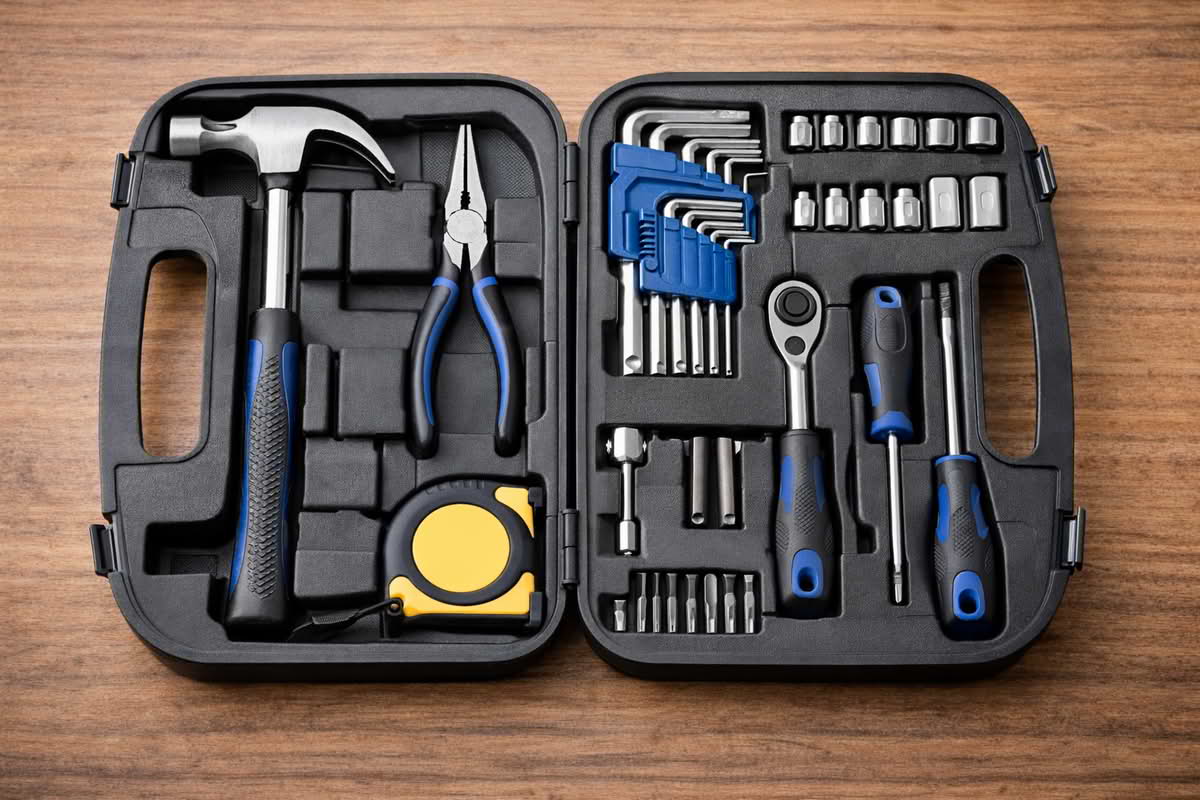
The most useful hand tool sets are built around ordinary household problems, not around the marketing appeal of a triple-digit piece count. For most homeowners, renters, and first-time DIY readers, the foundation should begin with a hammer, a tape measure, a utility knife, a set of screwdrivers or a multi-bit driver, a pair of slip-joint or groove-joint pliers, a small adjustable wrench, and a basic hex-key set. Those tools cover a surprising amount of real work: furniture assembly, wall hardware installation, loose cabinet pulls, battery compartment screws, hose clamps, picture hanging, and small maintenance tasks that do not justify a workshop full of specialty tools.
A set becomes more useful when it includes tools that reduce the chance of getting stuck halfway through a task. That usually means having both metric and SAE hex keys, more than one screwdriver tip style, and at least one plier that can grip irregular shapes. Small socket assortments can also be helpful, but only when they are large enough to solve common home tasks and not just included to raise the piece count. If a set includes sockets, the useful question is not whether sockets are present. It is whether the range is broad enough to matter and whether the ratchet itself feels durable enough to survive occasional real torque.
A home-oriented set should prioritize the tools most often used in furniture, hardware, fixture, and light repair work.
Coverage matters more than quantity. Ten useful tools beat fifty low-value accessories.
Basic measuring, gripping, fastening, and cutting tools create the most durable foundation.
Well-chosen redundancy can help, but duplicate filler pieces usually do not add much real capability.
Another overlooked factor is handle comfort and tool control. A hand tool set meant for occasional home use still needs to be easy to hold, easy to identify, and hard to misuse. Thin metal handles, slippery plastics, and poorly labeled bits all create friction that does not show up in the spec list. That matters because most people reaching for a house tool kit are not in a workshop mindset. They are solving a specific problem while standing in a hallway, kneeling under a sink, or working in poor light. Tools that feel secure and legible reduce mistakes and make the set more likely to be used instead of ignored.
A useful home tool set usually covers fastening, gripping, measuring, and light repair tasks without relying on inflated piece counts.
Storage format also affects long-term usefulness. Molded cases look tidy in product photos, but some make it difficult to return pieces quickly or keep small parts from falling out after normal use. Soft bags save space and can feel more flexible, but they may allow smaller tools to migrate and become harder to find. For most general home users, the best case is the one that makes the kit easy to store in a closet, laundry area, utility shelf, or under-bed bin while still keeping every tool visible enough to grab without dumping everything out.
The best starting mindset is simple: choose the set that solves common household work with the least friction, not the set that looks most impressive on paper. A strong home kit is a practical baseline. It does not need to cover automotive diagnostics, advanced carpentry, or high-torque mechanical jobs in its first version. It needs to help you handle the recurring jobs that would otherwise send you looking for improvised tools, stripped screws, or last-minute hardware store trips.
Size, coverage, and build-quality tradeoffs
One of the most common buying mistakes is assuming that a larger set is automatically the better deal. In practice, many oversized kits are built to win the comparison chart rather than daily use. They may include dozens of screwdriver bits, multiple tiny sockets, or repeated accessories that create a high piece count without improving household coverage very much. This is where buyers often confuse numerical abundance with capability. A 150-piece set can still be a poor first choice if the core tools are weak, the ratchet is sloppy, or the case is frustrating enough that tools end up scattered after the second use.
Smaller or mid-size sets often make more sense for general home use because they concentrate the budget into the tools you will actually touch. That can mean better pliers, a more comfortable screwdriver handle, or a tape measure that retracts smoothly and reads clearly. These details matter more over time than an extra tray of low-value accessories. If a set is meant to live in an apartment closet or under a sink, compactness can also be a practical advantage rather than a limitation.
Build quality tends to reveal itself in three places first: the gripping tools, the fastening tools, and the storage system. Pliers should close cleanly and feel aligned rather than loose or twisted. Screwdrivers should seat properly in common screw heads instead of wobbling immediately. Ratchets should engage consistently. The storage case should survive being carried, opened, and put away without turning every use into a reorganization project. When those areas are weak, the rest of the set usually follows the same pattern.
Large kits often spend too much of their value on filler pieces.
Mid-size kits usually perform better when the budget is concentrated in core tools.
Weak gripping, poor screwdriver fit, and flimsy cases are common early signs of a disappointing set.
A set that stores well is more likely to stay complete over time.
Material and finish also deserve a practical reading. Corrosion resistance, hardened tool steel, and textured grips can all be helpful, but those phrases are often used broadly. What matters more is whether the tools feel consistent and trustworthy in basic use. A set intended for occasional indoor household work does not need to promise industrial performance. It does need to avoid the low-end failure points that make ownership irritating: rust-prone finishes, brittle plastic latches, poorly bonded handle grips, and bits that round off before the set has even justified its cost.
There is also a long-term ownership question that many buyers miss. A hand tool set works best when it can either remain a complete standalone kit or become a clean base layer for future additions. Some kits are well suited to gradual upgrading because the included tools stay useful even after you buy better versions later. Others are so uneven that the entire case becomes dead weight once one or two tools disappoint you. That is why it is worth thinking beyond the first week of ownership. A decent starter set should not feel disposable. It should either remain your go-to general kit or continue serving as a compact secondary set after you expand into more specialized tools.
The smartest way to judge value is to ask whether the set reduces future friction. Does it help you avoid stripped screws, missing sizes, clutter, and emergency purchases? Does it earn a permanent place in the house because it is easy to carry and easy to trust? When the answer is yes, the set is probably sized correctly. When the answer depends on impressive packaging, inflated counts, or the hope that you might someday use every included piece, it is probably not.
Matching the set to your living situation
The right hand tool set changes depending on where you live, how much storage you have, and what kinds of tasks you realistically take on. Renters usually benefit from compact kits that cover assembly, hanging, minor tightening, and simple maintenance without taking up much space. In that context, portability and organization matter almost as much as raw tool count. A small but coherent kit is often better than a larger case that is awkward to store and discourages use.
First-time homeowners often need a broader range because small repairs appear quickly. Loose hinges, cabinet hardware, appliance feet, hose clamps, curtain rods, and basic yard-adjacent adjustments all add up. For this group, a mid-size set with a stronger mix of pliers, drivers, hex keys, and a few sockets usually makes more sense than the smallest apartment-focused kit. The goal is not to prepare for every repair in the house. It is to avoid being under-equipped for the first year of normal ownership.
Buyers who expect to handle bike adjustments, mower maintenance, or light garage tasks should be more careful. Many general household kits look versatile but are still weak mechanical kits. They may include a few sockets or wrenches, yet fall short in durability or size range once real torque enters the picture. In that case, it is usually better to treat the hand tool set as a household base layer and add a more targeted mechanic-style or socket-focused kit separately instead of forcing one case to do everything.
Renters usually benefit most from compact, easy-to-store sets with strong coverage of common indoor tasks.
First-time homeowners often need a broader kit that handles repeated small repairs without immediate upgrades.
Mechanical or garage-adjacent work usually requires more than a general household set can comfortably deliver.
Storage space, transport needs, and frequency of use should shape the size of the kit.
Another useful question is who else may use the set. In shared households, clearly organized kits with labeled bits and visible tool placement are often more practical than loosely packed bags. When multiple people can locate and return tools easily, the set is more likely to stay complete. In contrast, a disorganized kit tends to lose the exact piece you need most. That does not show up in a product photo, but it shows up a few months later when the small Phillips driver has vanished and the hex keys are no longer in order.
Space also affects how much case size you can tolerate. A basement shelf or garage cabinet can absorb a larger molded case. A one-bedroom apartment often cannot. In smaller spaces, compact tool kits have a real advantage because they are easier to keep accessible. Accessibility matters because tools stored too awkwardly may as well not be owned. The best set is the one you can reach quickly, use confidently, and put back without creating a mess.
Finally, consider how the set fits into your likely ownership path. Some people need a single dependable kit and little else. Others will eventually build out separate screwdrivers, pliers, socket sets, or power tools. If you expect the latter, the hand tool set should still serve a role: emergency household repairs, quick grab-and-go work, or a secondary kit for upstairs storage. That is a better long-term outcome than buying an oversized “everything” set that feels outdated as soon as you become more selective about tools.
Final Recommendations — choose for the jobs you will actually do
A good hand tool set is not defined by the biggest case, the highest piece count, or the broadest promise. It is defined by whether it covers ordinary household jobs with enough quality and organization that you keep reaching for it. For most readers, the safest choice is a compact or mid-size set built around fastening, gripping, measuring, and light repair rather than specialty tools or inflated accessory counts.
Choose a compact kit if you rent, have limited storage, or mainly handle assembly, hanging, and minor hardware tasks.
Choose a broader home tool kit if you own a home and expect a steady stream of small repairs across rooms and fixtures.
Treat mechanic-style capabilities as a separate need unless the set has genuinely strong sockets, wrenches, and ratchet quality.
Prioritize tool usefulness, handle comfort, and case organization over headline piece count.
The lowest-regret purchase is usually the set that feels slightly more focused and slightly less flashy. If it solves the jobs you actually face, stores cleanly, and stays intact over time, it will keep earning its place long after the packaging stops looking impressive.