Circular Saw Buying Guide for Sheet Goods, Lumber, and Everyday DIY Projects
A circular saw is one of the most useful cutting tools a homeowner can own, but it is also one of the easiest to buy based on the wrong signals. Many buyers focus on raw power, blade size, or whether the saw looks “serious” enough, while overlooking the things that shape everyday ownership: weight, visibility, cut control, battery commitment, and whether the saw actually fits the kinds of projects they do. In real home use, a circular saw is rarely judged by how dramatic it feels. It is judged by whether it can break down sheet goods, trim framing lumber, handle simple outdoor builds, and make repeated cuts without becoming awkward, tiring, or harder to control than expected. The right model is not always the largest or most powerful. It is the one that matches your work style, your storage setup, and the scale of projects you are likely to take on without turning straightforward cuts into a confidence problem.
What a circular saw actually needs to do
A circular saw is most valuable when it solves the most common cutting jobs cleanly and predictably. For many households, that means breaking down plywood or other sheet goods, trimming dimensional lumber, making cuts for shelving and storage projects, handling deck or fence repairs, and supporting general DIY work that would be slow or awkward with hand tools alone. That practical role is important because many buyers start by imagining rare heavy-duty projects instead of the cuts they are actually likely to make in the next year. A saw that performs well on ordinary lumber, common board stock, and straightforward project material is often the better ownership choice than a bulkier model bought mainly for reassurance.
Cut quality begins with control, not just speed. A circular saw does not have to feel delicate, but it does need to feel readable. You should be able to see the line, guide the tool steadily, and understand how it behaves when the cut begins and when it exits the material. A saw that feels nose-heavy, hides the cut line, or demands awkward body position can make even simple work feel more difficult than it needs to. In home projects, that matters because many cuts are made on sawhorses, on the floor with insulation support underneath sheet goods, or in garages and driveways rather than in ideal shop conditions.
Depth of cut and bevel capacity matter, but mostly in context. A homeowner who mainly cuts common lumber and panels does not need to chase extreme capacity figures. What matters is whether the saw covers standard project material with a margin of comfort and whether depth and bevel adjustments are simple enough to use correctly. Complicated or stiff adjustment systems do not only slow the work down. They also increase the chance that settings remain wrong because the user avoids changing them unless absolutely necessary.
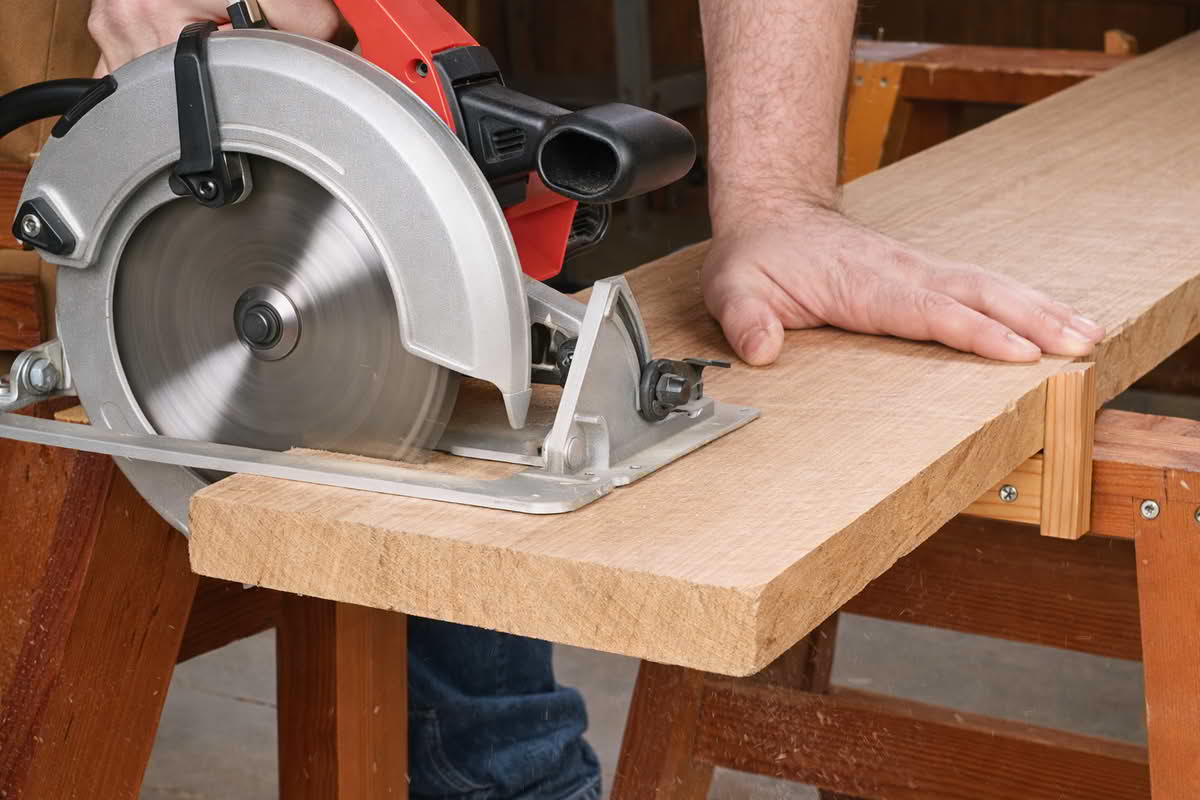
A practical circular saw should handle sheet goods, framing lumber, and common project materials without feeling oversized or unstable.
Visibility and handling often shape cut confidence more than headline power numbers.
Useful adjustment controls matter because real home projects often involve quick changes rather than one fixed cut setup.
The best saw is the one that makes common cuts feel manageable, not the one that is most impressive in theory.
Blade selection also plays a bigger role than many first-time buyers expect. A circular saw can feel rough or surprisingly clean depending on the blade installed, which means buyers should be careful not to judge the category entirely by stock setup assumptions. A decent saw with a more appropriate blade can often produce a much better user experience than a more expensive saw running a blade that is poorly suited to the material. That is especially relevant for sheet goods, finish-facing cuts, and projects where tear-out matters more than raw speed.
Safety and confidence are closely linked here. Circular saws are powerful enough that hesitation, poor stance, awkward support, or unclear sightlines can create tension quickly. A good buying decision should reduce that tension. Predictable startup, accessible controls, visible blade guard behavior, and comfortable grip all matter because many buyers are not using the saw every weekend. They are using it occasionally enough that the tool needs to feel understandable every time it comes back out.
The strongest circular saw purchase is usually the one that supports repeatable, low-drama cutting. If the saw tracks well, adjusts without a fight, and feels comfortable enough to use before frustration sets in, it will probably do more actual work over time than a more intimidating model bought mainly because it seemed more capable on paper.
A useful circular saw should feel stable and visible enough to make common plywood and lumber cuts manageable in ordinary home workspaces.
Corded, cordless, and size tradeoffs
The biggest buying decision usually comes down to corded versus cordless, with blade size and overall weight closely tied to that choice. Corded circular saws still make a lot of sense for buyers who want predictable runtime, straightforward value, and the ability to cut without thinking about battery charge or platform commitment. They are especially appealing when the saw will mostly be used in a garage, driveway, shop, or work area where power access is easy and mobility is not the main constraint. For many project-focused homeowners, corded models remain a very rational choice because cutting sessions can be longer and more demanding than casual drilling or driving tasks.
Cordless circular saws solve a different problem. They reduce setup friction, improve mobility, and make it easier to work outdoors, around fences, in yards, on ladders or platforms, and in parts of the property where cords become annoying or limiting. That convenience is real. But cordless ownership brings tradeoffs around battery cost, runtime, saw weight, and the broader platform you are entering. A cordless saw may feel liberating in the right context, yet heavier or less economical than a corded model if it is mostly used near outlets anyway.
Size is closely connected to both choices. Larger-blade saws tend to offer more cut depth and broader project flexibility, but they also bring more weight and sometimes more intimidation for casual users. Smaller or more compact circular saws can be easier to handle, easier to store, and more approachable for shelving, trim board, thinner stock, and lighter DIY work. Their limitation is that they may feel less universal if projects begin involving thicker framing material or repeated deeper cuts. This is why “bigger” is not automatically “better.” The right size depends on whether you want a general-purpose workhorse or a more compact saw that is easier to control and live with.
Corded saws are often the strongest value when runtime and cutting consistency matter more than mobility.
Cordless saws are most useful when setup flexibility and portability solve real project frustrations.
Larger saws usually offer broader capacity, but they also add weight and reduce approachability.
Compact saws can be easier to control and store, though they may be less flexible for thicker stock and larger builds.
Battery system logic matters more with circular saws than with smaller cordless tools because cutting puts real demand on the platform. A cordless drill can often get by with moderate batteries and light intermittent use. A circular saw asks more. If the saw belongs to a battery family that is expensive to expand, difficult to recharge quickly, or not very deep in future tool options, the initial convenience can start to look less attractive. On the other hand, if you already own compatible batteries or expect to grow within the system, a cordless saw can make much more sense as part of a wider ownership plan.
Weight distribution matters too. Some saws look manageable on paper but feel awkward in the hands because the balance is not natural or because the battery pack changes the center of gravity in a way that makes starting or finishing a cut less comfortable. This is especially important for users who are not cutting all day and who may be working in temporary setups. A slightly lighter, better-balanced saw often creates fewer mistakes than a more powerful model that feels tiring after a handful of cuts.
Storage and readiness also shape the decision. A corded saw with a simple case or predictable shelf footprint can be easier to keep “ready enough” for weekend work. A cordless saw may be quicker to grab, but only if its batteries are charged and organized. These are not glamorous considerations, yet they influence real-world use. The best saw is not only the one that cuts well. It is also the one that fits the way your home, garage, or work area actually operates.
The core tradeoff is simple: corded models favor uninterrupted cutting and lower entry cost, while cordless models favor freedom and convenience. Blade size and saw size then determine how much versatility you gain or how much extra bulk you accept. Good buying decisions come from knowing which of those tradeoffs matters most to your actual project life.
Choosing for beginners, home projects, and heavier work
Beginners usually benefit from a circular saw that feels manageable before it feels ambitious. That generally means clear sightlines, easy adjustments, reasonable weight, and enough capacity to handle normal lumber and sheet-goods work without seeming oversized. A beginner-friendly saw should reduce the stress of first cuts rather than magnify it. For this reason, compact and straightforward models often make more sense as first saws than larger, more aggressive tools chosen for hypothetical future builds. Confidence matters in this category, and confidence usually comes from predictability.
For general home projects, the best circular saw is often one that balances versatility with comfort. If you expect shelving, garage upgrades, workbench builds, closet improvements, utility projects, fence repairs, and occasional outdoor framing, you want a saw that can cross between plywood and lumber without becoming annoying to use. That usually points toward a broadly capable general-purpose model rather than a niche specialty saw. In this ownership tier, the question is less about maximum output and more about how often the saw will be useful enough to justify being kept ready and accessible.
Heavier project users need to think differently. If you already know that repeated cutting, deeper stock, deck framing, renovation work, or long cutting sessions are part of your routine, then capacity, runtime, and sustained confidence matter more. A compact saw that feels perfect for homeowner convenience may start to feel limited in that environment. This is the point where more capable corded models or stronger cordless platform-based saws become easier to justify. The difference is not just power. It is how comfortably the saw maintains performance across more demanding work.
Beginners usually do best with a manageable saw that favors visibility, comfort, and clear controls over maximum size.
General home project users should prioritize versatility across plywood, boards, and common DIY material.
Heavier project users can justify more capacity and runtime because their work demands it repeatedly.
The right saw is defined by project frequency and material reality, not by the most ambitious task you might someday attempt.
There is also a difference between cutting often and cutting well. Some buyers assume frequent use alone means they should buy the most powerful or most advanced model they can afford. But if the work mostly happens in tight garages, on small benches, or on intermittent weekend builds, ease of handling may still matter more than peak capacity. Likewise, buyers who cut less often but take on larger outdoor projects may need a stronger saw because each cutting session is demanding even if it is not frequent. Usage pattern matters as much as total volume.
Blade changes, shoe stability, and adjustment clarity also separate satisfying saws from frustrating ones. These are the details that do not always dominate the spec list but do dominate ownership. If a saw is awkward to reconfigure, imprecise to set, or difficult to keep aligned confidently along a guide, it can make even moderate project work feel more tiring than it should. That is why beginner-friendly and homeowner-friendly are not synonymous with underpowered. Often they simply mean more practical.
A lower-regret buying approach is to choose the saw that will cover the next layer of projects you are realistically ready to do, while leaving room for better blades, guides, and technique to improve results. Many disappointing purchases happen because buyers try to future-proof too aggressively and end up with a tool that is less pleasant for the work actually in front of them. A circular saw should open projects up, not raise the barrier to starting them.
Final Recommendations — choose the saw that makes common cuts feel manageable
A good circular saw should feel stable, understandable, and well matched to the materials and project scale you actually expect to handle. For most readers, the best choice is not the most extreme saw in the category. It is the one that balances cut capacity, visibility, weight, and ownership practicality in a way that makes sheet goods, lumber, and weekend projects easier rather than more intimidating.
Choose a compact or beginner-friendly circular saw if you want easier handling for sheet goods, boards, and first DIY builds.
Choose a corded model if runtime, lower entry cost, and longer cutting sessions matter more than mobility.
Choose a cordless model if setup flexibility and battery-platform compatibility solve real project frustrations on your property.
Prioritize balance, sightline confidence, and adjustment ease over buying the largest saw for tasks you may rarely do.
The lowest-regret circular saw is usually the one that feels ready for the cuts you actually make, not the one that promises the biggest future possibilities. If it stays comfortable in ordinary positions, handles common material cleanly, and fits your storage and power setup, it will become a far more useful tool than a larger model bought mainly because it looked more capable at the time.