Modular Storage Shelving Buying Guide: How to Choose Flexible Storage That Still Feels Coherent
Modular storage shelving is attractive because it promises freedom. You can stack, expand, rearrange, and customize it as needs change, which sounds ideal for real households where storage problems rarely stay fixed for long. The trouble is that flexibility alone does not guarantee a good result. Many buyers end up with systems that technically offer many options but feel visually messy, structurally limited, or poorly matched to the items they actually need to store. Good modular shelving is not just about buying pieces that fit together. It is about choosing a system with the right scale, load capability, compartment logic, and expansion path so the storage remains useful instead of becoming an awkward collection of add-ons. Whether the goal is tidier living-room storage, better home office organization, a mixed-bin utility system, or a flexible family drop zone, the right modular shelves should adapt without becoming clutter infrastructure in disguise.
Flexibility Only Helps When the Structure Matches the Storage Job
The central appeal of modular shelving is adaptability, but that benefit only matters if the system is structurally appropriate for the kind of storage you have in mind. Buyers are often drawn to modular units because they can be reconfigured, stacked, or expanded, yet many overlook the fact that not every modular system is built for the same categories of items. Some are better suited to books, baskets, folded goods, and household accessories. Others are designed more for bins, toys, office supplies, or mixed family storage. Problems usually begin when a buyer chooses a system for its layout freedom and then expects it to behave like heavier-duty utility shelving or more polished built-in furniture.
This is why the first question should not be how many cubes, tiers, or expansion pieces a system offers. It should be what the unit needs to hold consistently. Modular shelving often works best for medium-duty categories that benefit from visible organization and changing arrangements. It is usually less convincing when pushed into dense-load roles that demand higher rigidity, deeper shelves, or more serious long-span support. A system that feels excellent for baskets, books, and neatly grouped bins may feel much less confident once it is packed with heavy storage containers or awkward oversized items.
Material and connection style also influence whether the system feels temporary or dependable. Some modular units rely on simple interlocking or stackable construction that makes rearrangement easy, but may also create more flex or movement than buyers expect. Others are more substantial, with stronger panels, better anchoring logic, or a layout that feels intentionally built rather than merely assembled. Neither approach is inherently wrong. The key is matching the structural character of the system to the permanence and weight of the storage job.
Choose modular shelving for categories that benefit from changing layouts, visible grouping, and adaptable compartments.
Choose more substantial modular systems when you expect baskets, bins, books, or household storage to build up over time.
Choose another shelving category when the real need is heavy-duty support rather than flexible organization.
Another common mistake is confusing modular with universal. A system may be technically reconfigurable, but that does not mean every configuration works equally well. Some layouts become unstable-looking when stacked too high. Others lose efficiency when too many small compartments are created for large or irregular items. Modularity should be viewed as a tool for better fit, not as permission to build endlessly without a clear storage plan.
This is where restraint helps. The best modular shelving choices usually start with a realistic understanding of what the system will do most of the time, not every possible thing it could do in theory. A system that is flexible within a clear storage role tends to remain useful. A system purchased mainly for open-ended possibility often becomes a compromise that never feels quite settled.
Modular shelving works best when structure and compartment size match the kinds of items the system will hold most often.
Layout, Scale, and Compartment Logic Decide Whether the System Feels Efficient
Modular shelving succeeds or fails based on how well its layout fits the room and the categories being organized. Buyers often focus on total storage capacity, but modular systems are really about how storage is divided. That makes compartment logic more important here than in many other shelving categories. A shelf system with many small openings may look organized at first, but feel inefficient if the real items are tall, awkward, or inconsistently sized. On the other hand, a system with larger openings can become visually loose or wasteful if the categories are small and need more containment.
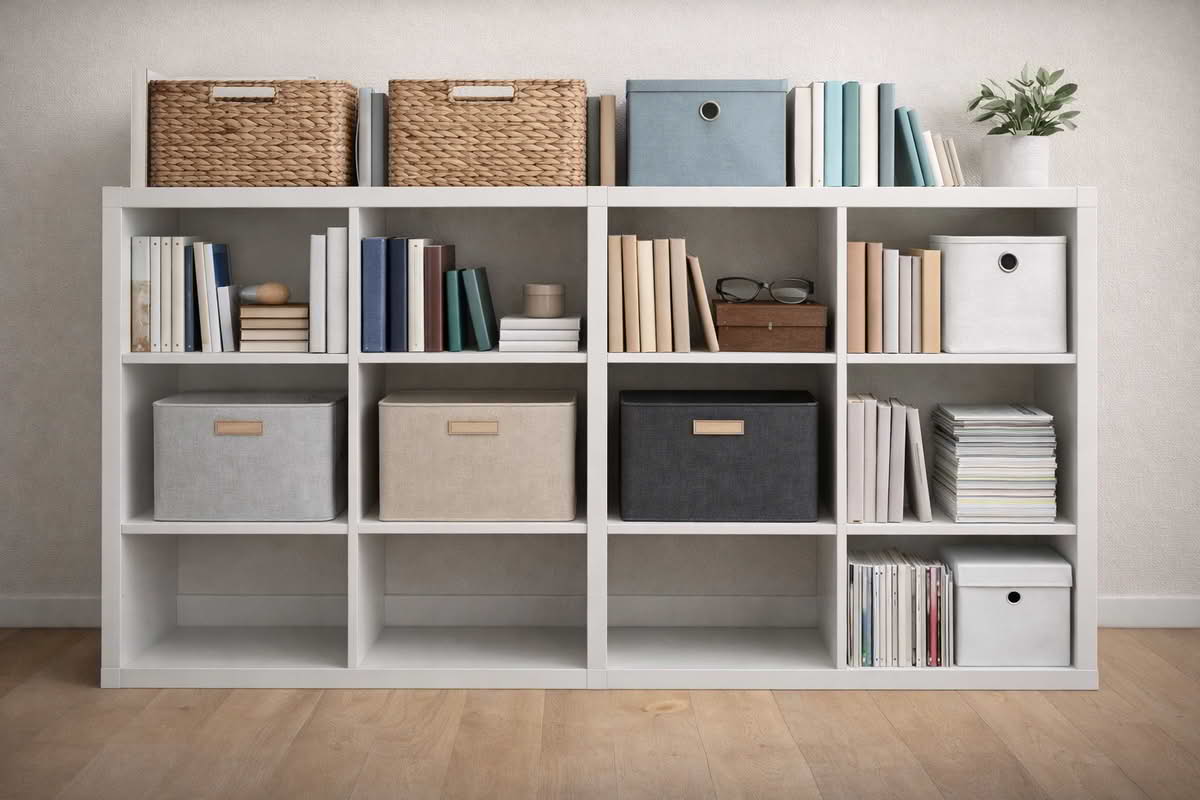
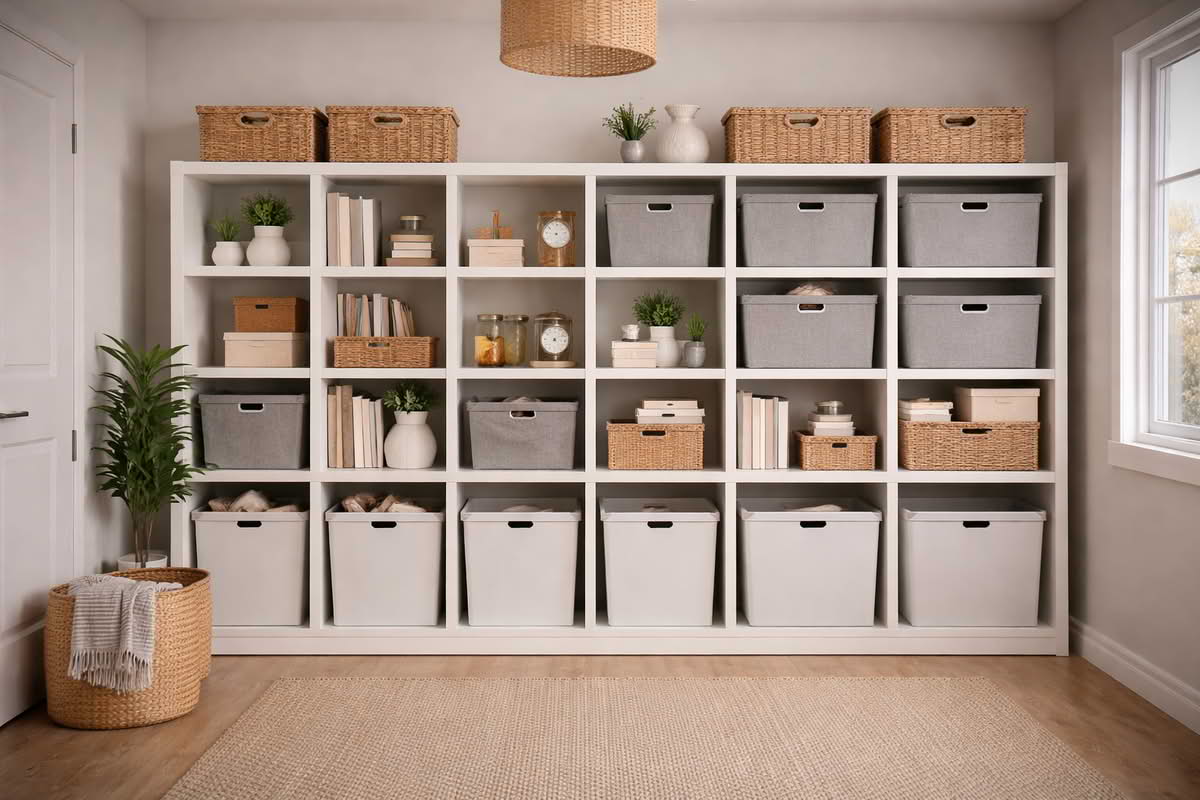
Cube-style storage is a good example. It performs well when the household uses baskets, fabric bins, labeled containers, books, toys, office materials, or grouped household supplies that fit neatly inside predictable compartments. It performs less well when buyers try to force long tools, bulky appliances, oversized pantry goods, or deep utility containers into fixed cube geometry. That does not make cube systems weak. It simply means the internal dimensions of the compartments matter as much as the overall footprint.
Scale matters too. A modular system that feels balanced in a home office or playroom may look undersized in a large wall zone, while a wide multi-bay setup may overwhelm a hallway niche, bedroom corner, or mixed-use living area. Because modular units often grow incrementally, buyers sometimes end up with a system that has expanded without a strong visual plan. What began as practical storage can start to feel pieced together. The best results usually come when expansion is anticipated from the start rather than improvised later.
Choose compartment sizes around the actual bins, baskets, books, or containers you plan to use.
Choose modular layouts that suit the wall and room proportions instead of growing the system in whatever direction is easiest later.
Choose a clearer storage pattern when the room needs visual calm as much as added capacity.
Open versus contained storage is another important tradeoff. Modular shelving is often open by design, which makes it strong for display-adjacent storage, quick visual scanning, and easy category assignment. But openness also means clutter remains visible unless the categories are well controlled. This is why many modular systems work best with a mix of open compartments and bin-based compartments rather than treating every opening the same. Some categories deserve visibility. Others benefit from containment.
Depth influences efficiency in quieter ways. Shallow modular shelves often feel cleaner in smaller rooms because they preserve floor area and reduce visual bulk. Deeper units can hold more, but may also invite stuffing, hidden overflow, and a mismatch between compartment depth and everyday access. In family spaces, office areas, and multi-purpose rooms, slightly shallower systems often age better because they support ongoing maintenance more naturally.
Modular shelving feels more efficient when compartment size, shelf depth, and room scale are planned together rather than expanded piecemeal.
Buyers should also think about vertical and horizontal behavior. A tall narrow arrangement may recover floor space but feel top-heavy visually or inconvenient for children. A wide low system may double as a room edge, media base, or bench-adjacent storage area, but might sacrifice some vertical capacity. The better choice depends on whether the room needs a storage wall, a compact organizer, or a more furniture-like storage layer. Modular shelving is strongest when it respects room behavior instead of simply filling empty space.
Expansion, Maintenance, and Long-Term Fit Matter More Than Initial Configurability
One reason buyers choose modular shelving is the belief that it will continue evolving with the household. That can be true, but long-term success depends less on the number of available add-ons and more on whether the system remains coherent as it grows. Expansion is only helpful when additional pieces integrate cleanly with the original layout, preserve stability, and still suit the room. Otherwise, flexibility turns into drift. The storage becomes more extensive but less intentional.
This is why growth paths matter. Before buying, it helps to ask how the system would expand if storage needs increase. Can additional units sit beside the original layout without making the room feel fragmented? Can the stack go taller without becoming awkward or visually heavy? Can components shift between rooms if needs change later? A modular system that offers graceful expansion or repurposing usually creates fewer regrets than one that only works well in its initial configuration.
Maintenance is another underappreciated issue. Modular shelving tends to invite category-based organization, which is good, but it also makes visual disorder easy to notice. In busy households, that can be either a feature or a burden. Open compartments help people see where things belong, yet they also make it obvious when categories start to blur. Buyers who want modular shelving to remain calm-looking over time should plan for baskets, labels, or container standards from the start. Otherwise, the system may become a grid for visible clutter rather than a framework for order.
Use modular shelving when you expect storage needs to change but still want the system to remain organized by category.
Use baskets or bins for compartments that would otherwise accumulate loose or visually noisy items.
Use expansion deliberately so the system grows in a controlled way instead of becoming an improvised wall of pieces.
Long-term fit also depends on whether the system remains appropriate as household priorities change. A cube-based unit that starts as toy storage may later hold office supplies, craft materials, linens, or entryway overflow. That versatility is part of the category's appeal. But it only works when the shelf dimensions, overall strength, and visual style are broad enough to survive that transition. Highly specialized layouts may solve one phase of life well and then feel awkward in the next.
Another practical question is whether the shelving should look like furniture, utility storage, or something in between. In visible rooms, modular systems often need to balance function with visual restraint. In closets, offices, utility corners, and play areas, utility may matter more. The right answer depends on where the shelving lives. A system that feels smart in a mudroom may feel too casual in a main living area, while a more polished modular system may be unnecessary in a back-room storage zone.
The strongest modular shelving decisions usually come from a clear balance: enough flexibility to adapt, enough structure to stay trustworthy, and enough visual discipline to remain livable. When those traits align, modular shelving becomes one of the most versatile storage categories in the home. It can shift roles over time without ever feeling like a temporary fix. When they do not align, the same flexibility that once seemed useful becomes the reason the system never quite feels finished.
Final Recommendations — Choosing Modular Shelving That Adapts Without Drifting
The best modular storage shelving is the system that offers useful flexibility without asking you to rebuild your storage logic every few months. Buyers usually get the strongest result when they treat modularity as a way to fine-tune fit and future growth, not as a substitute for deciding what the system actually needs to store.
Choose cube and compartment-based modular shelving when your storage categories work well with bins, baskets, books, and grouped household items.
Choose more substantial modular systems when the unit may expand or carry moderately heavier storage over time.
Choose visually simpler layouts when the shelving will live in prominent rooms and needs to feel calm rather than busy.
Choose a system with a believable expansion path so future additions still look intentional and function cleanly.
A low-regret modular shelving purchase stays useful because it evolves in controlled ways. When compartment logic, room fit, and long-term flexibility all work together, modular storage becomes a durable organizing framework rather than just a customizable way to hold more things.