How to Choose Spice Storage for a More Usable Kitchen
Spice storage looks like a small kitchen problem until it starts slowing down ordinary cooking. A drawer full of mismatched jars, a cabinet shelf where labels disappear behind each other, or a countertop rack that looks organized but keeps the wrong spices closest at hand can turn a simple task into repeated friction. Many buyers respond by choosing the most attractive spice jars or the most visually tidy rack they can find, assuming that appearance and function will naturally line up. Often they do not. The best spice storage system is not the one that looks most curated when everything is freshly arranged. It is the one that makes it easier to see what you have, reach for the right spice quickly, refill without annoyance, and keep the system working after weeks of ordinary use. Layout, cooking frequency, jar compatibility, label visibility, and how often you buy or refill spices matter more over time than a matching aesthetic alone.
Start with where your spices live and how you cook
The most useful place to begin is not the spice rack itself. It is the kitchen layout and the way spices are actually used during cooking. Some households keep spices in an upper cabinet near the stove. Others rely on a drawer system, a pull-out pantry shelf, a countertop rack, or a rotating organizer tucked into a corner. Those setups create very different needs. A good spice system should fit the physical space first and the visual style second.
The most effective spice storage system is usually the one that fits the kitchen’s real layout and keeps frequently used spices easy to see and reach.
This is where many spice-organization purchases go wrong. Buyers often choose products because they look orderly in photos, not because they solve the particular problem in their own kitchen. A tiered cabinet organizer can be very helpful when the problem is lost visibility on a deep shelf. The same product can be awkward in a shallow cabinet where it wastes space or makes jars harder to remove. A drawer insert can feel clean and highly efficient if you already have the right drawer dimensions. It can be a frustrating mismatch if the drawer is too shallow, too narrow, or already needed for utensils and tools.
Cooking style matters just as much as kitchen layout. A household that cooks frequently with a small set of core spices needs different storage than a household that has a large spice collection but only uses many of them occasionally. If ten jars are reached for constantly and twenty others are rarely touched, the system should reflect that. The spices you use most should be easiest to see and easiest to grab. One of the most common mistakes is organizing all spices with equal priority, which creates a neat-looking system that slows down actual cooking.
It also helps to think about whether your current problem is visibility, access, overflow, or inconsistency. Some kitchens have plenty of room but poor label visibility. Others have too many half-used containers in different sizes. Some simply lack a clear home for spices at all. Those are different problems, and they should not all be solved with the same product. Buyers often purchase a full spice-storage system before identifying which of these issues actually creates the daily frustration.
Choose the system around your actual cabinet, drawer, or counter space rather than around a generic spice-storage image.
Prioritize access to the spices you use most instead of organizing every jar with equal importance.
Identify whether the real problem is visibility, overflow, inconsistent packaging, or lack of a dedicated home.
Do not assume a visually tidy setup is automatically the most functional one for everyday cooking.
Another useful question is whether your spice collection is stable or always changing. Some households buy the same staples repeatedly and need a dependable, standardized system. Others are more experimental and add specialty spices, blends, and seasonal ingredients throughout the year. A highly fixed storage layout may work beautifully in the first kitchen and become frustrating in the second. The best purchase depends partly on how predictable your spice inventory really is.
Shared kitchens add another layer. A spice setup that only makes sense to the person who arranged it will not stay organized for long. Clear placement, readable labels, and an intuitive logic tend to matter more over time than elaborate sorting systems. Simpler systems usually survive more daily use because they ask less of everyone who cooks there.
A smart spice-storage purchase usually begins with restraint. Instead of buying everything at once, it often makes more sense to solve the shelf, drawer, or counter area that causes the most cooking friction first. That approach tends to produce a system that stays useful rather than one that looks perfect for a few days and then starts drifting back into disorder.
Jars, racks, drawers, and turntables solve different problems
Once the kitchen layout and usage pattern are clear, the next step is deciding which kind of organizer actually fits the problem. This is where buyers often blur different products together under the idea of "spice storage," even though spice jars, racks, drawer inserts, shelf tiers, and rotating organizers serve very different purposes. The right solution is usually the one that addresses your main friction point directly instead of trying to create a fully styled system all at once.
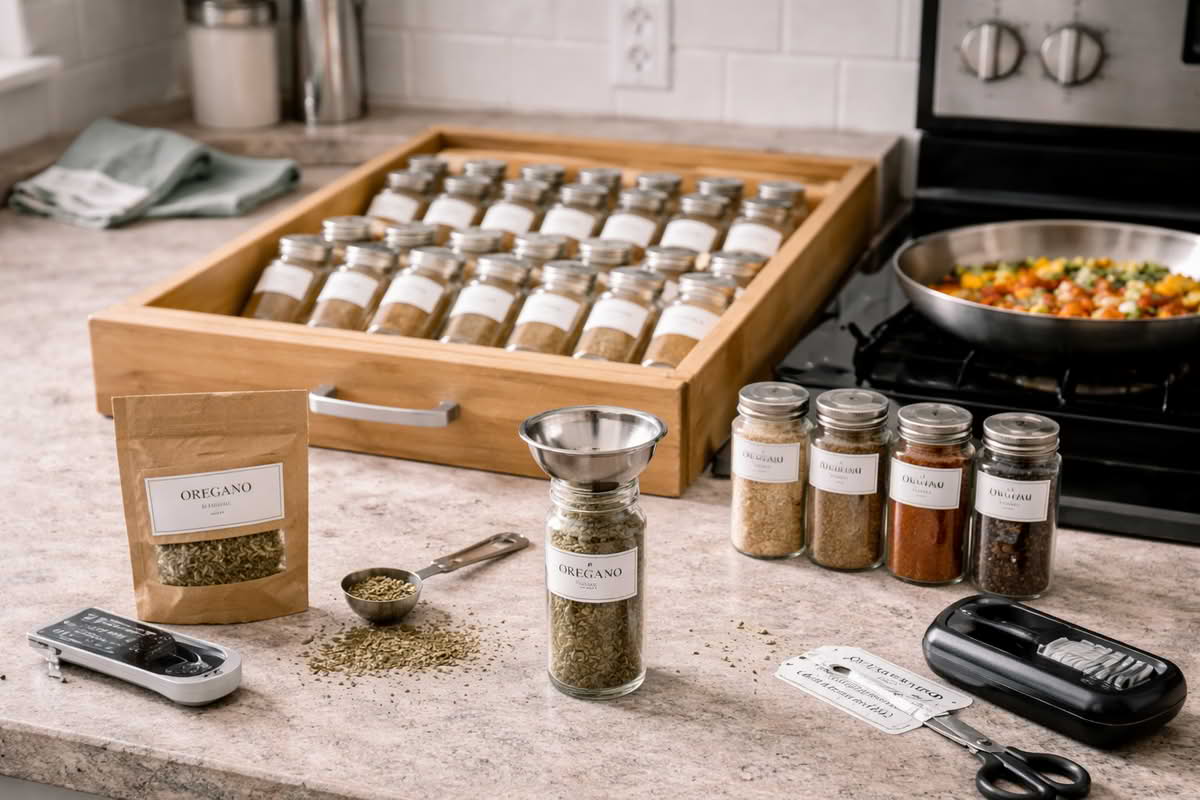
Spice jar sets are usually attractive when the main problem is packaging inconsistency. Mismatched store bottles can waste space, hide labels, and create visual clutter even when the actual number of spices is manageable. Standardized jars can help by making the collection easier to arrange and easier to label clearly. But they also create refill work. Buyers often underestimate how much time and attention is involved in transferring spices, labeling them, and keeping that system current. Standardization can be useful, but only if the household is willing to maintain it.
Rack systems solve a different problem. They work best when spices need a dedicated visible zone, especially in smaller kitchens where cabinet shelves are inefficient or when spices are used often enough to justify a permanent position. Their weakness is that they can create visual clutter if the collection is large or if the rack ends up holding too many rarely used items. A rack can be very efficient for a curated everyday selection and much less helpful for a sprawling spice inventory.
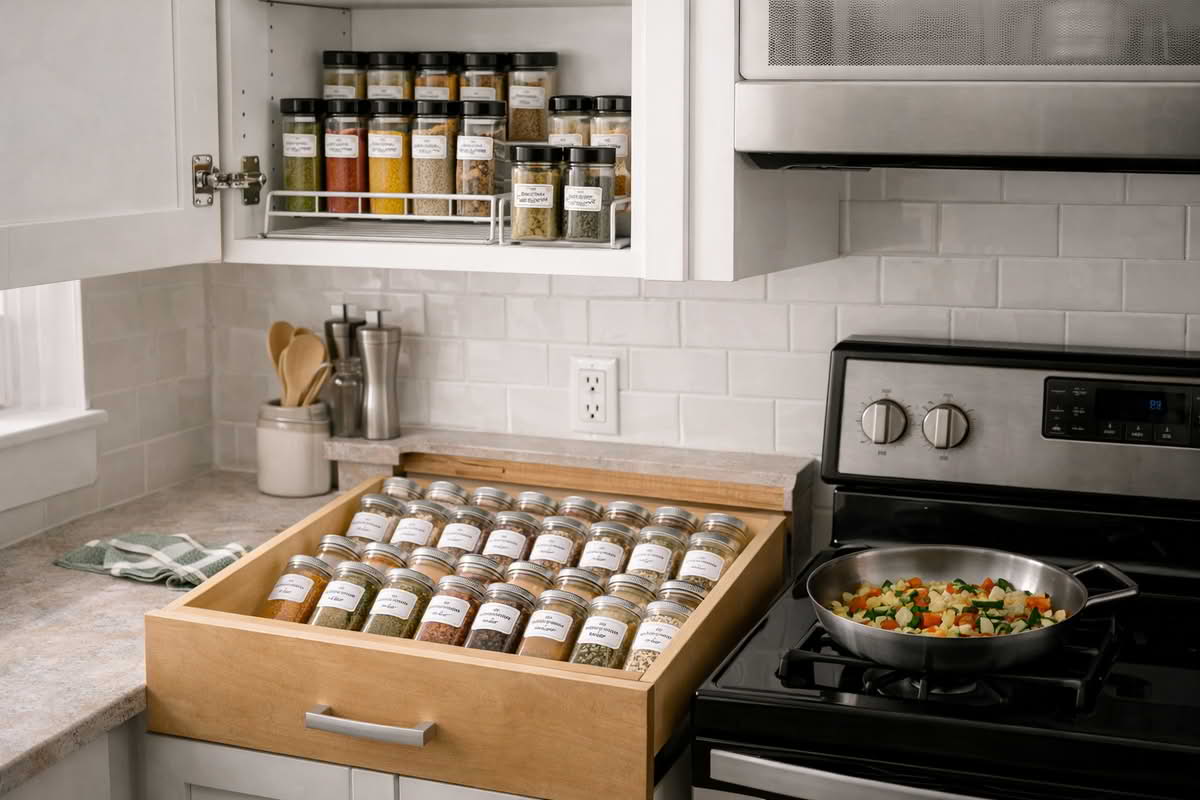
Drawer organizers are often strong solutions because they emphasize label visibility while keeping the collection out of sight when not in use. In the right kitchen, this can create one of the cleanest and fastest spice systems. The tradeoff is that they depend heavily on drawer dimensions and on having a drawer available for the purpose. They also work best when jar sizes are standardized enough that the layout stays orderly. If the drawer is shallow, crowded, or shared with other kitchen tools, the system may not hold up well.
Rotating organizers and turntables often make sense in corner cabinets, deep shelves, or awkward pantry spots where items would otherwise disappear. They can be very helpful when the core problem is reach rather than labeling. But they are not a universal spice solution. Tall jars, mixed container heights, or overloading can make them less effective than they first appear. Buyers sometimes choose them because they seem clever, but their usefulness depends heavily on the shape and density of the collection.
Use standardized jars when mismatched packaging is the main source of clutter and you are willing to maintain refills.
Use racks when spices need a dedicated visible zone and the collection is not too large for open display.
Use drawer inserts when label visibility and concealed storage both matter and drawer dimensions support the system.
Use turntables when the real problem is deep-shelf reach rather than overall organization.
Another common mistake is buying a complete spice-storage makeover before deciding which spices deserve prime access. The most effective systems often separate core spices from long-tail spices. Everyday spices can live in the most convenient zone, while occasional blends and specialty ingredients can live elsewhere without causing trouble. Buyers who try to keep everything in one equally prominent format often create a system that is visually uniform but less useful during real cooking.
Labeling deserves more attention than it usually gets because label orientation changes how a system feels. Top labels make sense for drawer storage. Front-facing labels make more sense on racks or shelf risers. A beautiful jar system can still fail if the labels are hard to read from the angle where the jars actually live. This is a detail that matters far more in use than it does during purchase.
The best spice-storage choices usually come from matching the product type to the exact access problem. Once buyers stop trying to solve every spice issue with one kind of organizer, the category becomes much easier to use well.
Visibility, refill work, and long-term maintenance
Spice organization only lasts when it stays easy under real cooking conditions. This is the point where many systems fail. The jars look aligned, the labels look clean, and the rack looks efficient right after setup. Then cooking happens. New spices come in. A half-used bottle does not fit the system. Labels fade or become inconsistent. Someone returns a jar to the wrong spot. A good system should survive those ordinary events without collapsing into disorder.
Visibility is often the biggest long-term factor. If you cannot see what you have clearly enough to find it quickly, the system is probably not helping as much as it should. This does not mean every spice must be on display. It means the household should be able to identify spices without digging, moving five jars, or repeatedly reading tiny labels from the wrong angle. A well-organized system reduces hesitation during cooking. That is its real job.
Refill work is another source of hidden friction. Standardized jars can be very satisfying once they are set up, but they ask for ongoing maintenance. Spices bought in bags, refills, or standard store bottles need to be transferred. Labels may need updating. Empty jars need attention before a shopping trip or right after it. If the household is unlikely to keep up with those steps, the system can drift into a messy hybrid of half-decanted containers and original packaging. That is not a moral failure. It is a sign that the storage system demanded more upkeep than the kitchen was willing to give.
A good spice system should stay readable and manageable through normal refills, relabeling, and everyday cooking rather than only looking organized at the start.
Long-term maintenance usually improves when the system is slightly simpler than your ideal. A partly standardized spice zone that is easy to keep going often works better than a perfectly decanted, highly segmented system that only looks good when freshly reset. The goal is not to create a spice display. It is to support cooking. If the maintenance work becomes its own project, the organization is probably too elaborate for daily life.
Cleaning and dust also matter more than buyers sometimes expect, especially for open racks and countertop systems. A setup that looks sharp on day one can become visually busy or annoying to wipe down in a few months if it lives near the stove or in an exposed corner. Enclosed or drawer-based systems may reduce that issue, but only if they remain easy to access and easy to keep sorted. Every storage method solves some problems and introduces others. The better choice is the one whose tradeoffs you mind least over time.
Prioritize label visibility from the angle where the spices will actually be stored.
Be realistic about how much decanting, relabeling, and re-sorting the household will actually maintain.
Choose a system simple enough to survive normal grocery changes and shared kitchen use.
Think about dust, wipe-down, and stove-adjacent mess if the spices will live on the counter or in open racks.
Cost should be judged by how much daily cooking friction the system actually removes. A small number of well-chosen jars or a drawer insert can dramatically improve spice access if the existing setup is chaotic. A full matching rack-and-jar system can cost more while solving less if the kitchen does not have a good place for it or if the user dislikes the refill work it requires. Mid-range spice-storage tools often make the most sense because they improve readability and order without pushing the kitchen into a highly curated maintenance routine. Higher-cost systems only make sense when the household truly values that level of refinement and will keep it going.
Another common regret pattern is organizing around visual appeal instead of cooking flow. A system may look organized when standing still and still fail when someone needs paprika, cumin, oregano, and garlic powder in the middle of dinner prep. The best spice-storage purchase is the one that makes those moments simpler. If a rack, drawer, or jar system cannot do that, its good looks will not matter for very long.
The lowest-regret spice-storage setup usually feels quietly intuitive. The right jars are easy to find, the labels make sense, refills are manageable, and the collection stays readable without much effort. That is what makes spice storage valuable over time. Not just the promise of order, but the reality of faster, calmer cooking.
Final Recommendations — choosing spice storage that helps you cook instead of just helping the shelf look tidy
A good spice-storage system should be chosen around kitchen layout, spice usage, and maintenance realism rather than by appearance alone. Buyers who mainly want faster access and less clutter usually do best by solving one clear problem first, whether that means a drawer insert, a tiered shelf organizer, a small rack, or standardized jars for a stable core collection. Kitchens with broader spice inventories may benefit from separating everyday spices from occasional ones rather than forcing everything into one polished display. In both cases, the goal is the same: make spices easier to see, easier to reach, and easier to keep organized without creating a second chore in the kitchen.
Match the storage type to the real problem: visibility, reach, inconsistent jars, or lack of a dedicated zone.
Choose standardized jars only when the household is willing to keep up with refills and labeling.
Prioritize label readability, quick access, and everyday cooking flow over purely decorative order.
Spend for better long-term fit, not just for a more curated-looking spice setup.
The lowest-regret spice-storage purchase is usually the one that feels proportionate. It fits the actual kitchen, supports the spices you use most, and stays easy enough to maintain that the system continues working long after the first organizing session is over. When that balance is right, spice storage becomes less about tidiness and more about making the kitchen easier to use every day.