How to Choose Pantry Organizers for a More Functional Kitchen
Pantry organization products are easy to buy with good intentions and then regret once they reach an actual shelf. Clear bins, matching containers, risers, racks, and modular systems often look immediately convincing because they promise visual order and easier access. In real kitchens, though, the wrong organizers can create a different kind of clutter: bins that waste depth, stackable systems that make items harder to reach, containers that fit the shelf but not the food you buy, or matching sets that look clean while reducing flexibility. Many buyers organize for appearance first and workflow second. That usually leads to a pantry that photographs well but functions poorly once groceries, family habits, and partial packages start moving through it every week. The better decision is to treat pantry organization as an access system. Shelf depth, container shape, refill habits, category grouping, and how often items are used matter more over time than visual uniformity alone.
Start with the layout and the food you actually store
The most useful pantry organization plan starts with the pantry itself, not with a matching set of products. Shelf depth, shelf height, lighting, door clearance, and the kinds of food you buy all shape what organization tools will actually help. A shallow pantry with fixed shelves creates different problems from a deep reach-in pantry, a narrow cabinet pantry, or a small backup pantry in a laundry or utility area. Buyers often skip that first step and shop by product category alone, which leads to organizers that seem useful individually but work poorly together once they meet the actual space.
Food type matters just as much as pantry shape. Some households store mostly boxes, cans, snacks, baking goods, and a few staple dry ingredients. Others rely heavily on bulk items, refill bags, cereals, bottled oils, or packed lunch supplies. Those patterns should drive the organization choices. A pantry dominated by packaged snacks may benefit more from open bins and category grouping than from decanting everything into matching containers. A pantry with lots of flour, rice, pasta, oats, and baking ingredients may genuinely benefit from standardized storage formats that reduce spills and simplify measuring. The right tools depend on what your pantry is trying to hold every week.
The most effective pantry organization usually comes from matching storage tools to the actual shelf layout and the kinds of food the household stores every week.
Another common mistake is treating all pantry items as if they should be organized the same way. That sounds tidy in theory, but it often creates frustration in practice. Frequently used staples should usually be easiest to see and easiest to reach. Backup stock, duplicates, seasonal items, and occasional baking ingredients can tolerate a less prominent spot. When everything is given the same kind of container or the same kind of access, the pantry often becomes less efficient, not more. A good pantry system separates everyday use from long-tail storage.
It is also worth being honest about shopping habits. A household that buys in bulk, warehouses extras, or rotates through warehouse-club packaging needs different organization logic than a household that shops more often and keeps less backup inventory. Deep bins and larger containers may make sense in one kitchen and become wasted volume in another. This is one reason pantries often fail after a reorganization. The system was built around a visual ideal instead of the way groceries actually enter and leave the house.
Choose pantry organizers only after understanding your shelf dimensions and traffic patterns.
Match the system to the actual foods you store, not to a generic pantry image.
Separate high-frequency items from backup or occasional items instead of organizing everything the same way.
Let shopping habits influence the decision, because bulk buying and light weekly shopping create very different storage needs.
Accessibility is often a bigger problem than clutter itself. Many disorganized pantries are not truly overfilled so much as poorly layered. Food disappears behind other food, short items vanish beneath shelf height, and partial packages get lost because there is no clear visual category for them. Buyers sometimes respond by adding more products everywhere at once, but a better approach is usually more selective. The question is not how much organization gear the pantry can hold. It is which friction points need to be solved first.
This is especially important in shared households. A pantry system that only makes sense when maintained perfectly is not really a strong system. If other people cannot tell where snacks go, where backstock lives, or which containers are meant for refills, the organization will erode quickly. Simpler logic often outperforms more beautiful logic in the long run. The best pantry systems tend to be readable at a glance, not just orderly after a full reset.
A smart pantry purchase usually begins with restraint. Instead of assuming every shelf needs a product, it is often better to identify the shelf that causes the most daily frustration and buy for that problem first. That mindset tends to produce systems that keep working after the first week rather than systems that slowly become another form of kitchen maintenance.
Bins, containers, and organizers each solve different problems
Once the layout and pantry habits are clear, the next decision is which type of organizer solves which problem. This is where many buyers collapse too many categories together. Clear bins, decanting containers, shelf risers, can organizers, lazy turntables, and drawer-like pull bins all look like organization tools, but they do not do the same job. The better purchase comes from understanding that each type changes access differently.
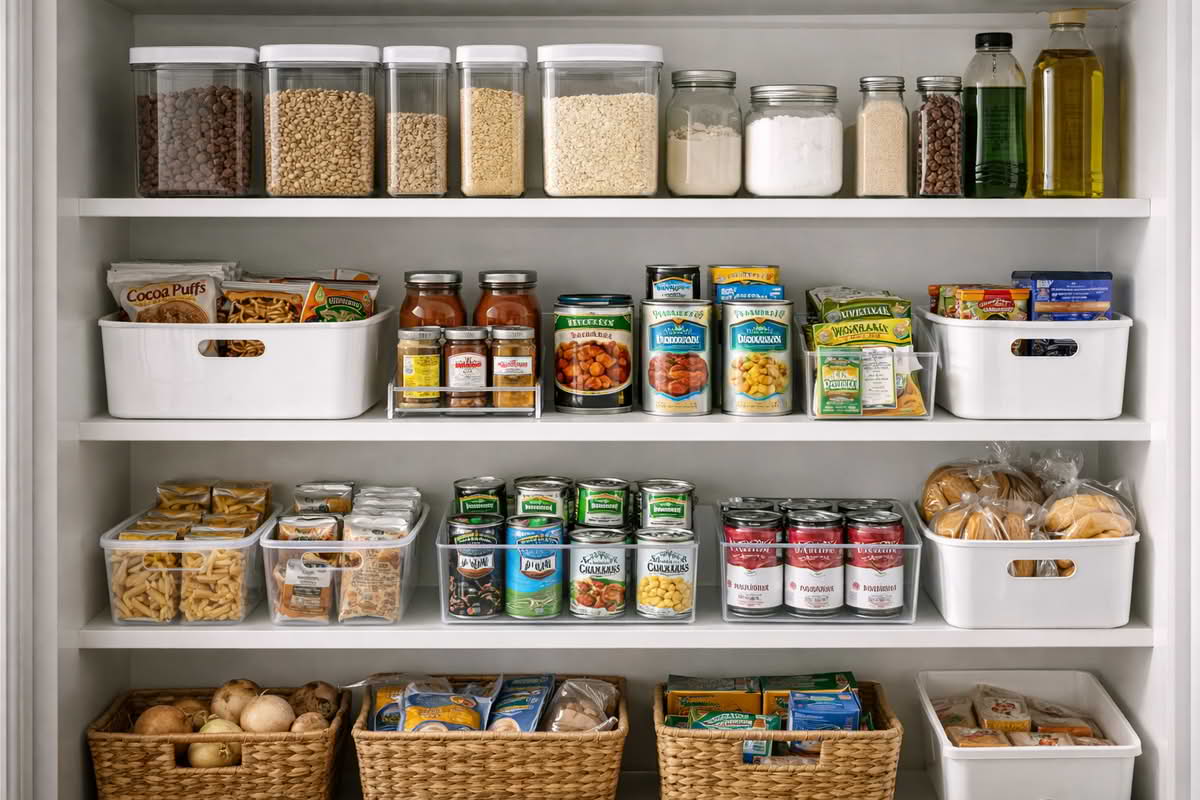
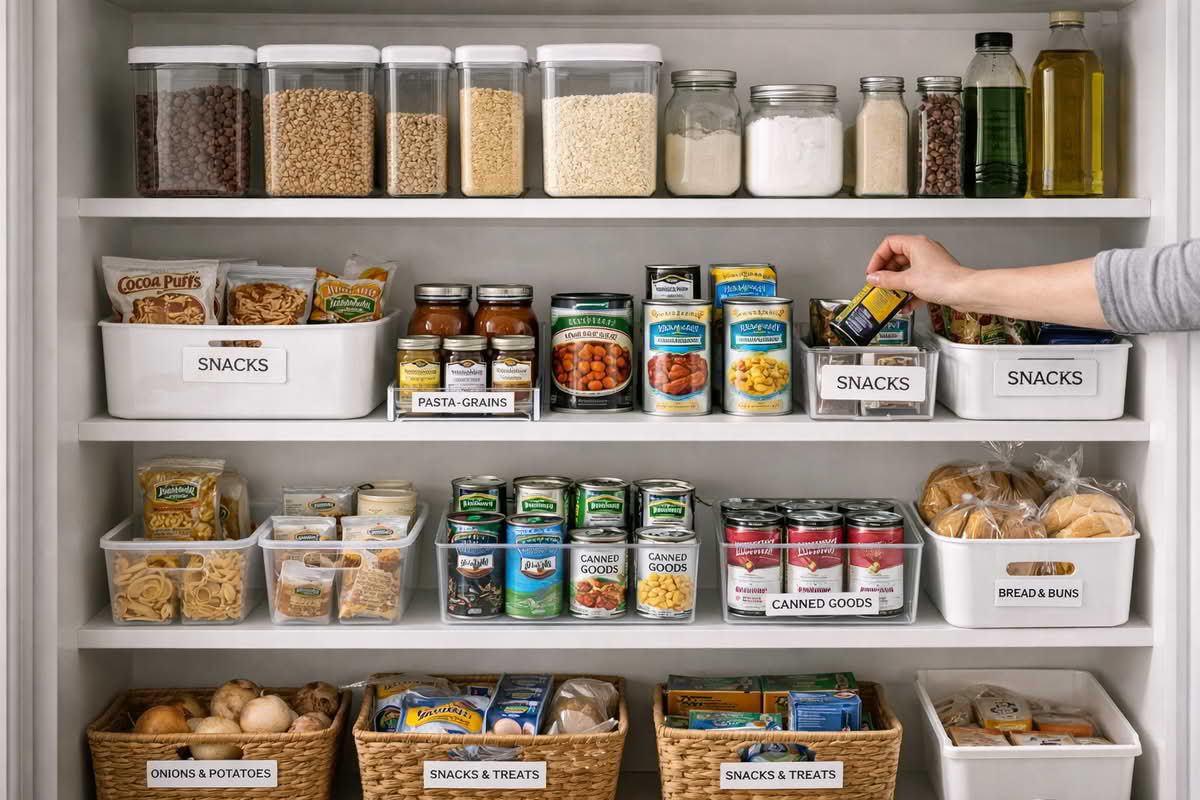
Open bins usually work best when the goal is category containment rather than full visibility of every item. They are especially useful for snack groups, packets, pouches, bread products, and irregularly shaped packaging that resists neat stacking. Their strength is that they turn visual scatter into one clear zone. Their weakness is that they can hide what is inside if the bin is too deep or overfilled. In a shallow pantry, bins can be very efficient. In a deep pantry, they may need labels or strict category logic to prevent items from disappearing into the back.
Decanting containers solve a different problem. They make sense when you want more stable storage for dry goods that are used often enough to justify transferring them out of original packaging. Flour, sugar, pasta, rice, cereal, oats, and baking staples are common examples. The strength of containers is consistency of shape and stackability. The weakness is refill work. Buyers often underestimate how much maintenance a full decanting system creates. If the household is unlikely to keep refilling and relabeling steadily, a large container-based setup can become half-organized very quickly.
Shelf risers and tiered organizers are most useful when vertical visibility is the main problem. They tend to work best for cans, jars, spices, and shorter items that otherwise disappear behind taller products. Their weakness is that they only help when the shelf height and item categories are compatible. A riser that looks efficient on paper can waste space if the products are too tall, too heavy, or constantly changing in size. Like many pantry tools, these are strongest when applied to a very specific shelf problem instead of used everywhere by default.
Turntables and rotating organizers can be helpful for awkward corners, oils, vinegars, sauces, or smaller grouped items that benefit from access without digging. They are less useful when items are too tall, too numerous, or too loosely grouped. Buyers sometimes buy them because they feel like a clever solution, but they are not universal. Their value depends heavily on whether the pantry truly has a rotation problem rather than a simple overcapacity problem.
Use bins for category control when packaged items are irregular or visually messy.
Use decanting containers when staple dry goods are used often enough to justify refill effort.
Use risers only where hidden rear rows are the real problem.
Use rotating organizers where reach and access matter more than dense capacity.
Another common mistake is buying a fully matched modular system before knowing which parts are actually needed. Modular products can be useful because they create cleaner visual lines and predictable stacking. But they are only valuable when the pantry's contents are stable enough to benefit from that structure. In kitchens where pantry categories change often, sizes vary week to week, or shopping is less standardized, too much modularity can create friction. A system should be flexible enough to absorb normal grocery variation without constantly needing to be rearranged.
Material and transparency matter too, though usually less than buyers think. Clear organizers often help because they reduce forgetting and make refill needs easier to spot. But full transparency is not automatically better if the result is visual overload or if the categories are already obvious by placement. In some cases, structure matters more than visibility. A messy category contained in one predictable zone can be more functional than a perfectly visible pantry with no real grouping logic.
The strongest pantry purchases usually come from treating each organizer as a task-specific tool rather than as part of a matching aesthetic package. A pantry works best when bins, containers, and shelf tools each solve a clear access problem. Once they start being purchased mainly for visual uniformity, practical performance often drops.
Visibility, refill friction, and long-term maintenance
Pantry organization only lasts when the system is easy to maintain under ordinary conditions. This is the point where many well-intentioned setups fail. The pantry looks clean for a week, then groceries come in, a few packages get opened, someone puts the wrong item in the wrong place, and the whole system starts drifting. The deciding factor is usually not motivation. It is friction. If the organization system takes too much effort to keep up, most households will stop keeping up with it.
Visibility is a major part of that. Items should be easy enough to spot that the household can find what it already owns before buying duplicates or letting food expire. This does not mean every shelf needs to look exposed or minimal. It means the pantry should reduce searching. If food is constantly hidden behind other food, categories are too deep, or containers all look identical without clear meaning, the pantry may be organized physically while remaining disorganized functionally.
Refill friction is another issue buyers often underestimate. Decanted pantry systems look orderly, but every refill adds labor. The same goes for bin-based systems that require re-sorting or for tall organizers that have to be lifted out to reach stock behind them. None of this is inherently bad. It just needs to match the household. A kitchen that enjoys maintaining order may tolerate more structure. A kitchen that mainly wants fast grocery unloading and easier food access usually benefits from a simpler system with fewer maintenance steps.
A pantry system works best when food stays visible, categories stay readable, and normal grocery refills do not turn organization into a second chore.
Long-term success usually comes from choosing categories that are stable enough to stay organized even when the pantry is only maintained moderately well. Snacks can have a bin. Baking goods can have a zone. Breakfast can have a shelf. Oils and sauces can be grouped together. That kind of logic tends to survive normal life better than ultra-specific systems where every single item type has one exact permanent home. The more granular the setup becomes, the more likely it is to fall apart unless someone is actively managing it all the time.
Cleaning and wipe-down should also be considered. Pantry products that trap crumbs, collect dust, or become difficult to remove from the shelf can create hidden upkeep. A system that looks elegant but is annoying to clean often becomes less satisfying with time. The best pantry tools usually help order without making shelf maintenance meaningfully harder. Since pantries are already working zones rather than decorative spaces, practicality should stay ahead of visual polish.
Choose a system that keeps food visible enough to reduce waste and duplication.
Be realistic about how much refilling, relabeling, and resetting the household will actually maintain.
Prefer category logic that survives ordinary use instead of requiring perfect discipline.
Think about cleaning and shelf access, not just how the organizers look when first installed.
Cost should be judged by whether the system solves repeated problems rather than by how complete it feels. A few well-placed bins, risers, or containers can dramatically improve pantry flow if they target the right shelves. A full pantry makeover can cost much more while solving less if it was built around aesthetics first. Mid-range organization products often make the most sense because they improve structure and durability without pushing the buyer into overly elaborate systems. Higher-cost modular setups only make sense when the pantry layout and household habits are stable enough to benefit from them for the long term.
Another common regret pattern is buying for social-media style organization instead of kitchen reality. Perfectly decanted shelves and highly segmented categories can look persuasive, but they are not automatically practical. The best pantry is not the one that looks the most curated. It is the one that helps the household find food quickly, store it without frustration, and put groceries away without creating extra work. That difference matters more over time than almost anything else in this category.
The lowest-regret pantry organization purchase usually feels almost invisible. The pantry becomes easier to use, refills become clearer, clutter drops, and the household does not have to think very hard about keeping the system going. That kind of quiet improvement is what makes pantry organizers worthwhile. Not the number of products added, but the amount of friction removed.
Final Recommendations — choosing pantry organizers that improve access instead of just appearance
A good pantry organization system should be chosen around layout, category flow, and maintenance realism rather than around matching products alone. Buyers who mainly want a more functional pantry usually do best by solving a few repeated access problems with the right mix of bins, containers, or shelf tools instead of trying to transform every shelf at once. Kitchens with lots of dry-goods storage may benefit more from standardized containers, while kitchens built around packaged foods and mixed inventory often do better with simpler category bins and visibility tools. In both cases, the goal is the same: make food easier to see, easier to reach, and easier to keep in order without creating a second job in the pantry.
Match the products to your shelves and grocery habits instead of buying a full system before understanding the space.
Use different organizer types for different pantry problems rather than forcing one solution everywhere.
Prioritize visibility, refill ease, and category logic over purely aesthetic uniformity.
Spend for better long-term fit, not just for a more polished-looking pantry reset.
The lowest-regret pantry purchase is usually the one that feels proportionate. It solves the shelves that actually cause frustration, stays manageable after ordinary grocery trips, and helps the pantry function more clearly without demanding constant attention. When that balance is right, pantry organization stops being a project and starts becoming part of a kitchen that simply works better.