How to Choose Food Storage Containers for Everyday Kitchen Use
Food storage containers look like a simple category until a kitchen starts relying on them every day. At that point, the small frustrations become obvious: lids that never match the right base, stacks that tip over in cabinets, containers that stain, shapes that waste shelf space, or sizes that somehow never fit leftovers from actual meals. Many buyers either grab the cheapest large set they can find or choose based only on appearance, assuming container problems are minor. In practice, storage containers influence leftovers, lunches, pantry organization, freezer use, and how efficiently a kitchen handles meal prep. The better decision usually comes from thinking of containers as an everyday operating system rather than a pile of plastic or glass boxes. Material, lid design, nesting logic, size range, and how the set fits your refrigerator and cabinets all matter more over time than a big piece count printed on the box.
Start with how the containers will actually be used
The most useful place to begin is not material or brand. It is the role the containers need to play in the kitchen. Some households mainly need a dependable leftover system for dinner portions, chopped vegetables, and occasional packed lunches. Others use food storage containers for batch cooking, weekly meal prep, fridge organization, and freezer rotation. Some want one unified set that stays visually consistent. Others mainly need practical coverage across a few common sizes and do not care much whether every piece matches perfectly. Those are different needs, and they do not all point to the same type of container set.
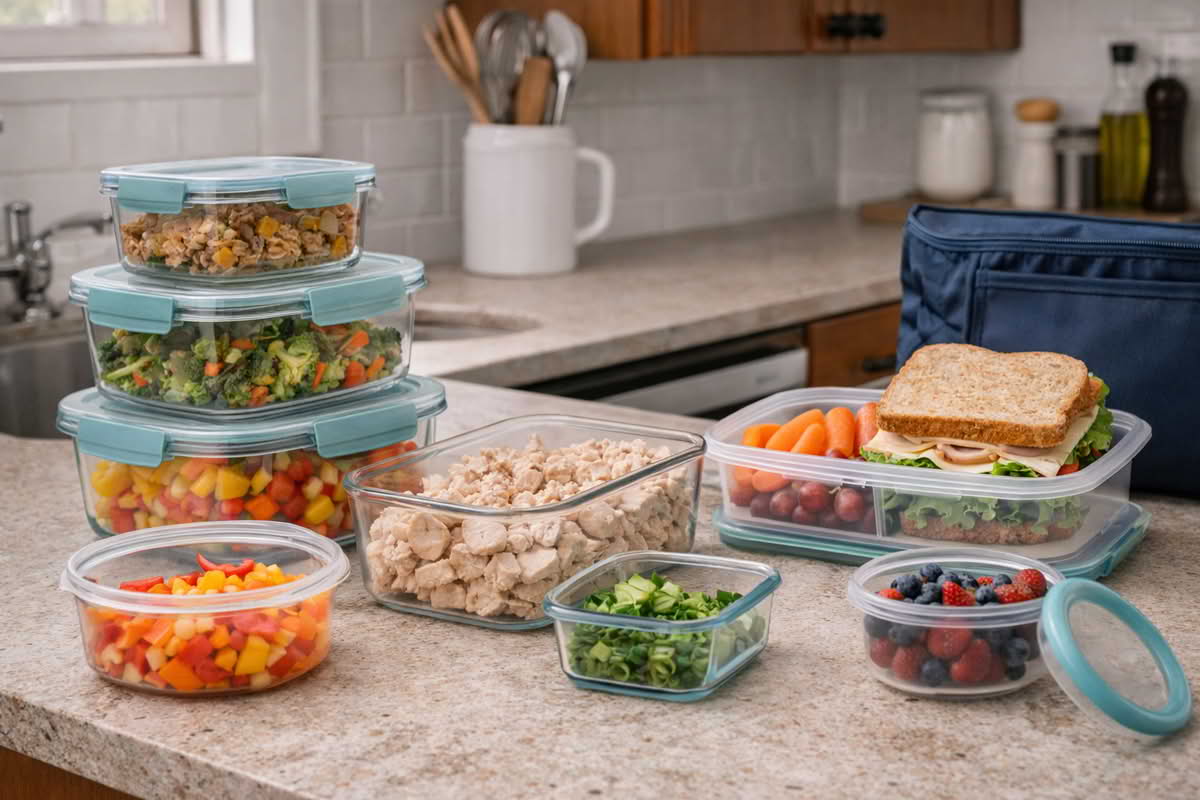
Food storage containers work best when they match the real jobs a kitchen repeats every week, such as leftovers, meal prep, and packed lunches.
This is where many buying mistakes begin. Buyers are often attracted to large sets because the value seems obvious. More pieces suggest more flexibility, and matching containers look organized before a single one has been filled. But quantity is not the same as usefulness. Many large sets include too many tiny containers, too many nearly identical sizes, or a mix of shapes that create cabinet clutter without solving everyday storage problems. A smaller set with a better size spread can easily be more functional than a large bundle full of filler.
It also helps to think honestly about food type. Storing soup, grain bowls, chopped produce, sliced fruit, sauces, sandwiches, and leftover casseroles does not place the same demands on a container system. Some foods benefit from wide shallow containers that cool and stack efficiently. Others work better in deeper forms that fit neatly in the fridge or lunch bag. If the household mainly stores leftovers from cooked meals, practical medium sizes tend to matter most. If meal prep and lunch packing dominate, portability and divided volume may matter more. The right system depends less on broad storage ambitions than on the foods that actually cycle through the kitchen every week.
Another common mistake is assuming containers are mainly about storage after cooking. In many kitchens, they are really about workflow. They hold washed berries, chopped onions, cooked rice, lunch components, pantry refills, and partial ingredients that make later meals faster. That broader role often changes what "best" means. A set that is acceptable for leftovers may be much less useful when the goal is organizing prep across several days. Buyers who define the job too narrowly often end up with containers that feel fine at first and quietly inadequate over time.
Choose the system around repeated uses such as leftovers, meal prep, lunch packing, or produce storage.
Be cautious of large sets that increase piece count without improving the sizes you actually need.
Think about the foods you store most often, not just the general idea of kitchen organization.
Judge the set by how well it supports daily workflow, not just by how tidy it looks when empty.
Frequency matters here too. A container set used occasionally for leftovers has very different priorities from one used every day for packed lunches, chopped produce, or prepared meals. Daily-use systems need better lid logic, better stacking behavior, and more predictable sizing because the friction repeats constantly. A slight annoyance with a lid or a shape that wastes space may sound minor in a product description and become irritating by the end of a week.
Household size should also be interpreted realistically. A larger family may not need the biggest set available, but it usually does need enough medium and large containers that leftovers and prepared food do not end up scattered into awkward combinations. A smaller household may not benefit from oversized pieces if most storage needs revolve around individual portions and smaller ingredient batches. The right system is usually the one that matches the real scale of your kitchen, not the one that seems most complete on paper.
A good food storage purchase usually feels ordinary in the best possible way. The right sizes are always available, the lids make sense, and the containers disappear into the routine without asking for much attention. That quiet usefulness is usually a much better sign than an impressive box count.
Materials, lid design, and everyday function
Once the role is clear, the next decision is how the containers should behave in actual use. Material is often treated as the main choice, and it does matter, but it should be understood as part of a larger ownership system that includes lid performance, weight, staining, portability, and how the containers move between fridge, freezer, counter, lunch bag, and dishwasher. The right choice depends on which tradeoffs bother you least over time.
Plastic containers often make sense when lighter weight, easier carrying, and lower break risk matter most. They are especially practical for lunches, busy households, and kitchens where containers are constantly moving in and out of bags or being stacked quickly after meals. Their weakness is that they can show wear more visibly over time. Staining, odor retention, slight warping, or lid fatigue can all affect how long they remain pleasant to use. That does not make plastic a poor choice. It means buyers should see it as a practical convenience system rather than a permanently perfect one.
Glass containers usually appeal for a different reason. They can feel more durable, more stable, and often better suited to kitchens that want a stronger leftovers and reheating system. In many households, they work especially well when containers go from refrigerator to reheating tasks or when buyers want to reduce the sense of disposability in their food storage. But glass introduces its own tradeoffs. It weighs more, takes more effort to carry in quantity, and may be less comfortable for lunch transport or highly crowded cabinets. A better material in one routine can be the wrong one in another.
Lid design matters almost as much as the container body. A good lid system should feel secure without turning every opening and closing into a small struggle. Buyers are often drawn to leak-resistant or tightly sealed systems, and that can be useful, especially for soups, sauces, or packed lunches. But the stronger the seal, the more important everyday usability becomes. A lid that technically performs well but feels irritating to align, close, or remove can reduce long-term satisfaction surprisingly fast.
Leak resistance should be matched to real use rather than treated as an automatic premium feature. If the household mainly stores leftovers in the fridge, the most important qualities may be stacking, shape efficiency, and easy reheating rather than travel-oriented sealing. If the containers are regularly going into work bags, coolers, or school lunches, then lid security becomes a much more central feature. The better purchase comes from matching lid design to the actual movement of food through your day.
Choose plastic when portability, lighter weight, and lower break risk matter most.
Choose glass when fridge storage, reheating confidence, and a more substantial feel matter more than convenience in carrying.
Judge lids by everyday opening and closing behavior, not just by how secure they sound in product descriptions.
Prioritize leak resistance heavily only when the containers regularly travel rather than staying mainly in the refrigerator.
Another overlooked factor is transparency and visual clarity. Containers that make it easy to see what is inside tend to support better kitchen flow because ingredients and leftovers are less likely to be forgotten. This matters more than buyers sometimes expect, especially in crowded refrigerators where unlabeled or visually opaque storage can turn into waste. The best system often makes food easier to find without asking the household to be unusually disciplined.
Shape also belongs in the material conversation because it affects how the container behaves. Rounded containers may feel comfortable to clean and useful for some foods, but rectangular or square systems often make better use of shelf and drawer space. Again, there is no universal winner. A lunch-focused setup may value portability and comfortable carrying differently from a fridge-organization system that prioritizes efficient stacking. The strongest choice is usually the one whose shapes support the space you are actually organizing.
The best container systems usually come from seeing material as a lifestyle choice rather than a moral one. One option may be better for commute-heavy lunches, another better for reheating leftovers, another better for pantry-style clarity. What matters is choosing the tradeoffs that fit your kitchen best, not the material that sounds most ideal in the abstract.
Size, stacking, and long-term kitchen fit
Size distribution is often the difference between a storage set that works and one that slowly becomes clutter. Buyers frequently focus on total piece count and underweight whether the set actually includes the sizes that match normal meals. Many kitchens need medium containers more than anything else, because medium sizes cover leftovers, chopped produce, lunch portions, and partial prep. Tiny containers and oversized tubs can still be useful, but not in the same repeated way. A set that overemphasizes extremes tends to leave the household still looking for the practical sizes it really needs.
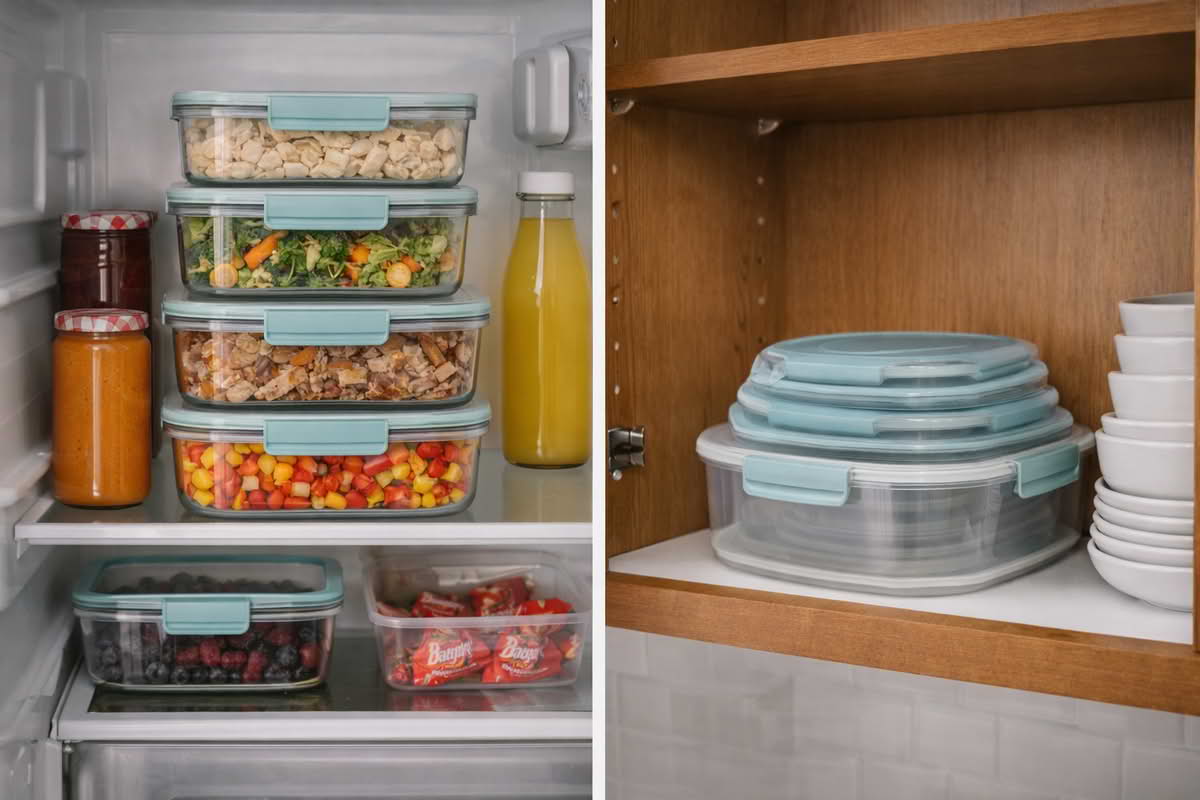
Stacking behavior matters in two places: when containers are full and when they are empty. Full containers need to stack securely in the fridge without sliding or wasting vertical space. Empty containers need to nest or organize well enough that the cabinet does not become a frustrating pile of mismatched shapes. Many container sets perform acceptably in one of those situations and poorly in the other. That is why it helps to think about the whole cycle. Containers are stored empty, filled, stacked, washed, and stored again. A good set supports that loop cleanly.
A good container system should stack securely in the refrigerator and store cleanly in the cabinet so it remains practical through everyday use.
Refrigerator fit is one of the most practical and least glamorous parts of the decision. Some shapes use shelf depth better. Some stack more cleanly under common shelf heights. Some fit well in packed family refrigerators, while others look efficient until they start colliding with milk jugs, leftovers, produce drawers, and condiment doors. Buyers often assume any medium-size container will work in the fridge, but repeated friction around shelf fit can affect satisfaction more than many product features ever will.
Cabinet fit matters just as much. Lids need to store in a way the household can actually maintain. Bases should not require constant re-sorting after every dishwasher cycle. If the system only stays organized when handled perfectly, it is probably the wrong system for a busy kitchen. This is one reason standardized shapes and sensible nesting often matter more than novelty features. The best storage containers tend to make order easier instead of demanding it.
Cost should be evaluated across the full ownership cycle. A lower-cost set can be entirely sensible if the goal is basic leftovers and light daily use. A mid-range set often makes the most sense for many kitchens because it can improve lid reliability, shape consistency, and long-term usability without asking the buyer to pay mainly for appearance. Higher-priced sets make sense when the household uses containers constantly, values stronger everyday handling, or wants a more stable kitchen system that reduces replacement churn. The mistake is paying for premium styling when the set still does not solve ordinary sizing and storage problems.
Choose sets with more of the sizes you actually reach for, especially medium everyday containers.
Judge stacking when full and nesting when empty, because both stages affect daily kitchen flow.
Think about refrigerator shelf depth and cabinet organization as part of the purchase decision.
Spend more only when better lid logic or better sizing clearly improves repeated daily use.
Another common regret pattern is buying too broad a system too early. A household may try to solve every future storage need with one giant set, then discover that half the pieces rarely get used. The reverse also happens: buyers choose a small minimalist set that looks clean and modern, then find themselves running out of useful containers during ordinary leftovers and meal prep. The better choice usually sits in the middle. It covers repeated needs well and leaves room to add a specialty piece later if a specific gap becomes obvious.
Replacement logic matters too. A strong container system should not feel disposable after a short period of ordinary use. At the same time, it should be realistic about how kitchens function. Containers get carried, stacked, reheated, washed, and occasionally lost. The best system is not the one that demands perfection. It is the one that remains useful under normal household wear and keeps the organization problem manageable instead of recreating it.
The lowest-regret food storage purchase usually feels quietly efficient. The lids fit, the sizes make sense, the fridge looks calmer, and leftovers stop becoming a game of compromise. That is what makes a container set valuable over time. Not just the materials or the number of pieces, but the way the whole system supports an ordinary kitchen without asking for extra effort every day.
Final Recommendations — choosing the container system that fits your leftovers, lunches, and kitchen space
A good food storage container set should be chosen by repeated kitchen use, not by piece count alone. Buyers who mainly need a solid leftovers and lunch-prep system usually do best with containers that emphasize sensible everyday sizes, lids that behave predictably, and shapes that fit the refrigerator and cabinet without constant reorganization. Households with heavier meal-prep use or broader storage needs may benefit from a more structured system, but only when that added volume clearly supports how the kitchen already works. In both cases, the goal is the same: reduce daily food-storage friction instead of replacing one form of clutter with another.
Match the set to the foods and portion sizes your kitchen actually repeats.
Choose materials and lid styles based on whether the containers mainly stay home or travel often.
Prioritize medium everyday sizes, good stacking behavior, and cabinet sanity over big piece counts.
Spend for better long-term fit, not just for a larger bundle or more polished presentation.
The lowest-regret container purchase is usually the one that feels proportionate. It is broad enough to cover normal kitchen needs, simple enough to stay organized, and durable enough that the system keeps working without constant replacement or frustration. When that balance is right, food storage stops feeling like a problem to manage and starts feeling like part of a kitchen that runs smoothly.