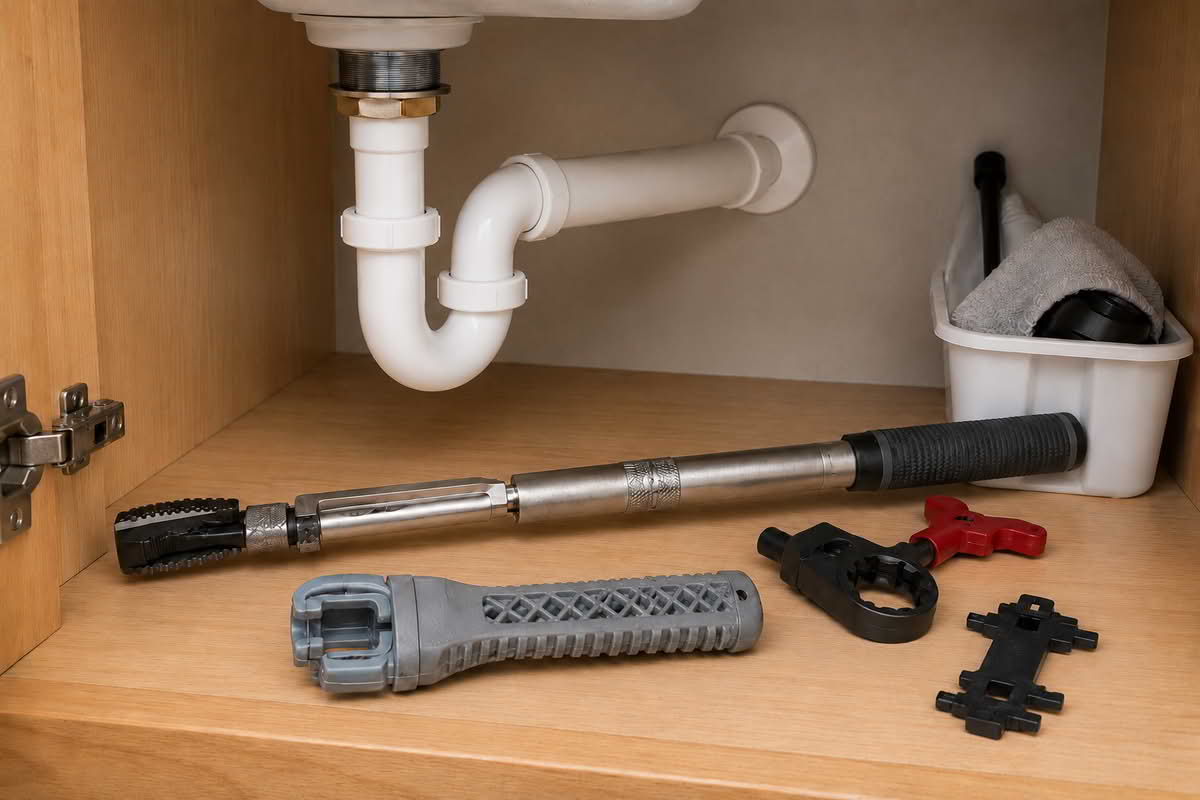
Faucet and Under-Sink Tool Buying Guide for DIY Plumbing
Faucet and under-sink work often looks simple from above the counter, but the difficult part usually happens in a cramped cabinet where nuts, supply lines, drains, and mounting hardware are hard to see and harder to reach. Buying the wrong tool can turn a basic faucet swap, supply-line change, or sink-drain adjustment into a frustrating project because ordinary pliers and wrenches may not fit behind the basin. This guide focuses on reach, grip, clearance, handle control, fixture access, and tool combinations that make common under-sink tasks more manageable without treating faucet repair as a generic parts problem.
Start With Access, Not Tool Count
Under-sink plumbing tools should be chosen around access first. The space below a kitchen or bathroom sink is usually restricted by cabinet walls, sink basins, disposal units, supply valves, drain traps, pull-down sprayer hoses, and the angle of the faucet mounting hardware. A tool that works well in an open workspace may be nearly useless once the handle hits the back wall of the cabinet or the jaws cannot seat squarely on a mounting nut. This is why faucet and under-sink work often rewards specialized reach and angle more than raw strength.
A basin wrench is the clearest example. Its value is not that it is stronger than every other wrench. Its value is that it can reach vertically behind a sink basin and grip mounting nuts that ordinary adjustable wrenches cannot easily reach. Some basin wrenches use telescoping handles, pivoting jaws, or compact heads to improve access. These features matter most when the faucet body is tucked close to the backsplash, when the sink bowl is deep, or when old mounting hardware has limited clearance around it.
Other faucet and under-sink tools solve different access problems. Adjustable pliers can help with slip nuts and supply connections when there is enough side clearance. A compact adjustable wrench can work on supply lines and shutoff valves. A socket-style faucet tool may be useful for certain mounting hardware and supply-line nuts. A drain installation tool may help with basket strainers or sink drain assemblies. The right set is not necessarily large; it is arranged around the places ordinary tools fail.
Use basin wrenches for hard-to-reach faucet mounting nuts behind or below the sink basin.
Use compact adjustable tools when side clearance is limited but the fitting is still visible.
Use drain-specific tools when the task involves sink strainers, drain assemblies, or trap connections.
Use standard pliers carefully, because poor jaw fit can round plastic or metal fittings.
This access-first approach also helps avoid overbuying. A homeowner replacing one faucet may not need a full plumbing tool kit if the cabinet is open, the hardware is modern, and the supply lines are easy to reach. Another homeowner working under an older sink with corroded mounting hardware may need a more capable basin wrench, a compact light source, gloves, and backup tools for fittings that do not loosen cleanly. The buying decision should start with the workspace, not with the longest tool list.
Under-sink tool choices depend heavily on reach, angle, and cabinet clearance because many faucet connections are difficult to access with ordinary wrenches.
Choose Tools by Reach, Grip, and Clearance
Once the workspace is understood, the next decision is how the tool actually engages the fitting. Reach gets the tool into position, but grip determines whether it can loosen or tighten the part without slipping. Clearance determines whether the tool can turn once it is in place. These three variables work together. A long-handled tool with poor jaw control may reach the nut but fail to grip it. A strong adjustable wrench may grip well but need too much turning room. A compact tool may fit into the cabinet but lack the leverage needed for stubborn hardware.
For basin wrenches, jaw design and handle control matter. The jaws need to open wide enough for common faucet mounting hardware, seat firmly, and reverse direction without excessive fuss. A telescoping handle can help in deep cabinets, but it should still feel stable when torque is applied. A very loose head may be frustrating when working overhead. A very bulky head may not fit into tight areas around supply lines and sink bowls. The right balance depends on whether the tool will be used occasionally for one project or kept for repeated household work.
For under-sink work beyond faucet mounting nuts, jaw protection and fitting material matter. Many drain connections use plastic slip nuts, which can be damaged by overly aggressive pliers. Metal supply-line connections may need firmer grip but still require careful alignment to avoid rounding. Basket strainers and drain assemblies may need tools that hold one side steady while another part is tightened. These tasks are not difficult because the parts are complex; they are difficult because space and angles are inconvenient.
Favor stable jaw engagement over maximum handle length when working near fragile fittings.
Choose telescoping reach when sink depth or cabinet layout blocks normal hand access.
Choose compact tools when turning clearance is more limited than distance.
Choose drain-specific tools when the job involves basket strainers, tailpieces, or trap assemblies.
It is also worth separating faucet installation from faucet repair. Installation tools help remove or secure mounting hardware, supply connections, and drain components. Faucet repair parts, by contrast, often depend on brand, cartridge type, stem design, handle configuration, and exact model fit. That is why a tool-focused buying approach is more reliable than treating faucet repair kits as broad comparison products. Tools can be compared by access, leverage, grip, storage, and durability. Replacement parts usually need to be identified against the actual fixture.
Plan for Setup, Storage, and Mistake Prevention
Faucet and under-sink tasks often fail because the project is not set up carefully, not because the homeowner lacks a large enough tool collection. Water needs to be shut off, the cabinet area cleared, towels or a shallow pan placed nearby, and the working area lit well enough to see the connection being adjusted. A tool that looks capable in the package may still be frustrating if the user cannot see the nut, brace the fitting, or turn the handle without bumping into the cabinet wall.
Storage should also influence the choice. A long basin wrench may be useful but awkward to store in a small apartment toolkit. A compact faucet tool may be easier to keep with household tools but less adaptable across unusual fittings. A broader under-sink tool kit may make sense for a homeowner who expects repeated faucet, drain, and supply-line work, while a renter or occasional DIYer may prefer a few targeted tools that solve the most likely access problems. The lowest-regret purchase is the one that will be available, understandable, and usable when a small plumbing job appears.
Mistake prevention deserves special attention around shutoff valves, supply lines, and drain fittings. Old valves can be stiff. Plastic drain nuts can crack if overtightened. Metal fittings can round if the wrong jaw size slips under pressure. Flexible supply lines should not be twisted excessively. A tool should help the user apply controlled force rather than encourage brute force in a cramped space. For many under-sink tasks, slow repositioning is better than forcing a poor grip.
Clear the cabinet before starting so tool handles have room to move.
Use a work light or headlamp so fittings can be seen before force is applied.
Match jaw size to the fitting instead of relying on one tool for every connection.
Avoid overtightening plastic drain components, especially when the tool has high leverage.
A practical tool choice also considers cleanup and storage after the job. Under-sink tools may contact old sealant, mineral deposits, water, or drain residue. Smooth, simple tools are easier to wipe down. Kits with many small adapters can be useful, but they can also become disorganized if they do not have a clear case. A tool that is easy to store and recognize is more likely to be used correctly later, especially during a rushed leak-prevention or replacement task.
Final Recommendations — Choosing Faucet and Under-Sink Tools by Task
The most practical faucet and under-sink tool setup is built around access, grip, and the specific type of work expected. A homeowner planning faucet replacement should prioritize a basin wrench or faucet installation tool that reaches mounting hardware cleanly. Someone working on sink drains should focus more on drain assembly tools, adjustable pliers, and careful control around plastic fittings. A small household toolkit can cover many under-sink tasks when each tool has a clear role.
Choose a basin wrench when faucet mounting nuts are hidden behind a deep sink basin.
Choose compact adjustable tools when fittings are visible but side clearance is limited.
Choose drain-focused tools for sink strainers, trap connections, and drain assemblies.
Choose a broader under-sink tool kit only when repeated faucet and drain tasks are likely.
The long-term value of these tools comes from reducing frustration and avoiding damage in tight spaces. A focused set that fits the cabinet, grips fittings cleanly, and supports controlled force will usually serve better than a large kit full of tools that cannot reach the actual connection. For faucet and under-sink work, the right tool is the one that makes the hidden part of the job visible, reachable, and manageable.