Gap Filler and Expanding Foam Buying Guide for Air Sealing, Insulation, and Everyday Home Gaps
Gap fillers and expanding foams can feel like shortcut products because they promise to seal awkward spaces that caulk, tape, or weather stripping cannot handle easily. Sometimes they are exactly that. Just as often, though, the wrong product turns a small draft or utility opening into a mess of over-expansion, trimming, cleanup, and cosmetic repair. A foam that works well around a rough framing gap may distort a tight window space. A crack filler that seems convenient may not bridge the real opening depth. A product labeled for insulation may be the wrong choice when pest blocking, controlled expansion, or visible finish quality matter more. The category gets confusing because the word “gap” covers many different conditions. Some openings are narrow and surface-level. Others are deep, irregular, or hidden behind trim and penetrations. This guide explains how to choose gap filler and expanding foam based on gap size, expansion behavior, cleanup demands, and long-term maintenance so the product solves the actual opening instead of creating a larger repair around it.
Gap Size and Product Category
The most important decision in this category is not brand or can size. It is choosing the right type of filler for the actual opening. Many disappointing results happen because a product meant for one kind of gap gets used on another simply because the label sounds broad enough. In practice, a narrow surface crack, a pipe penetration, a rough framing void, and an irregular foundation-adjacent seam are not the same sealing problem. Good buying starts by identifying whether the opening mainly needs a flexible surface seal, a controlled foam fill, or a more insulating volume fill.
Crack filler sealants are usually the better starting point for narrower gaps that stay close to the surface plane and benefit from a more controlled bead. These products make the most sense when the goal is to close a seam neatly rather than fill a deeper hidden cavity. They are especially useful where the opening needs a cleaner finish, where over-expansion would be undesirable, or where the gap is small enough that a full foam product would be excessive. Their weakness is that they are not ideal for wider voids where the problem extends beyond the visible line.
Minimal-expansion foam becomes much more useful when the opening has depth and irregularity, but nearby materials could be stressed by aggressive growth. This is why it often makes sense around windows, doors, tighter penetrations, and places where the seal needs to fill space without pushing hard on the surrounding frame. The value is not simply that it expands less. It is that the user gets more control over the final shape and less risk of creating pressure in the wrong place.
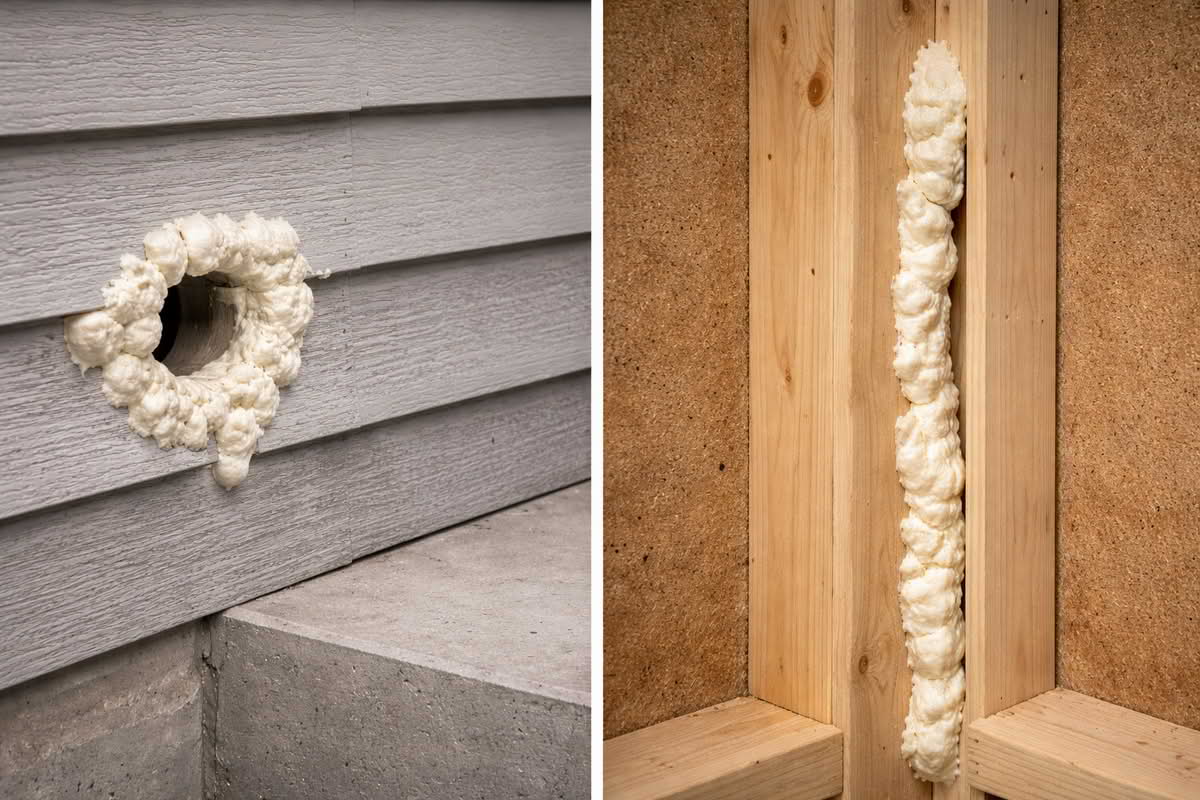
Insulating spray foams are better understood as cavity-filling products. They make more sense where volume matters and the surrounding area is less finish-sensitive, such as broader gaps in utility zones, rough framing transitions, rim areas, or penetrations where the goal is air sealing plus additional fill. These products can be very effective when the space truly calls for expansion, but they are easier to misuse in visible or tight-tolerance areas. A foam that performs well in a rough basement opening can be the wrong choice near trim, finished jambs, or small detail work.
Pest-blocking and specialty gap-fill products serve a narrower role but can be valuable when the opening is not only about air leakage. If the gap is part of an exterior utility penetration, lower wall transition, garage-adjacent opening, or another area where blocking intrusion matters, those specialty products may justify more attention. The important point is that these products should still be judged first by fit and expansion behavior. Specialty positioning does not excuse poor control or messy application in the actual space.
One of the most common mistakes is buying based only on the visible width of the opening. A gap may look small on the face and still open into a deeper irregular cavity. Another may appear larger but actually need only a controlled surface seal because the back side is already stable. Looking only at the surface can lead to overfilling or underfilling. The better question is whether the opening is mainly a seam, a void, or a penetration.
Choose crack filler sealants for narrower visible seams where clean control matters more than cavity fill.
Choose minimal-expansion foam where the gap has depth but the surrounding frame or finish needs gentler pressure.
Choose insulating spray foam for deeper and less finish-sensitive openings where volume fill matters.
Choose specialty gap-fill products only after confirming they still match the shape and behavior of the opening itself.
A useful way to classify the job is to ask whether you are sealing a line, filling a void, or blocking a pathway. Sealing a line usually points toward a controlled sealant. Filling a void points toward foam. Blocking a pathway may require a more deliberate specialty product, but still within the correct gap-size range. Once that distinction is clear, the category becomes much easier to navigate.
Low-regret buying in this category usually comes from resisting the urge to use expanding foam as the universal answer. It is extremely useful in the right place, but it works best when the opening truly benefits from expansion rather than simply tolerating it.
Expansion Control and Placement Risk
After the product category is narrowed, the next major question is how much expansion the job can tolerate. This is where many gap-filling projects go wrong. Buyers often think more expansion means a better seal because it appears more complete and more insulating. In practice, excessive growth can create trim distortion, frame pressure, difficult cleanup, and a repair area that suddenly becomes larger than the original gap.
Minimal-expansion products are valuable because they reduce those risks in tighter assemblies. Around windows and doors, for example, the goal is often to seal air pathways without affecting how the unit operates. Too much foam in those areas can create subtle binding, visible trim pressure, or harder-to-control trimming work. Minimal expansion helps keep the fill more predictable. It is not necessarily weaker. It is simply designed for spaces where control matters as much as sealing.
Higher-expansion insulating foams make more sense in rougher cavities, utility penetrations, and broader building-envelope gaps where the surrounding materials are less sensitive to movement. In those settings, extra growth helps the product reach irregular surfaces and occupy deeper space. The tradeoff is that the user needs more discipline during application. Small trigger decisions can create more final volume than expected, especially in hidden cavities where the product continues changing shape after application.
Placement risk is not only about expansion force. It is also about visibility and access. A hidden basement penetration can tolerate a little trimming and cosmetic roughness. A gap beside finished casing or a visible utility line inside a conditioned room often cannot. This is why the same foam can feel excellent in one part of the house and deeply frustrating in another. The product did not change. The placement standard did.
Application direction matters too. Vertical fills, overhead gaps, and deep narrow openings all behave differently. Some products are easier to control when gravity, nozzle position, and back-pressure are working against the user. Others can become stringy, uneven, or overly aggressive in those positions. For homeowners, this often means that the “best” gap filler is the one that remains manageable in the actual body position and access angle of the job, not just the one that promises the strongest final seal.
Another overlooked issue is how much of the opening should actually be filled. Some gaps benefit from partial filling followed by trimming and a finish seal. Others need only enough product to interrupt airflow rather than being packed completely. Overfilling is common because foam visually suggests progress, but more material does not always mean a better outcome. Sometimes it simply means more trimming, more waste, and more chance of pushing into places the product was never meant to go.
Gap fillers work best when expansion level matches the sensitivity of the surrounding materials and the amount of control the placement area actually allows.
Choose lower-expansion products when nearby frames, trim, or moving assemblies could be affected by pressure.
Choose higher-expansion foams only when the cavity is rough enough and hidden enough to justify broader fill.
Judge every product by placement risk, especially in visible or finish-sensitive locations.
Do not assume a gap must be fully packed to be effectively air-sealed.
One helpful decision frame is to ask whether the main failure risk is under-sealing or over-expansion. In rough utility zones, under-sealing may be the bigger problem. Around finished openings, over-expansion is often the bigger one. The right product is the one that addresses the more likely failure mode of the actual location.
In long-term use, the most satisfying fillers are usually the ones that remain predictable. Predictability matters because it lets you seal carefully instead of reacting to product behavior after it is already coming out of the can.
Cleanup, Finish Quality, and Long-Term Use
Gap fillers and expanding foams should also be judged by what happens after application. A product can technically seal well and still create a poor ownership experience if it is difficult to trim, hard to clean, or awkward to finish around. This is especially important in household maintenance, where many openings live near visible trim, utilities, flooring transitions, or other surfaces that people see regularly.
Cleanup burden varies widely by product type. Crack filler sealants usually create less chaos because they stay more surface-oriented and are applied with narrower control. Foams, by contrast, often ask for more staging discipline. Once they spread beyond the intended area, they can force extra scraping, trimming, and surface protection work. This does not make foam impractical. It means foam should be chosen partly according to whether the area can tolerate that cleanup burden.
Finish quality matters more than many buyers expect. A visible utility penetration in a laundry area may not need a polished look, but a gap near baseboard, a door frame, or a finished wall opening often does. In those areas, a rough foam blob that technically blocks air can still feel like a poor repair. This is why some jobs are better approached with staged filling: controlled foam where needed, then a more refined finish layer at the face. The best buying decision often supports that layered approach rather than expecting one product to do everything neatly.
Durability and future maintenance also matter. Some gaps may need to be revisited if wiring changes, trim is removed, or seasonal inspection reveals additional movement. A product that is overly aggressive, difficult to trim cleanly, or impractical to adjust later may still be acceptable in a one-time hidden void but less attractive in a location that could evolve. Homeowners are often happiest when the chosen filler solves the draft or infiltration problem without making future access unrealistic.
There is also a storage and reuse question. Many gap-fill jobs are small, scattered tasks rather than one large project. If a product is easy to stage, easy to control, and likely to stay useful across several small openings, it often delivers better value than a more powerful option that feels excessive every time it comes off the shelf. This is especially true for households doing gradual maintenance rather than a full renovation phase.
Another practical issue is whether the product will live beside other weatherproofing strategies. Weather stripping, caulk, sealant, and foam often work together rather than separately. A homeowner can get into trouble by asking expanding foam to solve what is really a trim joint issue, or by using sealant alone where a deeper cavity needs interruption first. Buying well in this category means seeing the filler as one layer in the broader air-sealing system of the house.
Choose simpler surface-oriented products when the gap is visible and finish quality matters.
Choose foam only where the area can tolerate trimming, shaping, or a rougher hidden fill.
Think about future access and maintenance before using aggressive fill products in semi-accessible locations.
Use gap fillers as part of a broader sealing strategy rather than as a substitute for every other weatherproofing tool.
A helpful question is whether the area is hidden, visible, or semi-finished. Hidden areas give you more freedom to prioritize pure sealing performance. Visible areas demand more controlled and finish-friendly choices. Semi-finished areas often need a compromise between the two. Once that standard is clear, product selection becomes much more practical.
The long-term low-regret approach in this category is to buy for control first and maximum fill second. When the product stays manageable during application, fits the visual standard of the area, and does not complicate future maintenance, the sealing work feels much more successful than simply filling the gap with the most aggressive option available.
Final Recommendations — choosing the filler that seals the gap without creating a bigger problem
For most households, the safest approach is to choose gap filler and expanding foam by gap depth, placement sensitivity, and finish expectations rather than by the biggest sealing claim on the can. Narrow visible seams usually benefit from controlled crack filler sealants. Minimal-expansion foams make more sense around tighter frames and finished openings where pressure control matters. Larger insulating foams are more useful in deeper, rougher, and less visible cavities where broader fill is actually helpful.
Choose surface-oriented fillers for narrow seams and finish-sensitive areas where neat control matters most.
Choose minimal-expansion foam for windows, doors, and tighter penetrations that cannot tolerate aggressive growth.
Choose insulating spray foam for deeper rough cavities where volume fill and air sealing matter more than appearance.
Judge every product by expansion behavior, cleanup burden, and how realistically it fits the opening’s long-term maintenance needs.
The long-term low-regret decision in this category is to stop treating all gaps as equal. A better product match means less trimming, fewer finish repairs, and a better chance that the opening will stay sealed without looking improvised. When the filler matches the depth, sensitivity, and visibility of the gap, the result feels more like thoughtful maintenance and less like a messy patch.