Step Ladder Buying Guide for Indoor Projects, Home Maintenance, and Everyday Reach Tasks
Step ladders seem simple until you live with the wrong one. Many buyers assume any folding ladder will handle light household work, but the frustrations show up quickly in real use: a ladder that feels too short once you reach the top cabinet, too heavy to carry room to room, too narrow to stand comfortably on, or too unstable to trust while changing a bulb or painting above shoulder height. The wrong ladder does not just slow a task down. It makes ordinary home jobs feel more awkward and more fatiguing than they should. The best step ladder is not automatically the tallest, lightest, or most industrial-looking option. It is the one that fits the kinds of indoor and general household tasks you actually do, feels stable in normal rooms, and stays easy enough to move and store that you will use it instead of improvising with a chair or stool. This guide focuses on height, comfort, stability, and ownership tradeoffs so you can choose a ladder that lowers friction rather than adding it.
What a step ladder needs to do well
A step ladder should make ordinary reach tasks feel calm and predictable. That includes changing bulbs, reaching pantry shelves, painting trim, cleaning upper cabinets, hanging curtains, touching up walls, adjusting closet storage, and handling the small projects that happen throughout a normal home. In those situations, the ladder is not just a height tool. It is a temporary work surface that has to feel trustworthy while your attention is divided between the task, the object in your hand, and the space around you.
Stability is the first requirement because it shapes everything else. A ladder can be lightweight and easy to store, but if it feels narrow, flexes too much, or shifts confidence every time you climb, it will quickly become a tool you avoid unless there is no alternative. That matters because step ladders are often used for jobs that are already mildly awkward. You may be working beside a toilet, in a narrow laundry room, next to a stair-adjacent wall, or in a kitchen where the floor is solid but the surrounding space is cramped. A good ladder should reduce that awkwardness rather than magnify it.
Comfort is just as important as pure stability. Many step ladder tasks take longer than buyers first imagine. Painting ceiling edges, cleaning light fixtures, organizing upper shelving, or installing several pieces of wall hardware can keep you on the ladder for more than a quick minute. In those situations, step width, top-cap usefulness, and whether the standing area feels secure start to matter a great deal. A ladder that is technically safe but unpleasant to stand on can still create fatigue and hesitation that make the project feel harder than it should.
A good step ladder should feel stable enough that you can focus on the task instead of constantly recalibrating your balance.
Comfort matters because many household jobs involve repeated climbs or longer standing periods.
Indoor usability depends on how well the ladder handles tight rooms, hard floors, and ordinary home layouts.
The best ladder is not just safe on paper. It is easy to trust during normal work.
Another overlooked quality is how naturally the ladder opens, locks, and closes. Since step ladders are used frequently for short projects, clumsy setup becomes a real ownership problem. A ladder should feel easy to carry into position, open without a small struggle, and close cleanly when the task is over. Buyers sometimes focus on standing height and forget that the ladder will spend a lot of its life in transit between storage and use. Ease of handling is part of usefulness.
Top cap and tray design can also affect real-world value. Some ladders make it easier to keep a screwdriver, rag, paint cup, screws, or light bulbs close at hand, which reduces repeated climbs. Others keep the top simple and compact, which can be better when storage space is tight. Neither approach is automatically best. What matters is whether the ladder supports the kinds of jobs you actually do. A feature is only useful if it reduces friction during common tasks rather than just adding bulk.
The strongest step ladder purchase is usually the one that becomes your default answer for indoor access instead of something you reluctantly drag out. If it feels steady, comfortable enough to stay on briefly, and convenient enough to move from room to room, it is likely doing exactly what a household ladder should do.
A useful step ladder should feel stable and easy to position for ordinary indoor tasks such as storage access, cleaning, and light maintenance.
Height, weight, and platform tradeoffs
The biggest mistake in this category is assuming that taller is automatically better. More height seems safer at first because it promises broader usefulness, but extra height often brings extra weight, a larger folded footprint, and a ladder that feels less convenient for routine jobs. Many homeowners discover that the ladder they bought “just in case” ends up staying in the garage because it is more cumbersome than the tasks usually justify. In practice, the better question is how often you actually need the extra reach and whether you are willing to carry, store, and set up a larger ladder every time.
Shorter and mid-height step ladders often make the most sense for indoor use because they are easier to move through doorways, fit better in closets or utility spaces, and feel less intrusive in kitchens, bathrooms, and hallways. They are usually enough for cabinet access, painting, shelving, and light installation work in most rooms. Taller step ladders start to make more sense when ceiling height, entryway fixtures, or room size repeatedly push smaller ladders to their limit. But if that need is occasional, it may not be worth living with the larger form factor every day.
Weight follows the same pattern. Heavier ladders can sometimes feel more substantial, but a ladder that is annoying to carry room to room or awkward to lift into storage often loses practical value quickly. For many households, portability matters more than buyers expect because step ladders are not usually set up once and left in place. They move from pantry to hallway to garage to bedroom over the course of ordinary ownership. A slightly lighter ladder that still feels stable can therefore be the lower-regret option.
More height only helps when your real tasks need it often enough to justify extra size and weight.
Compact and mid-height ladders are often easier to live with in ordinary indoor spaces.
Portability matters because step ladders are frequently carried, repositioned, and stored after short tasks.
The best ladder balances reach with a form factor you will actually tolerate using regularly.
Platform-style step ladders deserve special attention because they solve a different problem than basic narrow-top ladders. They are often more comfortable for longer standing tasks such as painting, patching, cleaning, or working with both hands for several minutes at a time. The broader standing area can reduce fatigue and make the ladder feel more secure. The tradeoff is that platform ladders are usually bulkier, heavier, and sometimes slower to store. That added comfort is valuable when the task length justifies it. For very quick grab-and-go jobs, it may feel like more ladder than you need.
Folding compact models work in the opposite direction. They are easy to tuck away in closets, utility nooks, or laundry rooms and can be excellent for households where storage is limited. Their tradeoff is that the smallest and slimmest models may feel less comfortable during longer tasks, especially if the standing surface is narrow or the handle area provides less support. These ladders are often strongest when access and convenience matter more than extended standing comfort.
Material also influences the experience, though mostly through weight, feel, and environment rather than abstract categories alone. Some ladders feel easier to carry, while others feel sturdier under repeated use. For typical indoor household work, the better choice often comes down to balancing manageable weight with enough stability that the ladder still feels solid once opened. The practical ownership question is not which material sounds better. It is which ladder you will actually want to carry to the job.
The core tradeoff is straightforward: taller ladders buy more reach, platform ladders buy more standing comfort, and compact ladders buy easier storage and movement. The best decision depends on which of those benefits matches your most common household tasks instead of your least common maximum-reach scenario.
Choosing for kitchen use, painting, and general home maintenance
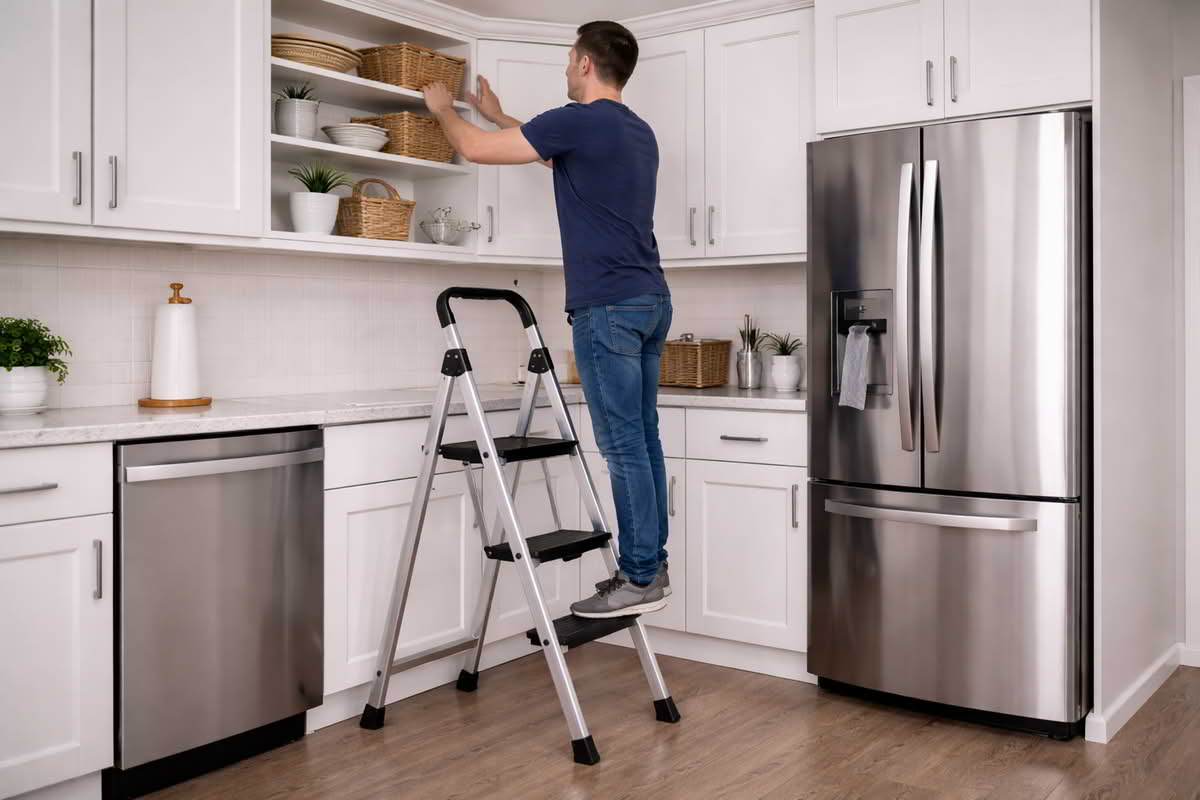
Kitchen and utility-room users usually need a ladder that is compact, easy to move, and comfortable enough for frequent short tasks. Reaching upper cabinets, cleaning above appliances, changing bulbs, and reorganizing storage all reward a ladder that can be carried with one hand and positioned quickly in tighter spaces. In this context, a lighter step ladder often makes more sense than a taller or more jobsite-oriented design. The key is accessibility. A ladder that is easy to grab will be used more often and more appropriately than a larger one that tempts you to use the nearest chair instead.
Painting and longer-duration indoor work change the priority. Once you expect to spend more time standing at height, comfort becomes more important than minimal footprint. Platform step ladders often earn their value here because they make repetitive trim, ceiling-edge, or wall-prep work less tiring. That does not automatically make them the best ladder for every household. It means they solve a specific frustration well: staying comfortably positioned while your hands and focus remain on the work instead of on your footing.
General home-maintenance users often need a middle-ground solution. Their tasks may include seasonal decorating, filter changes, smoke alarm battery replacement, closet adjustments, garage shelving access, and occasional repair work in several rooms. For this group, a broadly capable step ladder with reasonable height, manageable weight, and decent standing comfort usually makes the most sense. It should be easy enough to store and carry, but not so minimal that it feels underbuilt the moment the task lasts more than a minute or two.
Kitchen and utility-space users usually benefit most from compact, easy-to-carry ladders that fit tight rooms naturally.
Painting and longer indoor tasks often justify platform-style ladders because standing comfort matters more.
General home-maintenance buyers usually want a balanced ladder that can move easily through the house without feeling too minimal.
The right ladder depends on whether your work is mostly quick access, longer standing, or a mix of both.
Buyers should also think about who will use the ladder and how often. In shared households, a ladder that opens simply, feels intuitive, and does not require much effort to reposition may have more real value than one optimized for a narrower use case. A good household ladder should feel broadly usable, not like equipment that only one confident user wants to handle. That matters because many reach tasks happen unexpectedly rather than as part of a planned project day.
Storage reality should also shape the decision. A larger ladder might feel like the safer long-term purchase, but if it does not fit naturally in the home, it may become inconvenient enough that it loses its practical edge. Closet depth, garage organization, laundry-room wall space, and how far the ladder must be carried all influence whether a certain size remains a pleasure or becomes a burden. A ladder that fits your storage habits is more likely to remain part of your normal routine.
The lowest-regret buying path is usually to choose the ladder that matches the tasks you actually repeat. If you regularly need safe indoor reach, want a more comfortable alternative to unstable household improvisation, and can store the ladder without resentment, you will get more value from a well-matched step ladder than from a larger model chosen mainly because it seemed more future-proof.
Final Recommendations — choose the ladder you will actually use safely and often
A good step ladder should make indoor access tasks feel more stable, less awkward, and easier to complete without improvisation. For most readers, the best choice is not the tallest ladder that fits the budget. It is the one that balances reach, portability, standing comfort, and storage practicality in a way that matches everyday household use. A ladder that feels easy to trust and easy to grab usually creates the least regret.
Choose a compact or lightweight step ladder if your work is mostly cabinets, light bulbs, closet access, and quick indoor tasks in tighter rooms.
Choose a platform step ladder if painting, patching, and longer standing tasks are common enough that comfort becomes a real concern.
Choose a taller household step ladder only if ceiling height and repeat reach needs justify the added size and storage burden.
Prioritize stability, ease of carrying, and practical standing comfort over buying the tallest ladder for rare maximum-reach situations.
The lowest-regret step ladder is usually the one that becomes the obvious choice for ordinary household work. If it feels stable on hard floors, easy to move, and comfortable enough to stay on while finishing the job, it will deliver far more real value than a larger or more impressive model that mostly stays folded in the corner.