Overhead Garage Storage Buying Guide: How to Reclaim Ceiling Space Without Creating New Risks
Overhead garage storage is appealing because it seems to unlock unused space without taking up more floor area. That promise is real, but it is also where buyers make some of their worst storage decisions. Many households install ceiling racks or tote systems before thinking through headroom, garage door clearance, lifting difficulty, or whether the items being stored overhead actually belong there. The result can be a setup that technically holds more stuff but makes the garage harder to use, harder to access, and less safe in everyday life. Good overhead storage is not just about putting clutter above your head. It is about choosing a system that fits the ceiling structure, respects vehicle and walkway clearance, and is used for the right categories of items. The best solution usually stores low-frequency, predictable loads in a way that feels secure, intentional, and sustainable over time.
Space, Clearance, and Ceiling Fit Come Before Storage Capacity
The biggest mistake in overhead garage storage is assuming that unused ceiling space is automatically usable storage space. In reality, overhead systems only work well when the garage has enough clear volume to support them without interfering with vehicles, doors, lighting, or normal movement. A rack that fits on paper can still create daily frustration if it hangs too low above a parked car, crowds the garage door track, or turns part of the room into a zone where taller people constantly notice reduced clearance.
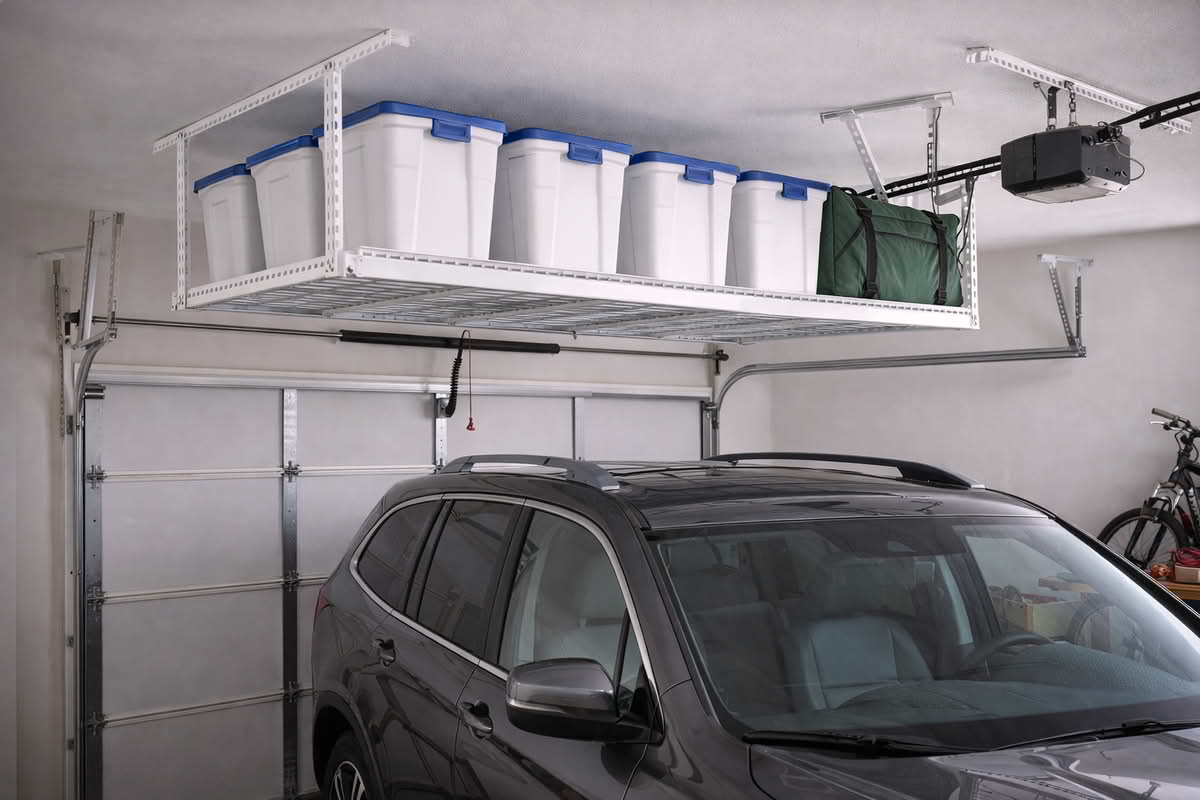
Ceiling height is the first practical filter. In garages with generous vertical space, an overhead rack can store seasonal bins, camping gear, holiday decorations, or rarely used household overflow without affecting daily function much at all. In tighter garages, the same rack may feel like an intrusion. This is why overhead storage is not best judged by dimensions alone. It has to be judged by remaining usable space after installation. What matters is not just whether the system can fit above the car, but whether the room still feels comfortable and functional below it.
Garage door mechanics also deserve close attention. Tracks, openers, support brackets, lighting, sprinklers, attic access points, and ceiling-mounted accessories all compete for overhead real estate. A clean rectangular patch of ceiling is less common than buyers expect. Some garages provide obvious installation zones. Others only appear open until the door is fully raised or a ladder is brought in for access. Overhead storage decisions often go wrong because buyers focus on product dimensions before mapping the actual overhead environment.
Choose overhead systems only after confirming full garage door travel, opener clearance, and usable ceiling zones.
Choose placements that preserve walking comfort and vehicle clearance instead of maximizing storage across every available span.
Choose overhead storage for garages with enough vertical margin to keep the room functional after installation.
Placement within the garage matters almost as much as total clearance. Over a hood, over a side parking lane, above a rear storage zone, or above a less-used work area can all produce very different outcomes. The most efficient-looking installation is not always the most comfortable one. Sometimes a smaller rack in a better zone creates a better long-term result than a larger rack installed wherever enough mounting points happen to exist.
Adjustable drop length can be useful here because it helps the system fit real ceiling conditions rather than forcing one fixed hang depth into every garage. But adjustability is only helpful when used thoughtfully. Lowering a rack to make access easier may reduce the very clearance that made overhead storage attractive in the first place. The best overhead fit usually comes from balancing access and clearance, not optimizing only for one of them.
Overhead storage only works well when ceiling placement respects garage door movement, vehicle height, and comfortable circulation below the rack.
Weight Support and System Design Matter More Than Extra Platform Size
Buyers are often drawn to overhead storage by platform dimensions and advertised capacity, but the real question is whether the structure feels appropriate for the loads being stored and the way those loads will be used. Overhead systems operate under stricter consequences than floor shelving. A disappointing shelf may sag or wobble. A disappointing ceiling rack creates a much more serious confidence problem. That does not mean overhead storage is inherently unsafe. It means build quality, mounting integrity, and realistic loading matter more here than in many other storage categories.
The mounting method is central. A large rack is only as trustworthy as the ceiling structure supporting it and the quality of the installation. Published weight limits assume proper attachment to appropriate framing, correct hardware, and reasonable load distribution. In practice, households often store large bins, awkward seasonal items, and unevenly loaded containers. If most of the weight ends up concentrated toward one side or one end, the day-to-day experience may feel less reassuring than the official numbers suggest.
Rack design also affects usability. Some systems provide broad open platforms for totes and bins. Others are more specialized around tote hanging, narrower spans, or lower-profile storage. Open platform racks work well when you want flexibility, but they also depend on disciplined loading. If items are loose, mismatched, or oddly shaped, the platform can become an elevated clutter shelf. Tote-specific systems can create cleaner storage logic, though they work best when you are willing to standardize around compatible container sizes.
Choose structurally serious systems when storing multiple loaded bins or heavier seasonal gear overhead.
Choose designs that match your preferred storage method, whether that is open platforms, consistent totes, or more modular overhead organization.
Choose realistic load expectations rather than planning to push the system close to maximum stated capacity.
Material and finish matter too, though usually as secondary factors behind mounting and frame quality. Metal systems are common because they offer the rigidity and durability overhead storage typically demands. But not all metal systems feel equally confidence-inspiring. Bracing, connection points, and overall stiffness affect whether the rack feels settled once loaded. A strong design usually shows itself not in dramatic marketing language, but in how little movement or uncertainty it creates once installed.
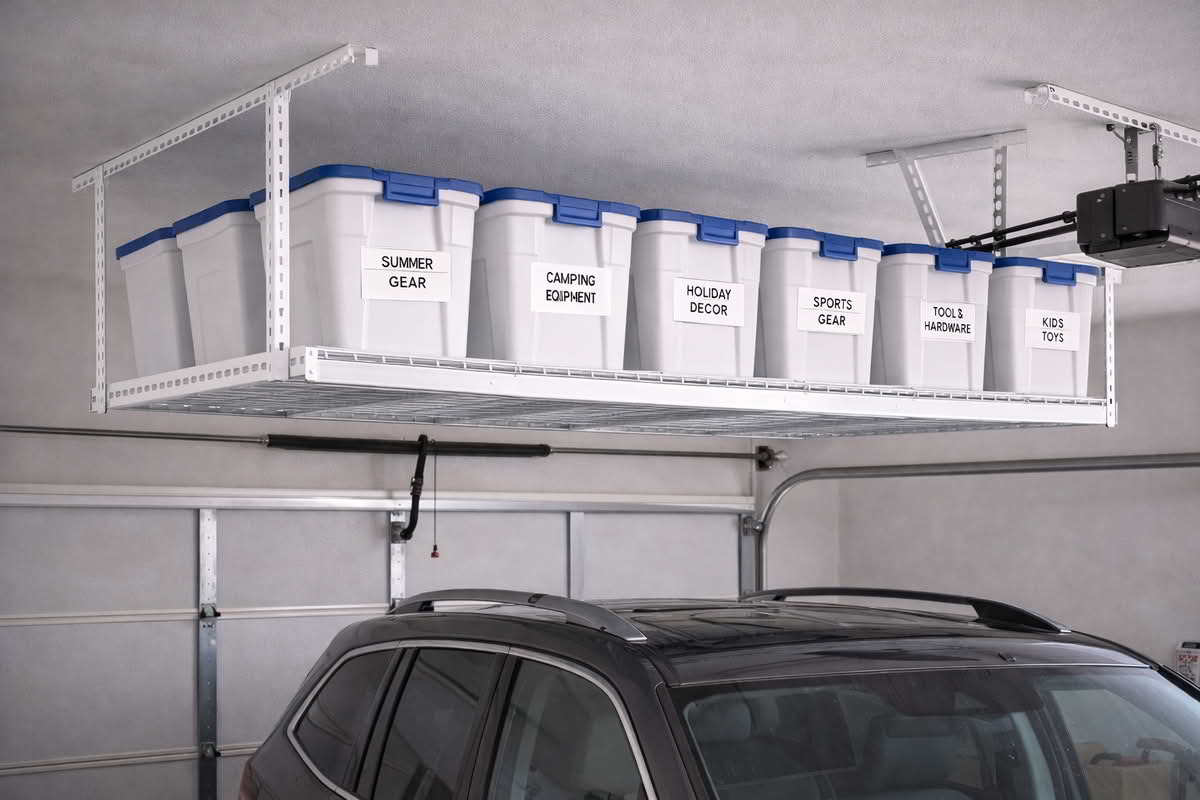
Another overlooked detail is container behavior. Overhead storage works best when what goes up there is compact, predictable, and reasonably easy to lift. Large soft bags, loose piles of materials, or awkward gear that has no stable footprint can make loading and retrieval more difficult than expected. Standardized bins usually create better results because they stack more cleanly, label more clearly, and reduce the temptation to turn the rack into an overhead dumping zone.
Overhead storage is easier to maintain when it holds consistent, labeled bins rather than loose or irregular items that are hard to lift and harder to organize.
This is where many buyers make a subtle but important mistake: they buy based on the largest rack they can fit instead of the most manageable system they can maintain. Bigger is not automatically better when loading is awkward, access requires a ladder, and the storage zone is above valuable floor space. A slightly smaller, better-organized rack often performs better in real life than a larger platform that becomes hard to use and difficult to keep under control.
Access Frequency and Long-Term Logic Determine Whether Overhead Storage Makes Sense
Overhead garage storage only makes sense for the right kinds of items. It is best suited to low-frequency categories: holiday decorations, seasonal sports equipment, camping gear, backup supplies, off-season clothing bins, or project materials that do not need weekly access. Buyers run into problems when they treat overhead storage as a place for frequently used objects simply because the system offers extra space. Every trip to a ladder increases friction, and friction changes whether a system remains organized over time.
This is why category planning matters before purchase. Ask what deserves the inconvenience of overhead access and what does not. If something is used often, heavy to lift, difficult to label, or likely to change location regularly, it probably belongs on shelves, in cabinets, or on wall storage instead. Overhead systems perform best when they hold stable categories with predictable turnover. The less often you need to touch the items, the better the system tends to work.
Safety logic should shape the decision too. Overhead storage asks you to think about more than storage volume. It asks you to think about lifting, reaching, balance, and what happens when containers are moved down from height. That does not rule it out for ordinary households, but it does favor lighter, well-contained loads over dense, difficult, or fragile ones. A bin full of light seasonal décor is a different experience from a bin full of tools, books, or heavy automotive supplies.
Use overhead storage for predictable, lower-frequency categories that do not create constant retrieval friction.
Use consistent containers and clear labels so the system remains manageable even when accessed only a few times each year.
Use other storage types for anything heavy, fragile, or needed often enough that repeated ladder access becomes annoying.
Long-term satisfaction also depends on resisting the urge to let overhead space become invisible clutter. One reason ceiling storage feels efficient is that it removes items from eye level. That benefit can become a weakness if it encourages keeping too many low-value items simply because there is somewhere to put them. Overhead storage is most effective when it supports intentional retention, not when it hides indecision. A good system should store the right things out of the way, not make it easier to postpone sorting.
There is also a broader layout consideration. Overhead racks pair best with other garage storage types that handle more active categories below. Shelving, cabinets, and wall systems do the daily work. Overhead storage handles the slower-moving inventory. When those roles are clear, the garage usually feels more coherent. When overhead storage is asked to solve too many problems, it often becomes an awkward compromise between capacity and accessibility.
In the long run, the best overhead storage choices usually share three traits: they are installed in the right zone, loaded with the right categories, and kept within a realistic comfort margin for both weight and access. That combination makes the ceiling feel like useful reserve space rather than a stressful place to stash items that never really had a home.
Final Recommendations — Choosing Overhead Storage That Adds Capacity Without Adding Hassle
The right overhead garage storage is the system that uses ceiling space intentionally, not aggressively. Buyers generally get the best result when they treat overhead storage as a reserve zone for light-to-moderate, low-frequency items rather than as a universal answer to garage clutter. Capacity matters, but fit, loading logic, and everyday comfort matter more.
Choose ceiling-mounted racks when your garage has genuine vertical margin and you need organized space for seasonal bins or predictable overflow.
Choose adjustable systems when ceiling conditions, vehicle height, or door clearance make fixed drop lengths harder to fit well.
Choose tote-friendly setups when you want clearer labeling, more disciplined storage categories, and cleaner overhead organization.
Choose smaller or more restrained overhead solutions when easy access, safer lifting, and preserved room comfort matter more than maximum platform area.
A low-regret overhead storage decision creates extra capacity without making the garage feel cramped, awkward, or harder to maintain. When the ceiling zone is used for the right items in the right way, overhead storage becomes a useful long-term layer of garage organization instead of a hard-to-reach holding area for future frustration.