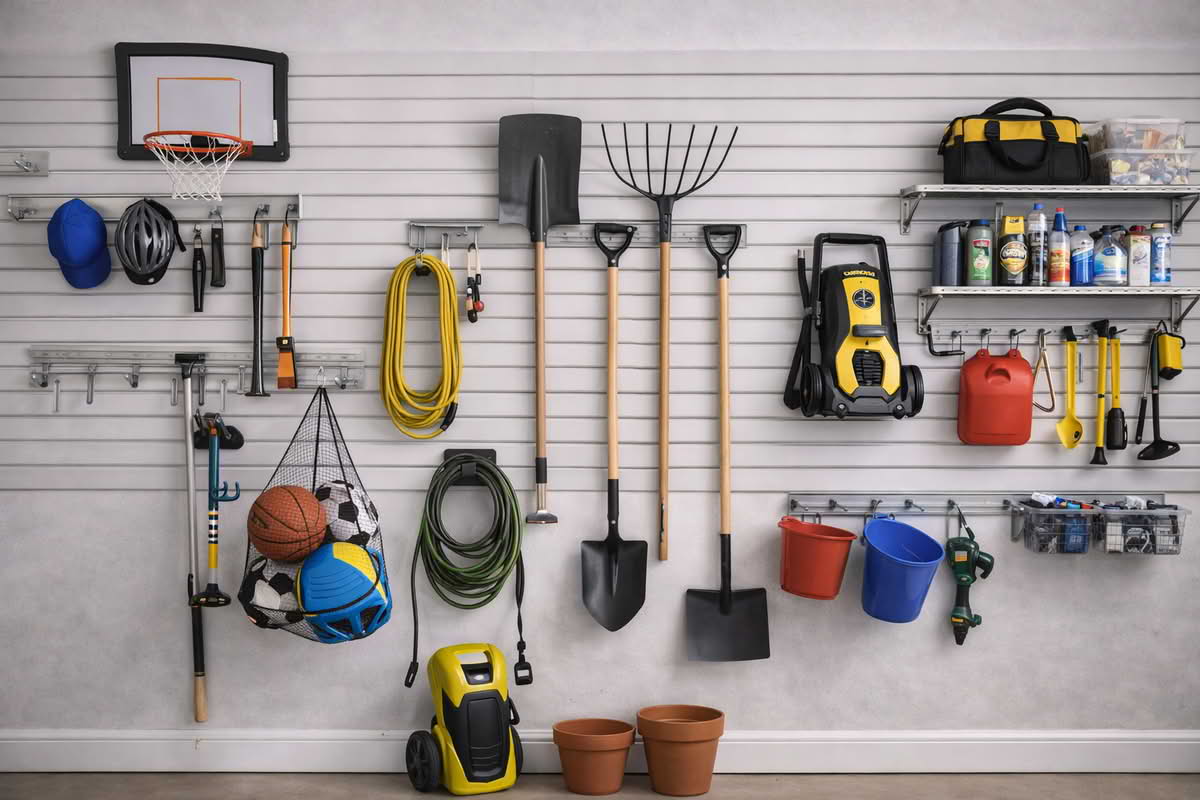
Garage Wall Storage Buying Guide: How to Free Up Floor Space Without Creating Clutter
Garage wall storage often looks like an obvious upgrade because it promises to lift tools, yard gear, sports equipment, and utility items off the floor. The problem is that many systems solve one kind of clutter while creating another. Buyers end up with hooks that only fit a narrow range of items, rails that run out of useful space quickly, or wall panels that look organized at first but become visually chaotic once real household gear starts accumulating. Good wall storage is not just about hanging more things. It is about choosing a system that matches the shape, weight, frequency of use, and awkwardness of the items you actually need to store. The best setup keeps the floor clearer, preserves access, and remains flexible enough to adapt as your garage changes instead of locking you into a rigid arrangement that becomes frustrating within a few months.
System Types and Item Fit Determine Whether Wall Storage Helps
Garage wall storage is not one product category so much as a family of systems that solve different problems. Rails with interchangeable hooks, slatwall panels, individual heavy-duty hooks, and modular rack kits can all work well, but they do not perform the same way once real equipment is involved. The most common buying mistake is choosing a system based on how tidy it looks in a staged photo rather than how it handles ladders, hoses, extension cords, folding chairs, lawn tools, helmets, bags, or oversized sports gear in an active household.
Rail-based systems are often a good middle ground because they allow repositioning without asking you to reinstall everything. They work especially well for long-handled tools and medium-weight categories that benefit from clean spacing. The weakness is that they may become crowded if you try to hang too many different shapes in a short span. What looks modular in theory can feel cramped in practice once handles overlap, hooks interfere with one another, or larger items project farther off the wall than expected.
Slatwall-style systems usually offer the most flexibility and the broadest accessory ecosystem. They can support baskets, shelves, specialized holders, and a more customized storage layout. That adaptability makes them attractive for buyers who want the garage wall to function as an evolving storage zone rather than a fixed row of hooks. The tradeoff is that they can become expensive quickly, and not every household actually needs that much configurability. Some people install an elaborate panel system only to use a small fraction of its capability.
Choose rail systems when you want cleaner linear organization for tools, cords, and commonly used utility gear.
Choose slatwall systems when you need higher flexibility, mixed accessory types, or expect the layout to evolve over time.
Choose simple heavy-duty hooks when you have a few bulky categories to solve rather than a full-wall organization plan.
Item fit matters more than many buyers assume. A wall storage system should be chosen around the actual categories creating floor clutter, not around the abstract idea of “garage organization.” Garden tools hang differently from bicycles. Folding chairs behave differently from leaf blowers. Sports gear often needs a combination of hooks, baskets, and containment rather than one universal hanging solution. Before buying, it helps to identify whether your main problem is long tools, oversized seasonal gear, frequently used grab-and-go items, or mixed household overflow. Different problems justify different wall systems.
Wall storage works best when organized by category and access pattern. Different gear types usually need different supports, spacing, and wall zones to stay manageable.
Another practical issue is projection depth. Some systems keep items relatively close to the wall, while others push them farther into walkways or parking space. This matters more in compact garages, where a wall-mounted solution can technically free the floor while still making the room harder to move through. A clean wall is only helpful if the items on it do not interfere with doors, vehicle clearance, or routine movement.
Weight Support and Installation Quality Matter More Than Accessories
Many garage wall storage disappointments come from installation decisions rather than the storage hardware itself. Buyers often focus on accessory count, hook variety, or modular features while giving too little thought to how the system attaches to the wall and what those walls can realistically support. A well-designed system installed poorly is still a poor result. Garage walls vary widely, and drywall alone is not the same as direct framing support.
Weight ratings should be treated as guidance tied to proper mounting, not as unconditional promises. Long-handled tools and light utility gear are one thing. Loaded shelves, heavy power equipment, or awkward large items generate different stress patterns, especially when they are pulled on frequently or hung unevenly. The more dynamic the use, the more important it becomes to think beyond a static weight number. Repeated loading, tugging, and shifting can expose weaknesses that a simple capacity claim does not explain.
This is why the wall itself matters. Stud spacing, surface condition, and the amount of uninterrupted mounting area can affect what type of system is practical. Some products are forgiving and easy to place across multiple framing points. Others demand more exact layout work and leave less room for adjustment if the wall has obstructions, outlets, trim interruptions, or utility access. A system that looks universal online may fit awkwardly once it meets a real garage wall.
Prioritize secure mounting across appropriate framing support, especially for heavy or frequently handled items.
Be cautious of systems that offer many accessories but limited real support for bulkier categories.
Match the storage system not just to the items, but to the wall conditions where it will actually be installed.
Accessory quality matters too, though not always in the way buyers expect. A large bundle of hooks and attachments can seem like good value, but many households only end up using a few reliable pieces repeatedly. Stronger, better-shaped supports are usually more useful than a broad accessory count. A crowded wall full of mediocre holders can become less functional than a simpler system with fewer, more deliberate mounting points.
It is also smart to think about damage prevention. Tools with metal edges, bikes with pedals, and outdoor equipment with irregular shapes can scratch walls, bang against one another, or become awkward to remove if the spacing is too tight. Good wall storage allows enough room for safe loading and unloading. When every hook is packed tightly together, the system may look efficient but feel irritating in day-to-day use.
Flexibility, Visibility, and Long-Term Use Separate Good Systems From Temporary Fixes
The best garage wall storage systems hold up because they can absorb change. Household gear shifts over time. Children outgrow equipment, tool collections expand, seasonal items rotate, and one storage zone often starts serving a completely different purpose a year later. A rigid layout may look polished at installation, but if the system is difficult to reconfigure, it can become obsolete faster than expected. Flexibility is not just a premium feature. In many garages, it is what prevents a storage system from becoming a decorative failure.
Visibility is another underappreciated factor. Wall storage should make key items easier to see and retrieve, not bury them behind overlapping silhouettes. This is especially important for categories with frequent turnover, such as yard tools, sports equipment, extension cords, or cleaning supplies. If items are hung too closely, blocked by taller gear, or assigned to awkward heights, the wall becomes a clutter display instead of an organizational tool. Good storage reduces visual noise by giving categories clear boundaries.
This is why zoning works well. Instead of thinking in terms of filling wall area, it is usually better to assign specific zones based on use. One section for lawn and garden tools, another for sports gear, another for frequently used household utility items. That approach creates a more maintainable system because items return to predictable places. It also makes it easier to recognize when one category is outgrowing its space and needs adjustment.
Use wall storage for categories that benefit from quick visual recognition and easy grab-and-return access.
Group similar items together rather than mixing tools, recreation gear, and utility supplies across the same small area.
Leave open wall capacity for growth instead of filling every available span immediately.
Long-term satisfaction also depends on choosing the right balance between openness and containment. Wall storage is excellent for active-use gear, but it is not always ideal for every item in the garage. Smaller loose parts, dirty accessories, and visually chaotic categories may still be better handled by bins, cabinets, or shelving. Buyers sometimes expect wall storage to solve the entire garage, when in reality it works best as one layer within a broader storage system. It clears the floor and improves access, but it does not automatically replace every other form of organization.
In that sense, the strongest purchase decisions come from restraint. A good wall storage system solves a defined set of clutter problems cleanly and leaves room for other storage types to do their jobs. It should support how the garage functions, not force every object onto the wall because wall mounting feels efficient in theory. When the balance is right, the space looks calmer, works better, and stays easier to maintain across seasons and changing household needs.
Final Recommendations — Choosing Wall Storage That Creates Order Instead of Visual Noise
The best garage wall storage is the system that matches your gear categories, your wall conditions, and your access patterns without turning the room into a crowded display of hanging objects. Strong results usually come from identifying the items that genuinely benefit from wall mounting and then choosing a system flexible enough to support those categories well over time.
Choose rail-based systems when you want a practical, moderately flexible setup for tools and medium-size household gear.
Choose slatwall systems when you need broader customization, mixed accessory types, and the ability to rework the layout over time.
Choose simpler heavy-duty hooks or rack kits when your main goal is solving a few bulky storage problems efficiently.
Choose systems with installation and spacing in mind, because secure mounting and usable clearance matter more than accessory count.
A low-regret wall storage setup makes the garage easier to move through, easier to maintain, and easier to reset after daily use. When wall storage is selected around real item behavior rather than showroom appearance, it becomes a durable organizing tool instead of another layer of clutter.