Umbrella and Accessory Storage Buying Guide: How to Control Small Entry Clutter Before It Spreads
Small entryway items cause an outsized amount of household clutter because they slip between categories. Umbrellas lean in corners, keys migrate across counters, mail lands on any flat surface, and small grab-and-go accessories never seem important enough to justify a system until the entry starts feeling chaotic every day. Many buyers respond by adding a catchall tray, hook, basket, or umbrella stand without thinking about how moisture, daily traffic, and item variety actually behave near the door. The result can be storage that technically holds the right things but still looks messy, overflows quickly, or turns a narrow entry into a clutter checkpoint. Good umbrella and accessory storage should do more than gather loose items into one place. It should support wet-weather realities, keep essentials easy to find, and fit the scale of the entry so the space feels calmer instead of more crowded. The best choice is usually the one that controls small disorder early before it spreads into the rest of the home.
What Actually Belongs Near the Door Should Shape the Storage Plan
The first mistake in this category is assuming every small loose item in the house deserves a place near the entry. In reality, entry accessory storage works best when it is selective. Items that support leaving and returning, such as keys, wallets, sunglasses, dog-walking supplies, incoming mail, reusable shopping bags, or umbrellas, genuinely benefit from a dedicated landing zone. But when that zone starts absorbing chargers, random receipts, tools, unopened packages, and general household odds and ends, it stops functioning as entry storage and turns into a clutter shelf by the door.
This is why the buying decision should begin with behavior, not with a product. Ask which items repeatedly create friction in the entry. Is the real problem wet umbrellas with no home? Lost keys? Mail stacks? Small items dropped on the nearest table? Different problems call for different solutions. Buyers often purchase a broad “entry organizer” and expect it to solve everything, when the better answer is usually a more focused piece sized around the specific categories that truly belong there.
Use frequency matters too. Keys and wallets need immediate, consistent access. Mail needs short-term sorting, not indefinite residence. Umbrellas may be used seasonally or only during weather events, but when they are needed, their storage has to work quickly and cleanly. This means a good entry accessory system should keep the highest-frequency items easiest to reach while preventing slower-moving or one-off items from taking over the same small area. The more selective the categories, the more effective even simple storage tends to be.
Choose entry accessory storage around the items that truly support daily leaving and returning, not around every loose object that lacks a home.
Choose focused solutions when one small category, such as keys or umbrellas, is the real recurring problem.
Choose layouts that keep the highest-frequency items easiest to reach instead of giving equal space to everything.
Another overlooked issue is household size. A single-person apartment entry may only need a key tray and an umbrella stand. A family entry may need multiple hooks, mail sorting, room for dog leashes, and some method for keeping duplicate small items from blending together. The wrong product often fails not because it is badly made, but because it assumes a simpler entry routine than the household actually has. Small storage categories become surprisingly demanding when several people use the same zone.
There is also a difference between short-term holding and permanent storage. Mail organizers, catchalls, and accessory trays are most useful when they support temporary staging: incoming letters, keys for later, sunglasses until morning, an umbrella drying after use. They are much less useful when asked to become archival storage. Good entry storage should make it obvious what belongs there briefly and what needs to move somewhere else. Otherwise, the organizer itself becomes the reason small clutter never leaves the entry.
Entry accessory storage works best when each category has a clear purpose near the door instead of one catchall area trying to manage everything at once.
Wet Items, Small Items, and Entry Fit Need Different Storage Logic
Umbrellas create a different kind of storage problem than keys or mail because they introduce moisture. That alone changes what kind of organizer makes sense. An umbrella stand has to do more than hold a narrow object upright. It should manage dripping water, tolerate wet use, and sit in a location where a damp umbrella will not create a mess around flooring, walls, or adjacent storage. A decorative stand may look attractive in a dry product photo, but if it lacks practical drip control or is awkward to clean, it may quickly become less appealing in everyday use.
This is one reason umbrella storage often works best as its own category rather than as part of a mixed catchall system. Wet items need separation. When umbrellas share space too closely with paper mail, fabric bags, or small-accessory baskets, the entry becomes harder to maintain. Even a modest dedicated umbrella solution can perform well if it respects moisture management and entry flow. The real question is not whether the household uses umbrellas constantly, but whether the times they are used create enough mess and inconvenience to justify a stable home near the door.
Small-item organizers solve a different problem. Key and mail holders, trays, catchalls, and wall-mounted accessory units are most useful when they reduce searching and surface clutter. But they work only when the compartments match the categories. A tray that is too shallow or too open can become a visual dumping ground. A mail organizer with too many slots may encourage paper buildup instead of short-term sorting. A wall-mounted caddy may save space but feel overbuilt if the entry really only needs one hook and a dish for keys. Good small-item storage is usually narrower in purpose than buyers first think.
Choose dedicated umbrella storage when wet-weather mess is a recurring entry problem, not just when a stand looks like a nice decorative extra.
Choose trays and catchalls for small high-frequency items, but keep their role narrow enough that they do not turn into miniature junk drawers.
Choose the format around the entry's actual stress points, whether that is moisture, mail buildup, or daily key-and-wallet retrieval.
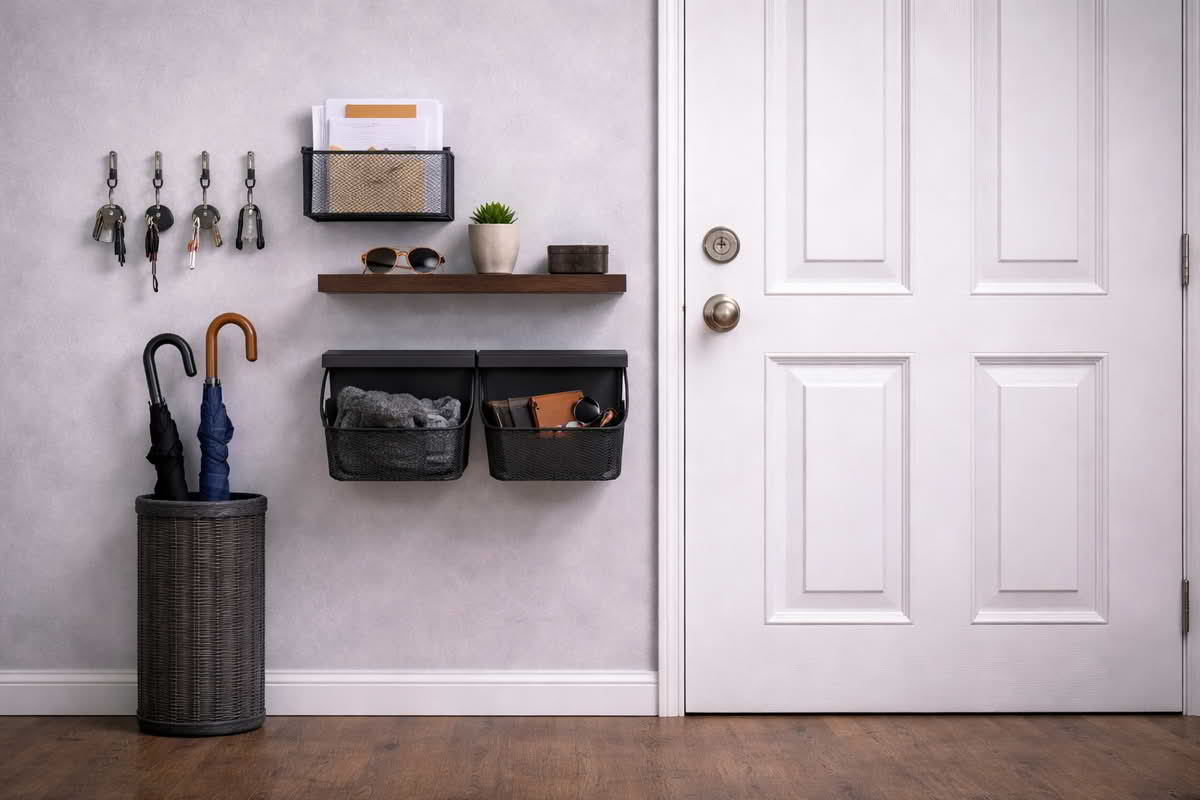
Wall-mounted accessory storage can be especially effective in tighter entries because it lifts small items off already limited horizontal surfaces. A wall organizer with a few hooks, a mail slot, and a shallow shelf can work well when floor and console space are scarce. But these systems should be judged carefully for depth and projection. In narrow hallways, even a small wall unit can feel intrusive if it sits too proud of the wall or encourages overloading with bulky items. Wall storage works best for slim, predictable categories rather than for thick bags or piles of papers.
Compact entry catchalls solve a related but more horizontal problem. They create a landing zone on top of a console, bench, or small shelf and are useful when the household already has a surface but lacks boundaries for small items. The risk is that a catchall can expand from “place for keys and sunglasses” into “place where every loose item waits indefinitely.” That does not make catchalls a bad choice. It means they work best when the tray size itself limits what can accumulate and keeps the category honest.
Fit matters across all of these formats. Entryways are often shallow, narrow, or visually exposed. A storage product that is physically small but badly placed can still make the room feel more crowded. The right solution should support the entry without becoming the first thing people have to navigate around or visually process when walking in. That often means choosing smaller, more specific pieces rather than one oversized all-purpose organizer.
Maintenance, Visibility, and Long-Term Use Matter More Than Decorative Neatness
Entry accessory storage often looks appealing because it promises tidy control over the smallest categories in the home. But small-item storage only stays useful when it remains easy to clean, easy to scan, and easy to reset. This is where many pretty organizers disappoint. A container with too many small sections, delicate materials, or hard-to-clean corners may look refined but become annoying once wet umbrellas, dusty mail, and constantly handled objects start passing through it.
Maintenance matters especially for umbrella storage. Water has to go somewhere, and if the stand or tray does not make that manageable, the burden shifts to the floor and surrounding surfaces. Buyers should think beyond appearance and ask whether the unit can be emptied, wiped, or cleaned without much effort. A practical umbrella stand often succeeds because it handles ugly realities well, not because it disappears visually. The better the moisture control, the more believable the storage becomes during the exact moments it is most needed.
Visibility matters just as much for keys, mail, and daily accessories. If the organizer hides them too completely, people start setting them down elsewhere. If it is too open or too large, it encourages accumulation. The strongest solutions strike a balance: visible enough that important items can be found quickly, limited enough that the storage does not silently expand into a holding area for unrelated clutter. This is why smaller trays, modest wall units, and clearly defined compartments often outperform larger “command center” products that try to anticipate every possible category.
Choose easy-clean materials and simple shapes when the organizer will regularly handle moisture, dust, or repeated daily contact.
Choose enough visibility that essentials are easy to find, but not so much storage volume that the organizer invites category creep.
Choose entry accessory systems that can be reset quickly, because small storage succeeds by making order easy to restore.
Another long-term issue is whether the storage creates good habits or merely hides bad ones. A well-sized key tray encourages keys to land in one place. A modest mail sorter encourages sorting, not stacking. A useful umbrella stand keeps wet items upright and contained until they can dry. But once the organizer gets oversized, overcompartmentalized, or poorly matched to the routine, it can start preserving disorder in a neater-looking form. That is why smaller, tighter systems often age better than larger ones in this category.
Visual calm is still important, especially in entries that open directly into main living areas. Small accessories are visually noisy by nature. The organizer should reduce that noise, not frame it in a more elaborate way. A minimal wall hook and shelf may work better than a large accessory board. A compact umbrella stand may be better than a combined decorative tower that dominates the entry. In many cases, the most successful storage is the least visually assertive piece that still performs the job reliably.
In the long run, good umbrella and accessory storage helps the entry do something difficult: manage the smallest, easiest-to-lose, and often dampest parts of daily coming and going without demanding much attention. When the storage fits the actual categories, stays easy to maintain, and prevents clutter from spreading, it becomes one of those quiet systems that makes the rest of the home work better. When it does not, the entry keeps absorbing small disorder no matter how polished the organizer looks at first.
Final Recommendations — Choosing Entry Accessory Storage That Actually Stays Under Control
The right umbrella and accessory storage is the system that solves the specific small-item problems your entry actually has, without creating one bigger clutter zone in the process. Buyers usually get the best result when they separate wet-item storage from key, mail, and small-accessory storage and keep each solution modest enough to support daily use without encouraging buildup.
Choose umbrella stands when wet-weather storage needs dedicated moisture-tolerant containment near the door.
Choose key and mail organizers when the entry's real problem is small-item drift across consoles, counters, or nearby surfaces.
Choose compact catchalls when you need a controlled landing zone for a few essentials rather than a broad accessory station.
Choose wall-mounted accessory storage when floor and surface space are limited and the categories are light, slim, and predictable.
A low-regret purchase in this category should make small essentials easier to find, easier to dry, and easier to put back where they belong. When moisture control, visibility, and entry fit all align, umbrella and accessory storage stops being decorative filler and becomes real infrastructure for a calmer, more manageable entryway.