Smart Plug Buying Guide for Practical Everyday Home Automation
Smart plugs are often the most sensible first step into home automation because they do not ask much from the house. There is no wiring change, no fixture replacement, and no need to rethink an entire room before you can start using schedules, remote control, or simple routines. That simplicity can also make them easy to buy thoughtlessly. Many people assume a smart plug is just an on-off adapter with an app, but the difference between a useful one and an annoying one usually comes down to what it is controlling, where it is installed, and whether the automation actually fits everyday life. A plug that works well for a lamp may be a poor fit for a heater, a seasonal display, or a crowded outlet behind furniture. This guide focuses on those practical tradeoffs so you can choose smart plugs that solve real household problems without adding clutter, confusion, or unnecessary upkeep.
Start with the device you want to automate, not the smart plug itself
The easiest way to make smart plugs more useful is to stop thinking about them as gadgets and start thinking about them as control points for specific devices. A smart plug does not improve a room by itself. It improves the behavior of something already plugged into that room. That distinction matters because not every appliance, lamp, or seasonal item benefits equally from simple remote power control.
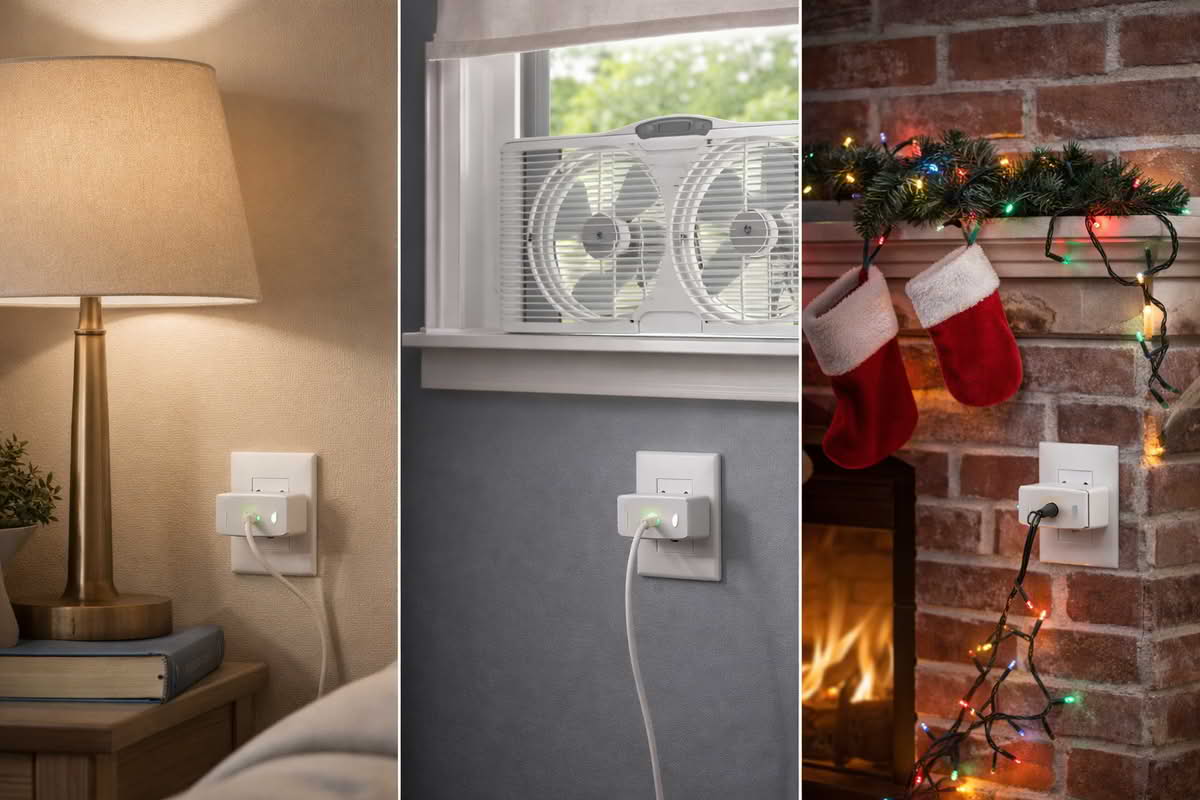
Lamps are one of the clearest use cases because they respond well to scheduling and do not usually create complicated safety or behavior issues. A living room lamp that turns on before sunset, a bedroom lamp that shuts off at a set time, or an entryway lamp that gives a home an occupied look while traveling are all practical examples. In those situations, the smart plug is doing quiet work in the background and reducing a small but repeated friction point.
Fans can also be good candidates, but only when they behave predictably after power is restored. That is a crucial detail buyers often miss. Some appliances resume their prior setting when power returns. Others require a manual button press or reset. A smart plug only works well when the attached device can actually respond usefully to restored power. If the device does not “remember” its state, the automation may be technically functional but practically pointless.
Seasonal lighting is another strong use case because the automation need is simple and recurring. Holiday lights, porch decor, and temporary indoor displays often benefit from schedules more than from voice control or app-based micromanagement. In these cases, a smart plug can save repeated manual effort and make temporary setups feel much more intentional. That is often where smart plugs prove their value most clearly: not through complex automation, but through consistent low-effort timing.
Choose smart plugs for devices that behave predictably when power is turned on and off.
Use them where simple schedules or remote shutoff solve a repeated household inconvenience.
Think of the plug as part of the device’s behavior, not as a standalone smart-home purchase.
Be cautious with appliances that require manual restart or have unclear power-restoration behavior.
This is also where common buyer assumptions fail. People sometimes buy smart plugs with the vague hope that they will “find uses” later. That usually leads to scattered, low-value automation. The better approach is more specific: identify a lamp that should run on a schedule, a coffee corner light that should turn on early, a window fan that should shut off automatically, or a porch display that should not need manual attention every evening. The clearer the problem, the easier it is to judge whether the plug is actually the right solution.
There are also devices that should make buyers pause. Heat-producing appliances, high-draw equipment, and anything with more serious safety implications deserve more scrutiny than a simple lamp or decorative light string. A smart plug is best when it adds convenient control to ordinary household devices, not when it is used to override common-sense limits or automate something that is better left under direct supervision.
Smart plugs are most useful when they are assigned to specific, predictable devices such as lamps, fans, or seasonal lighting that benefit from simple automation.
Energy-monitoring plugs deserve a separate note here. They can be useful when the goal is not just control, but insight into how a device behaves over time. That can matter for home offices, media areas, or certain recurring-use appliances where you actually care about consumption patterns. But energy monitoring is not automatically valuable. Many people think they want detailed usage data, then rarely review it once the novelty fades. It is best treated as a purposeful extra, not a default requirement.
The practical lesson is simple: choose the smart plug only after you understand the device, the outlet location, and the routine you want to create. That sequence usually produces better results than shopping by feature list and hoping the household need will reveal itself later.
Match the plug’s form factor, outlet use, and environment to the room
Once you know what the plug will control, the next decision is physical fit. This is where smart plugs stop being abstract app-controlled devices and become real objects attached to actual walls, furniture, and outlet locations. Shape matters. Plug size matters. Whether the unit blocks a second outlet matters. Whether it sticks out behind a sofa, behind a dresser, or at floor level in a busy walkway matters. These are not minor annoyances. They often determine whether a smart plug feels clean and useful or awkward and temporary.
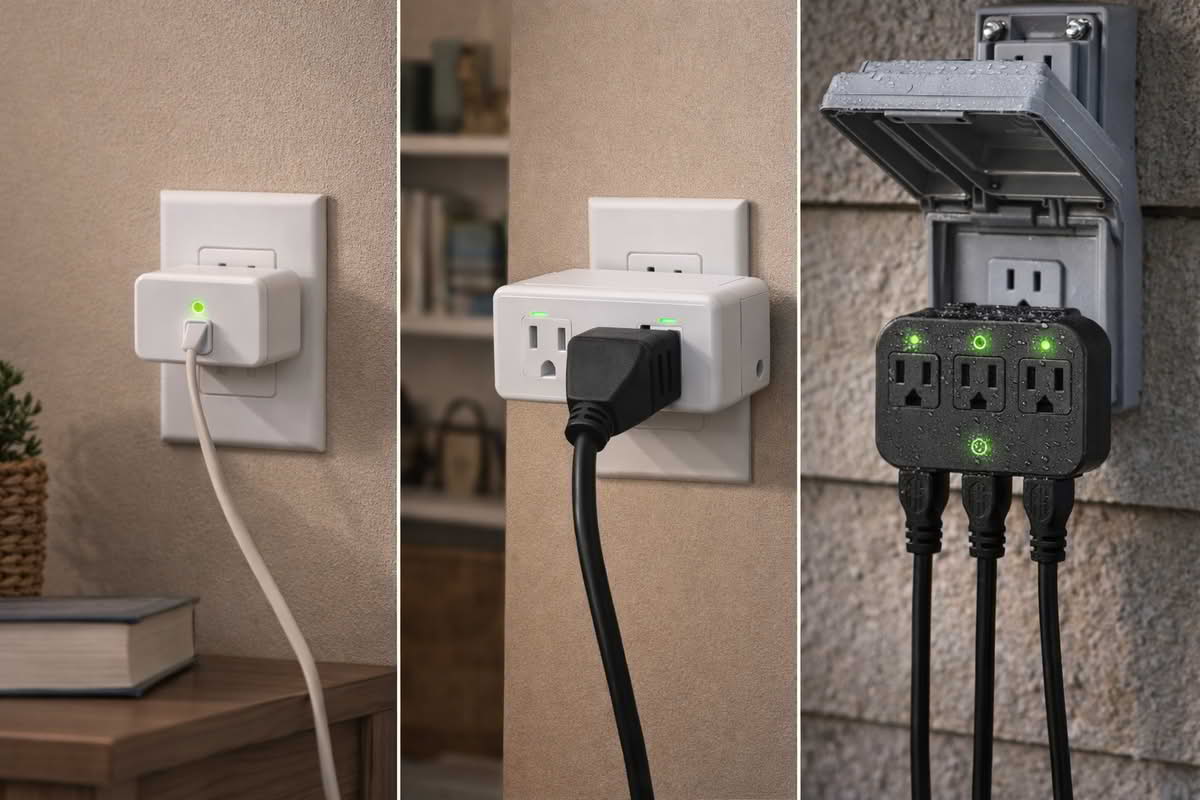
For indoor use, compact single-outlet plugs usually make the most sense when space is limited or when the second outlet in a duplex receptacle still needs to remain usable. In older homes or crowded living rooms, this can be more important than buyers expect. A plug that covers both sockets may work fine in a tucked-away corner, but it can become irritating in a kitchen, office, or media setup where outlet space is already at a premium.
Dual-outlet smart plugs offer a different advantage. They can make sense when one wall outlet needs to manage two simple loads, such as a pair of lamps or seasonal decor on a porch. But the real value depends on whether the two outlets are controlled independently and whether the physical design still fits the space cleanly. A bulky unit that technically offers two smart outlets may not actually be more practical if cords interfere with furniture or if the plug becomes visually obtrusive in a visible room.
Outdoor smart plugs introduce a separate set of considerations. Weather exposure, outlet cover clearance, cord direction, and mounting stability all matter more outside than they do indoors. A plug on a covered porch has a different life than one exposed to blowing rain or used for seasonal yard lighting. Outdoor units should be chosen for genuine outdoor use rather than treated as indoor devices temporarily placed outside for convenience. Exterior power control is one of the strongest smart plug applications, but only when the hardware is suited to that environment from the start.
Choose compact plugs when preserving nearby outlet access matters.
Use dual-outlet models when two loads in the same spot genuinely benefit from shared smart control.
Match outdoor plugs to real exterior conditions, not just to temporary convenience.
Consider furniture placement, outlet crowding, and cord direction before assuming any plug will fit cleanly.
Placement also affects connectivity. Smart plugs often sit low to the ground, behind furniture, or near dense materials that weaken wireless signals. A plug that pairs easily during setup may be less dependable if the outlet is behind a large media cabinet or outside near thick walls. Buyers sometimes blame the smart plug when the deeper issue is that the outlet location is one of the weakest points in the house for network coverage. For single-plug experiments this may be manageable, but for multi-room automation it becomes more important.
Safety and electrical fit should stay in view as well. A smart plug should not turn an already strained outlet into a more crowded one without thought. The added device body, adapter shape, and attached cord all change how the outlet is being used. If a plug is being installed in a busy kitchen area, a garage, or an outdoor location, physical stability matters more than it might in a quiet corner behind a lamp table.
This is one reason smart plugs work best with a modest design mindset. The better setups usually look ordinary. The plug fits the outlet without blocking everything around it, the cord routing stays tidy, and the controlled device behaves predictably. When the installation begins to look improvised or overloaded, the convenience argument starts to weaken.
The right smart plug depends as much on physical fit and outlet placement as it does on app features or automation options.
Room type should guide the decision too. In bedrooms and living rooms, appearance and outlet access may matter most. In garages, utility areas, and exterior zones, durability and stability become more important. In home offices, compact size and dependable connectivity may matter more than anything else because plugs often share crowded power areas with monitors, chargers, and other electronics. A good buying decision accounts for the room, not just the product category.
Focus on dependable routines and low-friction control over novelty
Smart plugs tend to deliver the most lasting value when they automate something quiet and repetitive. That may sound less exciting than advanced smart-home marketing, but it is exactly why they remain useful over time. A lamp that follows a schedule, porch lights that run on a timer, or a fan that shuts off automatically can reduce small repeated tasks without demanding much attention. When a smart plug succeeds, you often stop thinking about it entirely.
This is why app quality and routine stability matter more than extra features. Buyers may be drawn to energy dashboards, layered automations, or extensive platform integrations, but the core question is simpler: does the plug respond reliably, stay easy to understand, and continue doing its job after the first week of setup enthusiasm? If it does, it has probably earned its place. If it requires constant checking, re-pairing, or routine adjustments, the value drops quickly.
Scheduling is usually the strongest feature in this category because it turns ordinary devices into predictable parts of the home’s rhythm. Entry lamps can come on before dusk. Seasonal decor can shut off overnight. A coffee station light can wake up before the household does. These are not dramatic transformations, but they are exactly the sort of low-effort improvements that make a home feel more intentional. The key is not adding more schedules everywhere. It is adding them where they eliminate a repeated manual task.
Prioritize reliable schedules and on-off behavior over complex automation that is unlikely to be used consistently.
Use smart plugs for routines that save repeated effort rather than for automation that exists only because it can.
Choose energy monitoring only when you have a real reason to care about the usage data.
Expand gradually so you can see which automations actually hold their value in daily life.
Voice control can be helpful, especially for lamps and hard-to-reach outlets, but it should be treated as a convenience layer rather than the entire point of the purchase. The strongest smart plug setups still make sense even if voice commands are rarely used. Likewise, app-based remote control is valuable when you are away or when the outlet is inconvenient, but it becomes less compelling if that remote control is the only benefit. The most durable use cases are usually the ones where the plug handles timing or routine automatically and does not need much attention afterward.
There is also a temptation to use smart plugs as a universal answer to smart-home indecision. Someone may be unsure whether to buy smart bulbs, switches, or more permanent controls, so they start scattering smart plugs around the house instead. That can work temporarily, but it often produces a patchwork system with inconsistent logic. A smart plug is strongest when it solves a device-level problem. It is weaker when it is used as a substitute for better room-level planning.
Long-term ownership is generally easy, but not entirely effortless. Software changes, network updates, moved furniture, and changing household routines all affect whether a plug continues to make sense. A seasonal lighting plug may be perfect in one season and unnecessary the rest of the year. A plug controlling a lamp may lose value if the room is redesigned. That is normal. The goal is not to make every plug permanent. The goal is to choose plugs whose value is clear enough that they remain worth keeping in the setup.
The best buying mindset is restrained and practical. Choose smart plugs where a simple power schedule or remote toggle noticeably improves the way a device fits into the home. Ignore the urge to automate everything just because it is possible. The category is at its best when it solves small real problems cleanly, not when it tries to simulate a much larger smart-home strategy on its own.
Final Recommendations — choosing smart plugs that quietly improve everyday routines
The best smart plug is usually the one attached to a device that genuinely benefits from predictable on-off control, not the one with the most features. Start by identifying a specific lamp, fan, or seasonal setup that would be more useful with schedules or remote access, then choose a plug shape and category that fit the outlet location and environment.
Choose compact indoor smart plugs for lamps, small appliances, and room setups where outlet space is limited.
Choose outdoor smart plugs for porch lighting, seasonal displays, and exterior devices that need weather-appropriate automation.
Choose dual-outlet or energy-monitoring models only when those added functions clearly support the use case.
Prioritize dependable schedules, clean physical fit, and simple everyday control over novelty features you are unlikely to use later.
In the long run, the lowest-regret smart plug setup is the one that disappears into the household routine and keeps doing a small job well. Good smart plugs do not need to feel dramatic. They just need to make ordinary devices easier to live with, one outlet at a time.