Outdoor Security Camera Buying Guide for Practical Home Monitoring
Outdoor cameras are easy to buy badly because the marketing usually highlights video resolution, app convenience, and broad claims about protection, while the real frustrations show up later. A camera that looks impressive on a product page may send constant false alerts, miss the area you actually care about, struggle at night, or become annoying to recharge once everyday life gets busy. The better choice usually comes from thinking through entry points, power source, weather exposure, mounting height, and how often you want to review footage. For most households, the goal is not building a complex surveillance setup. It is creating a system that is dependable enough to check the driveway, front walk, side gate, or back patio without producing constant friction. This guide focuses on those practical decisions, so you can choose an outdoor security camera setup that stays useful after the novelty wears off.
Start with coverage and placement, not camera specs
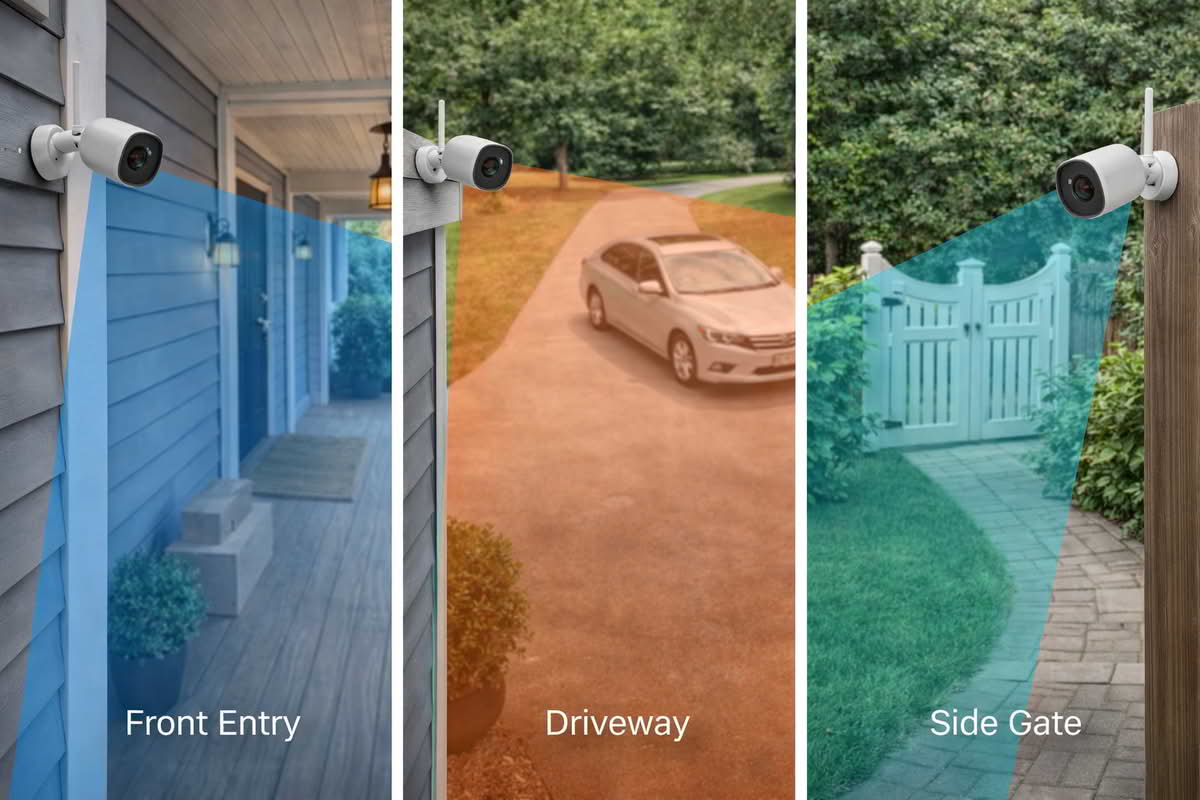
Many buyers begin with headline specs such as resolution or a quoted viewing angle, but outdoor camera performance is shaped more by placement discipline than by spec-sheet ambition. The first question is not whether you want a sharper image. It is which real-world zone you need to understand quickly: the front door approach, the driveway, the garage side path, a fence gate, or a backyard access point. Once that zone is clear, the camera type becomes easier to narrow down.
A common mistake is trying to make one camera watch too much space. Wide fields of view can look reassuring in product descriptions, but the broader the scene, the smaller people and objects become in the frame. That matters when you want to distinguish a delivery from a passerby, see where someone entered the property, or understand whether a motion event is meaningful. In many homes, two modestly targeted cameras provide more useful coverage than one camera pointed across a broad yard.
Mounting height matters just as much. Cameras mounted too high often capture the tops of heads and a lot of sky, while cameras mounted too low can be easier to tamper with and may trigger on close-range movement that is not actually important. In practice, the best mounting position is usually one that balances recognizability, weather protection, and a stable view of a specific path of travel. You want the camera to see where motion begins, not just where it disappears.
Use entry paths and choke points as your first planning reference.
Prioritize useful framing over maximum advertised viewing angle.
Think in zones: front approach, package area, driveway, side yard, back entry.
Assume that trees, parked cars, porch columns, and eaves will shape real coverage.
Night performance should also be judged by context, not by abstract promises. A front porch with a fixture light behaves differently from a dark side yard, and a driveway with street spill light behaves differently from a fenced backyard. Some outdoor cameras perform well with modest ambient light but lose clarity when the scene is fully dark. Others rely heavily on spotlights or bright LEDs to make nighttime footage more informative. That can be useful, but it also changes how visible the camera is and whether you want light activation every time motion is detected.
Mapping specific outdoor coverage zones usually leads to better results than choosing a camera based only on resolution or marketing features.
Weather exposure is another area where buying assumptions often fail. “Weather-resistant” does not mean equally suited to every location around a house. A camera under a covered porch may live an easy life. A camera facing blowing rain, intense afternoon sun, or winter temperature swings is dealing with a much harsher environment. If you are installing cameras in exposed positions, durability and stable mounting become more important than feature extras that sound impressive but add little to daily use.
Finally, think about what the camera should help you decide after an alert appears. Do you want to confirm whether someone is at the door, whether a package was delivered, whether a person crossed a gate line, or whether an animal triggered motion in the yard? A camera is only as useful as the decision it helps you make. When you define that decision clearly, placement, lens style, and lighting needs usually become much easier to judge.
Choose a power and recording setup you can live with
The biggest long-term difference between outdoor camera systems is often not image quality. It is the combination of power source and recording method. That combination determines whether the system feels nearly invisible in daily life or becomes another household task that quietly stops getting done.
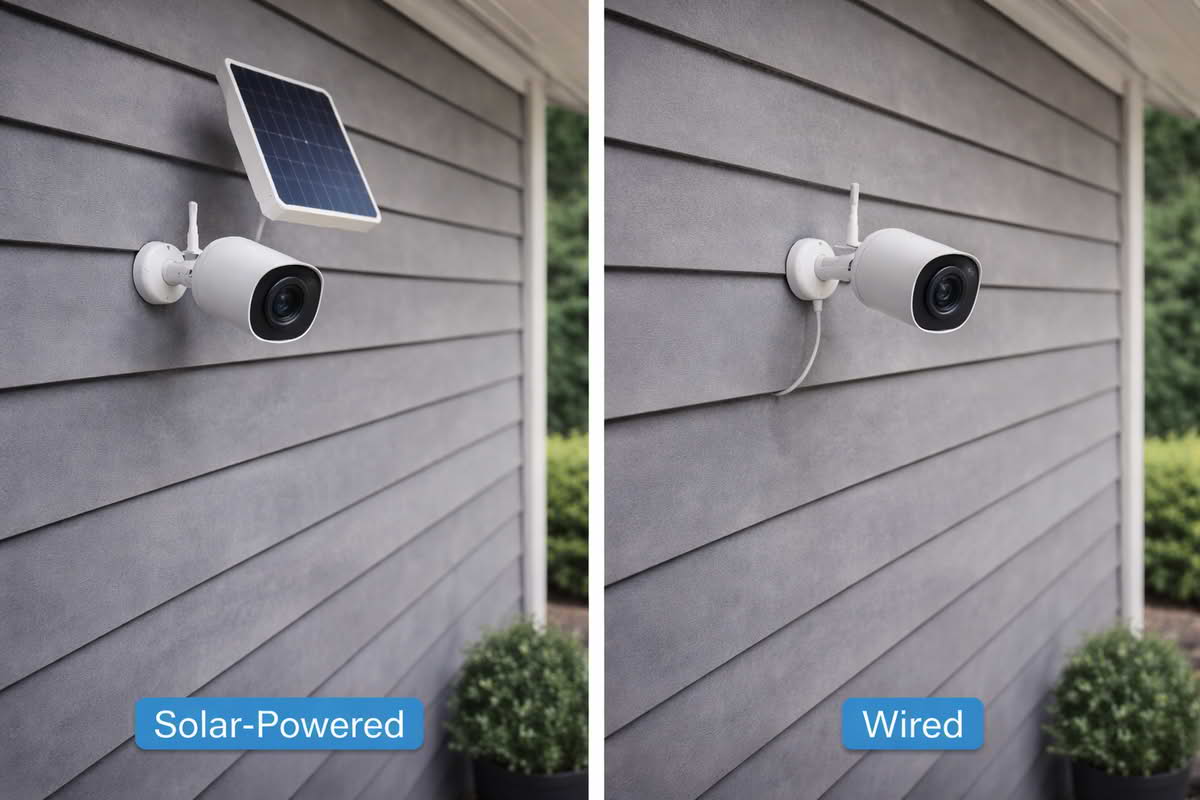
Battery-powered outdoor cameras appeal to many homeowners because installation is easier and placement is more flexible. They are often the fastest path to basic coverage at the front door, on a detached garage, or along a fence line where running wiring would be inconvenient. For renters or for households that want minimal installation disruption, that flexibility can be the deciding factor. The tradeoff is maintenance. Recharge cycles, cold-weather battery behavior, and heavier motion activity can all reduce convenience. A battery camera in a high-traffic location may create more upkeep than the buyer expected.
Wired cameras usually demand more planning up front, but they tend to reduce long-term friction. Permanent power is especially valuable for locations that see frequent motion, such as a front walk, street-facing driveway, or active side entrance. If you know a camera will be triggered often, relying on a rechargeable battery can become tiresome. Wired setups also tend to support more continuous behavior, whether that means steadier responsiveness, more consistent event capture, or broader recording options depending on the system design.
Recording philosophy matters just as much as power. Some buyers are comfortable with event-based recording stored in the cloud because it is simple and familiar. Others want local storage to reduce ongoing costs or to keep footage handling closer to home. Neither approach is universally correct. The better fit depends on how much footage you expect to review, how much you value off-site access, and how comfortable you are with subscriptions, storage limits, or managing local hardware.
Battery-powered cameras favor quick installation and flexible placement.
Wired cameras favor lower maintenance in high-activity zones.
Cloud recording simplifies access but may introduce recurring costs.
Local storage can reduce dependence on subscriptions but may add setup complexity.
It is also worth thinking through what happens during missed events. Systems that wake on motion can perform very differently from systems designed for fuller ongoing awareness. A package drop on a quiet porch is different from activity at the edge of a driveway, where motion may begin farther away and move quickly. If event timing is central to your use case, do not assume all cameras react the same way just because they share similar marketing language.
Internet reliability should be part of the decision too. A household with strong, stable Wi-Fi at the exact outdoor mounting location has more flexibility than a house with weak signal near exterior walls or detached structures. Buying a camera before checking signal strength at the actual install point can lead to a frustrating half-solution: the app works indoors, but the outdoor feed becomes inconsistent where you need it most. In larger properties, improving network coverage may be just as important as choosing the camera itself.
The practical difference between outdoor camera setups often comes down to long-term power and recording habits, not headline features.
Storage retention is another overlooked factor. Some people only need to review recent motion clips. Others want a longer lookback window for deliveries, recurring disturbances, or property issues that are noticed later. It helps to decide in advance whether you want a quick-check convenience tool or a more complete home monitoring record. Systems built around those two goals can look similar at first but feel very different after a few months of use.
The most durable purchase is usually the one that fits your tolerance for upkeep. If you dislike recurring subscriptions, frequent charging, or troubleshooting separate devices, keep the system simpler even if that means giving up some advanced features. A slightly less ambitious setup that stays active is usually more valuable than a feature-heavy one that becomes annoying to maintain.
Look past app features to long-term ownership quality
Outdoor cameras are often sold through convenience features: smart alerts, people detection, package detection, spotlight automations, two-way talk, and app integrations. Those features can be useful, but they are only helpful when the underlying system is calm enough to live with. The daily quality of ownership comes from alert accuracy, app speed, clip review clarity, and how easy it is to understand what happened without scrolling through noise.
False alerts are one of the fastest ways a good-looking camera becomes ignored. A system that triggers constantly from trees, shadows, passing cars, or harmless street movement gradually trains the household to dismiss notifications. That means the decision is not just whether a camera can send alerts, but whether it can be tuned in a way that matches your property. Motion zones, sensitivity controls, activity scheduling, and the quality of detection categories all matter because they determine whether alerts remain believable.
Two-way audio is another feature worth framing realistically. It can be useful for a front door interaction or for speaking to someone near an entry, but it is rarely the deciding reason a camera works well. Buyers sometimes overvalue conversational features and undervalue simpler questions such as how fast the live view opens, whether recorded clips are easy to scrub, or how quickly you can tell if an event needs attention. The practical quality of the app usually matters more than the existence of one flashy capability.
Integration with the rest of the home should be considered, but not romanticized. If you already use a smart display, voice assistant, or a larger security ecosystem, staying within that environment can reduce friction. On the other hand, choosing a weaker camera simply because it belongs to a familiar platform can create avoidable compromises. Good integration is helpful when it supports the camera’s job, not when it distracts from it.
Alert quality matters more than alert quantity.
Fast clip review is often more valuable than a longer feature list.
Motion tuning should match the property, not just the product defaults.
A camera that becomes easy to ignore is not solving the original problem.
Long-term ownership also includes privacy and household comfort. Some families want visible deterrence at the front of the home, while others prefer discreet coverage in less obvious positions. Neighbors, shared boundaries, sidewalks, and apartment-style exterior conditions can all influence placement choices. A camera should monitor your property purposefully, not create unnecessary uncertainty about what it is capturing.
Maintenance routines deserve attention too. Exterior lenses get dirty. Spider webs appear. Seasonal light changes affect detection. Battery units need charging discipline. Mounts may need occasional adjustment after storms or heat cycles. None of this is dramatic, but it is exactly the kind of slow ownership reality that separates a system that stays useful from one that gradually degrades. The more exposed and active the location, the more valuable it is to choose equipment that is physically easy to reach, clean, and maintain.
It is also smart to think beyond the first camera. Many homeowners begin with one outdoor unit and later add a second or third when they understand the blind spots better. A camera platform should make that growth reasonably straightforward. That does not mean buying the most expandable system on the market by default. It means avoiding a dead-end choice that becomes awkward once you want coordinated coverage for the front, side, and rear of the property.
The best buying mindset is usually modest and specific: identify the two or three most important outdoor areas, choose a power and storage approach you can maintain, and prioritize clean daily usability over feature inflation. Outdoor security cameras are most helpful when they reduce uncertainty with minimal effort. The more a system depends on constant attention, perfect tuning, or repeated upkeep, the less likely it is to remain valuable over time.
Final Recommendations — choosing a low-friction setup for your home
The right outdoor security camera is usually the one that matches your property layout and your tolerance for maintenance, rather than the one with the longest feature list. Start by identifying the entry points that actually matter, then work backward into placement, power, network strength, and recording method. That process leads to more durable decisions than starting with resolution or branding.
Choose battery-powered cameras when installation flexibility matters most and motion volume is relatively manageable.
Choose wired cameras when the location is busy, important, or inconvenient to recharge regularly.
Prefer focused camera coverage over trying to watch the whole property with one wide-angle device.
Value alert accuracy, app usability, and recording logic above novelty features that sound impressive but add daily friction.
In the long run, the lowest-regret setup is usually simple, well-placed, and easy to maintain. A camera system does not need to feel advanced to be genuinely useful. It needs to capture the right spaces, stay reliable through normal life, and remain calm enough that you keep paying attention to it when it matters.