Wi-Fi Extender Buying Guide for Solving Practical Home Dead Zones
Wi-Fi extenders appeal to buyers because they promise a fast, inexpensive fix for one of the most annoying household problems: a room that almost works. The bedroom at the far end of the hall streams unreliably, the patio camera drops in and out, the garage speaker hesitates, or the office in the back corner always feels one step behind the rest of the house. In the right situation, an extender can be a practical solution. In the wrong one, it becomes an awkward patch that spreads weak signal farther without truly improving the experience. That is why extenders need to be chosen more carefully than their packaging suggests. The real decision is not whether you want more Wi-Fi in one room. It is whether the weakness is narrow enough that an extender makes sense, where it can be placed, and whether the household is trying to solve a single dead zone or a larger networking problem that needs a different approach. This guide focuses on those practical tradeoffs so you can choose an extender that fits the home’s weak spots without creating a more fragile network everywhere else.
Start by deciding whether you truly need an extender instead of a better router or mesh system
The most important extender decision happens before you compare speeds, antennas, or setup steps. It is deciding whether the home actually has an extender-shaped problem. Buyers often reach for extenders because they are inexpensive and easy to imagine: just plug one in near the bad room and the problem goes away. But extenders work best when the weakness is specific and limited. If the home has multiple poor signal areas, inconsistent performance across floors, or a router that is already overwhelmed, an extender may only disguise the problem rather than solve it.
Extenders make the most sense when the house is mostly fine except for one stubborn area. This might be a bedroom at the far end of the floor plan, a back office separated by dense walls, a garage-adjacent room, or a patio where a camera or speaker struggles. In these cases, the main network may already be good enough in most rooms. The issue is that one location sits just far enough beyond reliable coverage that devices there feel frustratingly inconsistent. That is exactly the kind of narrow problem extenders were made for.
The trouble starts when buyers use extenders to fix homes that really need broader change. If the router is old, underpowered, or poorly placed, or if several rooms have weak signal, the extender is not adding strong coverage so much as repeating a weak foundation. That can create a network that technically reaches farther but still feels unstable. A better router or a mesh system is often the cleaner answer when the home’s layout or device load has outgrown a simple patch.
Choose an extender when the home is mostly well covered and one or two areas remain the clear problem.
Avoid using an extender as the first answer to a house with several weak rooms or whole-home instability.
Think about whether the issue is a specific dead zone or a router that is no longer serving the home well.
Treat an extender as a targeted repair tool, not as a substitute for a stronger network foundation.
This is especially important in smart-home households because connected devices often reveal weak zones more sharply than phones or laptops do. A front porch camera, garage controller, patio speaker, or far-bedroom smart display may fail more often than browsing on a nearby couch would suggest. That does not automatically mean the whole house needs mesh. It may simply mean one device cluster lives in the wrong place relative to the router. In those cases, an extender can be very practical. But if several camera and speaker zones are struggling in different parts of the home, a larger network redesign is usually the better investment.
Another useful question is whether the weak zone is temporary or structural. A temporary office in a spare room, a seasonal patio use case, or a recently added device cluster may justify a smaller targeted fix. A long-term household pattern of weak coverage across important daily-use rooms suggests the home may need something more permanent. The safer buying mindset is to match the solution to the scale of the weakness, not just to the cheapest available product category.
Wi-Fi extenders are most useful when the network is already solid in most of the home and only one specific dead zone needs a targeted boost.
Buyers also sometimes confuse weak Wi-Fi with slow internet service generally. An extender can improve wireless reach inside the home, but it cannot fix every provider bottleneck or overloaded plan. If the house feels slow even near the router, the problem may be upstream. If the house feels good near the router but drops sharply in one room, the extender becomes much more plausible as the right kind of fix.
The safest starting point is to map where the network actually fails. If the answer is one clear edge or one predictable trouble room, an extender may be a sensible and cost-effective solution. If the answer is “kind of everywhere,” it usually is not.
Match extender type and placement to the shape of the weak zone, not just the room with the problem
Once you know an extender makes sense, the next crucial decision is placement. This is where many extender purchases disappoint. The most common mistake is plugging the extender into the room that already has weak signal and expecting it to create strength from nothing. But an extender can only work with the signal it receives. If it sits in a dead zone, it has very little worth extending. That is why placement matters as much as the extender itself.
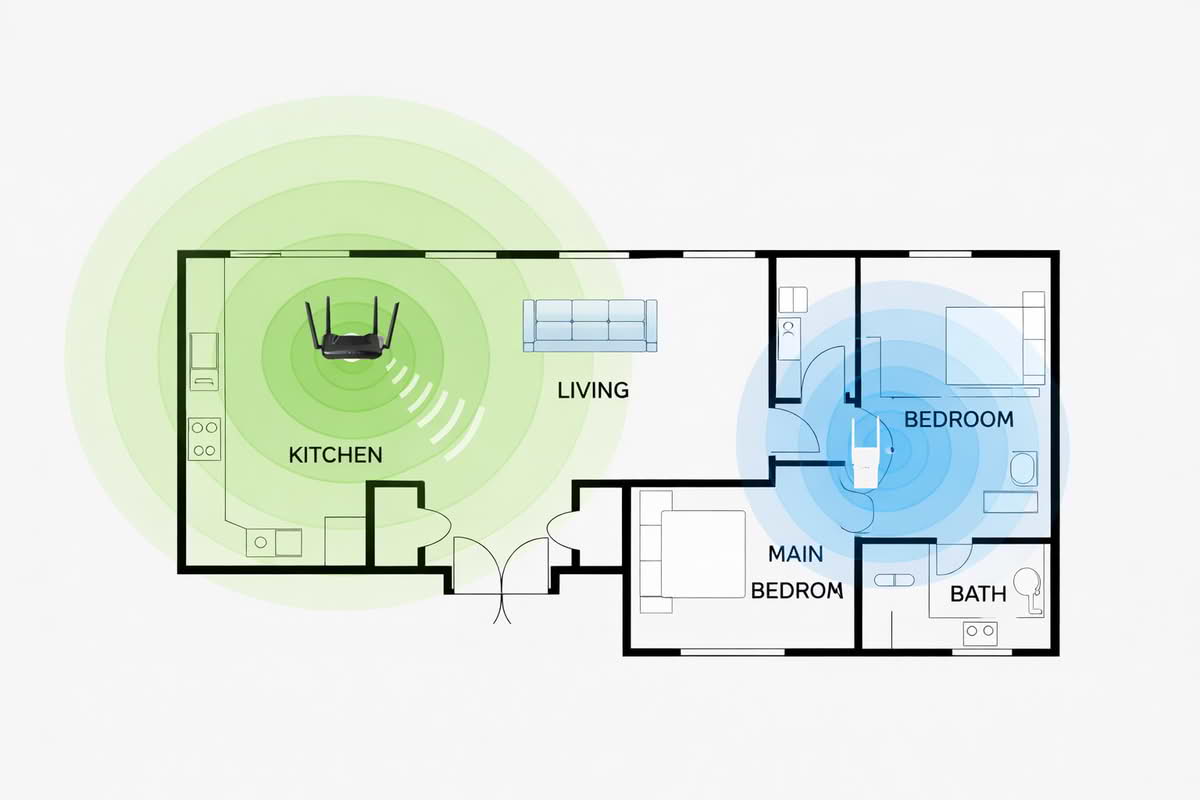
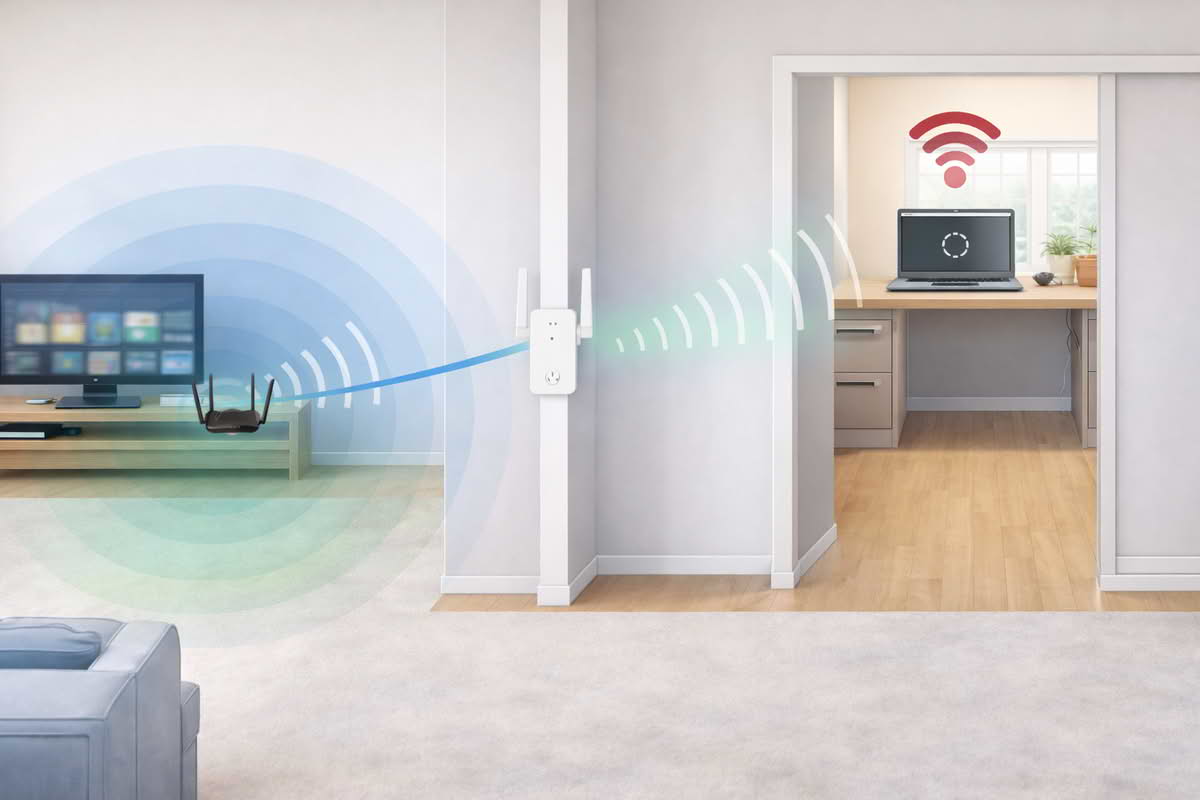
In most homes, the extender belongs partway between the main router and the weak room. It needs enough signal from the router to build on, while still being close enough to the problem area to improve conditions there. This often means hallways, intermediate rooms, stair landings, or outlets just before signal quality begins to fall off sharply. Buyers who think in terms of “the bad room” rather than “the path to the bad room” often miss this and end up with disappointing results.
Plug-in range extenders are appealing because they are simple and compact. They make the most sense when the weak zone is modest and the house offers a convenient intermediate outlet in a good position. Their strength is ease, not depth. They can be a very good fit for one upstairs bedroom, one office corner, or one smart-home device zone near the edge of coverage. But their practicality depends heavily on whether the outlet location is actually useful for signal handoff rather than just physically nearby.
Dual-band extenders can make more sense when the household is asking a little more from the fix, such as supporting video calls, streaming, or several devices in the weak area. Their value is not just more technical complexity. It is often steadier behavior in homes where the weak zone still needs to handle meaningful daily use. That said, buyers should still resist turning the extender into a proxy for a full network redesign. An extender is strongest when it solves one coverage gap well.
Place the extender where it still receives solid signal, not in the weakest part of the problem room.
Think about the path from router to weak zone instead of treating the dead zone as the placement target.
Choose simple plug-in extenders for modest coverage problems with clear intermediate placement options.
Choose stronger dual-band or combo-style units when the weak zone still needs meaningful daily network performance.
Extender-and-access-point combos deserve attention when the house gives you a more structured option. In some homes, especially where there is a useful wired connection or a more deliberate room setup, these hybrid-style devices can make sense because they give you flexibility beyond simple repeating. They are not automatically necessary, but they can be helpful when the weak zone is important enough that you want a more stable arrangement than the most basic plug-in fix.
Home shape matters here as much as room count. A long rectangular house, a home with thick interior walls, a garage separation, or an upstairs corner room all shape signal travel differently. A good extender choice comes from imagining the signal moving through the home rather than assuming the room itself is the only thing that matters. The more obstacles and turns the signal faces, the more valuable thoughtful placement becomes.
Extenders work best when placed along the signal path to the weak room, not when plugged directly into the dead zone itself.
Smart-home device clusters add another layer. A camera at the front edge of the property, a garage controller, or a cluster of devices in a home office may need only modest bandwidth but strong consistency. In those cases, the best extender placement may not be where a person wants stronger browsing. It may be where the device cluster needs steadier connection. That is why room-use thinking should include both people and background devices.
The better buying mindset is to choose an extender and placement plan together. The product alone does not solve the problem. The product in the right halfway position does. That distinction is what separates useful extender setups from ones that feel like they never fully deliver.
Judge extenders by everyday reliability and simplicity, not just by the promise of more coverage
Extenders are often sold through the language of reaching farther, but range alone is not the goal. What matters is whether the weak room becomes reliably usable for the tasks that matter. A slightly stronger but still unstable signal is rarely satisfying. Buyers should therefore judge extenders less by what they promise in theory and more by whether they make the room feel calm and dependable in daily life.
Setup simplicity matters a great deal in this category because extenders are often chosen precisely to avoid a more involved networking project. The setup experience should be understandable enough that the household can place the unit, connect it properly, and know whether it is doing its job without becoming a full-time network troubleshooter. If the extender turns every weak-room problem into another series of small adjustments and second-guesses, the value of the cheaper solution starts to fade.
Everyday reliability matters more than headline speed. A home office extender should support stable calls and ordinary work without random dropouts. A bedroom extender should make streaming and browsing feel normal rather than just slightly less bad. A smart-home extender zone should keep cameras, speakers, or other edge devices connected consistently. These are modest goals, but they are exactly what make an extender purchase feel worthwhile. It does not need to transform the room into the fastest place in the house. It needs to make the weak area stop feeling like a problem.
Easy-setup extenders often have real value here because many households are not trying to build a perfect network. They are trying to remove one repeated frustration. If the home’s networking needs are otherwise modest, clear setup and understandable status indicators may provide more practical value than a more advanced extender that looks stronger on paper but is harder to position and manage confidently.
Prioritize steady everyday room usability over the biggest range claims.
Choose extenders with setup and status feedback that make placement mistakes easier to catch.
Judge success by whether calls, streaming, and smart devices become reliable enough to stop noticing them.
Remember that a good extender is solving a local problem, not turning the home into a whole new network class.
Long-term value also depends on whether the extender keeps the network simple. Some households tolerate the added device because the benefit is clear. Others eventually realize the weak room has become more important, device count has increased, or the household has added enough smart-home hardware that the network is outgrowing patch-style fixes. That is not a failure of the extender. It simply means the household’s needs have changed. The best extender purchases are often honest about that from the beginning: this is a targeted fix, not the final answer to every future networking demand.
Another quiet factor is room expectations. If the extended area is mainly for casual browsing, smart speakers, or light streaming, an extender can feel perfectly adequate. If the room becomes a full-time office, gaming space, or high-demand media zone, the standards rise. Buyers should be realistic about that trajectory. A targeted solution is most satisfying when it is asked to do a targeted job.
The lowest-regret buying mindset is to choose the simplest extender that fully solves the specific dead zone you have today, while staying honest about whether the home may soon need something broader. In some homes, that means a compact plug-in extender placed well in a hallway. In others, it means a stronger dual-band or combo device for a more important edge room. Either way, daily calm matters more than spec-sheet drama.
A good extender purchase should feel almost invisible after setup. The weak room becomes workable, the edge device stops dropping off, and the household stops thinking about that one bad corner of the home. That quiet improvement is a much stronger sign of success than any dramatic marketing language about coverage area or speed class.
Final Recommendations — choosing an extender that fixes the right problem cleanly
The right Wi-Fi extender is usually the one that fits a clear, limited weak-zone problem and can be placed in a sensible signal path between the router and the room that struggles. Start by confirming that the home is mostly well covered already, then choose the extender type that matches how important the weak area is and how demanding its devices really are.
Choose plug-in range extenders when the goal is a simple affordable fix for one modest dead zone.
Choose dual-band extenders when the weak room still needs steadier support for streaming, calls, or several active devices.
Choose extender-and-access-point combos when the room matters enough to justify a more structured connectivity fix.
Prioritize placement quality, reliable room performance, and simple management over the biggest advertised coverage claims.
In the long run, the best extender is the one that makes one frustrating corner of the home feel normal again without complicating the rest of the network. It should solve a targeted problem cleanly, support the devices that live there, and leave the household with less reason to think about Wi-Fi at all.