How to Choose a Frying Pan or Skillet for Everyday Cooking
Few kitchen tools get used more often than a frying pan or skillet, which is exactly why a bad one becomes irritating so quickly. Buyers often focus on surface claims, brand reputation, or broad material categories without thinking through how the pan will actually be used night after night. A pan that seems impressive in a product listing can feel too heavy, too sticky, too small, or too fragile once it is cooking eggs on a weekday morning or searing vegetables after work. The better decision is usually not about buying the most advanced pan. It is about matching heat behavior, weight, size, and maintenance demands to real cooking habits. A well-chosen pan tends to disappear into the routine. A poorly chosen one keeps reminding you that it was the wrong fit.
Start with how you cook
The most useful way to shop for a frying pan or skillet is to ignore the finish for a moment and start with cooking patterns. Many buyers jump straight to material because that feels like the expert part of the decision, but daily use is shaped first by what actually goes into the pan. A household that mostly cooks eggs, reheats leftovers, and makes quick weeknight vegetables needs something different from a household that browns meat, finishes dishes in the oven, and uses high heat regularly. Both may need a skillet, but not the same one.
This is where many low-quality decisions begin. Shoppers buy for the idealized version of their kitchen life rather than the repetitive version. A pan that is technically excellent for hard searing may be frustrating if most meals are quick, delicate, and cleanup-sensitive. On the other hand, a pan designed around easy release may feel limiting if cooking habits expand into browning, pan sauces, or higher-heat techniques. Before comparing options, it helps to identify the pan's real job. Is it the daily breakfast pan, the main dinner pan, the pan for fast cleanup, or the pan expected to handle almost everything?
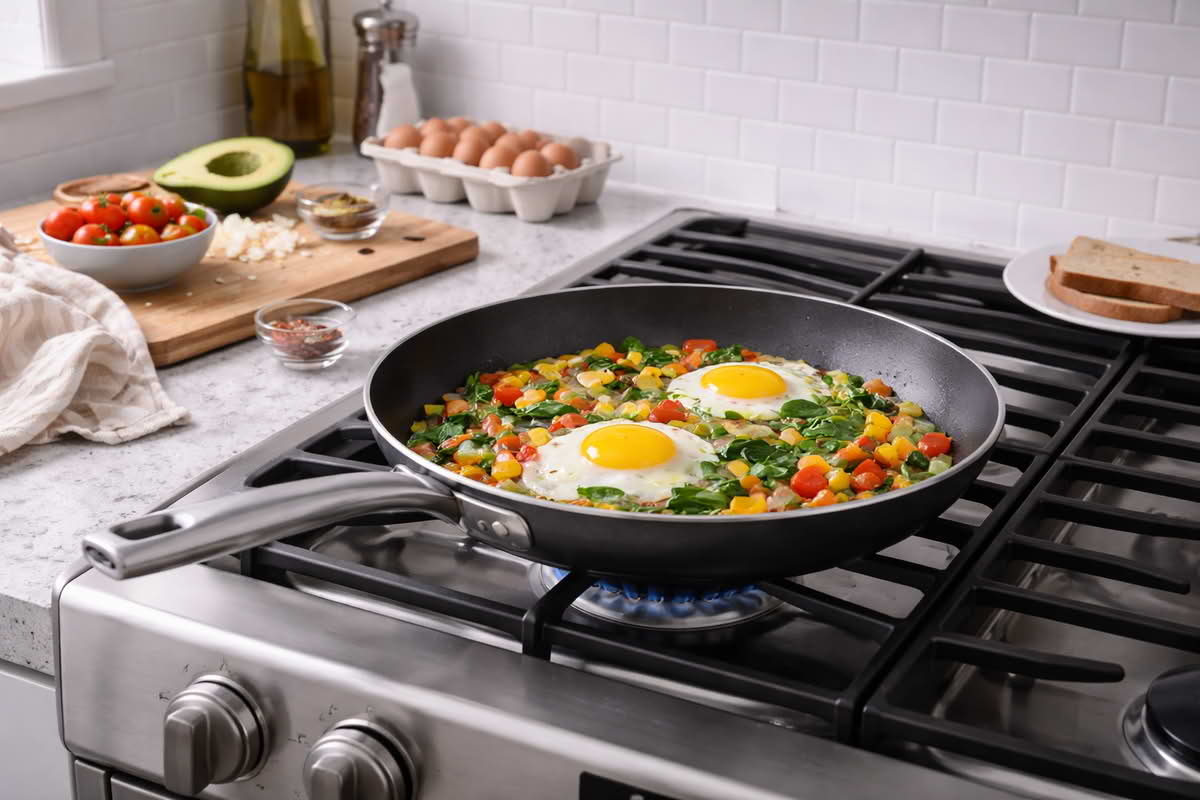
A frying pan is most useful when its size, weight, and surface match the kinds of meals the kitchen repeats most often.
Frying pan and skillet are often used interchangeably, and in practical home use that is usually fine. The important distinction is shape and purpose. Flared sides can make tossing, stirring, and sliding food easier. Straighter walls can give more cooking surface and slightly better control for certain foods. That means the right pan is not just about diameter. It is also about how usable the bottom cooking area actually is. A wide pan with aggressively sloped sides may hold less food comfortably than expected.
Common buying mistakes usually come from underestimating routine friction. A pan may heat well but feel too heavy to lift one-handed. It may cook beautifully but need too much care for a busy household. It may look large enough, yet crowd food once two portions are in it. These problems rarely appear in a short first impression, but they become obvious after repeated use. Since this pan category is often the first one grabbed from the cabinet, even small annoyances compound quickly.
Choose your main pan based on your most frequent meals, not occasional aspirational cooking projects.
Think about whether easy cleanup, high-heat cooking, or oven versatility matters most in your routine.
Pay attention to usable cooking surface, not just the listed rim diameter.
Consider how often the pan will be lifted, tilted, washed, and stored, because comfort affects long-term satisfaction.
Another practical issue is whether you are buying one all-purpose pan or filling a specific gap in an existing kitchen. If this is the pan that will do nearly everything, balance matters more than specialization. It may need to handle delicate food well enough, tolerate moderate heat, and still feel durable over time. If you already own a few capable pans and are solving a narrower problem, a more specialized choice can make sense. Many buyers regret purchases because they confuse these two situations. They buy a specialized pan expecting universal convenience or buy a general-use pan expecting specialized results.
It is also worth being honest about maintenance habits. Some cookware asks for more technique, more heat discipline, or more careful cleanup. None of that is inherently bad, but it should match the household. A pan that only performs well under ideal handling may not be the best daily tool for a shared kitchen, a busy family schedule, or anyone who wants simple, repeatable results. The right pan is not the one that sounds most serious. It is the one that supports the way the kitchen actually operates.
How material changes performance and maintenance
Material has a major effect on how a pan behaves, but it is often discussed too broadly. Terms like nonstick, stainless, cast iron, and ceramic are useful starting points, not complete answers. Within each category, thickness, base construction, weight, handle design, and surface quality can change the experience substantially. A good buying decision comes from understanding what each material usually does well and where it commonly disappoints.
Nonstick is often the most forgiving choice for delicate foods and quick cleanup. That makes it appealing for eggs, pancakes, fish, and many low-stress weeknight meals. The tradeoff is lifespan. Even when used carefully, nonstick surfaces usually have a more limited ownership cycle than more durable uncoated materials. That does not make nonstick a poor decision. It just means the buyer should see it as convenience cookware with eventual replacement built into the equation. Problems arise when shoppers expect a nonstick pan to behave like a permanent kitchen anchor.
Stainless steel tends to reward technique and patience. It handles broader temperature ranges, supports browning well, and usually offers stronger long-term durability. It is often a better fit for cooks who want to build fond, deglaze, and move comfortably between stovetop and oven. But stainless is less forgiving. Heat management matters more, sticking is more likely if the pan is misused, and cleanup can take more effort. That makes it excellent for some kitchens and needlessly demanding for others.
Cast iron and carbon steel introduce another set of tradeoffs. They can deliver strong heat retention and excellent browning, and many cooks appreciate the way they become familiar tools over time. But they are heavier, often slower to heat, and more demanding in storage or upkeep than the average buyer expects. Weight is not a minor detail here. A heavy skillet may sound durable and professional, but if it feels awkward to wash or uncomfortable to move full of food, it may end up used less than intended.
Ceramic-coated pans are often chosen by buyers looking for a slicker cooking surface without going in the exact direction of traditional nonstick. Their appeal usually centers on easy food release and a cleaner-feeling ownership experience. The problem is that buyer expectations can drift into vague assumptions. A ceramic label does not automatically guarantee long life, superior heat handling, or maintenance simplicity. Performance depends heavily on construction quality and how the pan is used.
Nonstick usually works best when easy release and fast cleanup matter more than maximum lifespan.
Stainless usually works best when browning, oven use, and long-term durability matter more than convenience.
Cast iron and carbon steel make more sense for buyers who accept extra weight and a more hands-on ownership style.
Ceramic-coated pans can be useful, but they should be judged by real performance tradeoffs rather than broad material impressions.
Construction quality often matters as much as the outer category. A thin pan can heat quickly, but it may also create hot spots, warp more easily, and respond unpredictably once food is added. Better-built pans tend to heat more evenly and feel more stable, though they may weigh more or cost more. This is where buyers should shift from simplistic material labels to a systems view. Heat behavior, handle balance, rim shape, oven tolerance, and base thickness all affect whether the pan works well in actual kitchens.
Handle comfort deserves more attention than it gets. A pan can have excellent cooking performance and still feel slightly wrong every time it is lifted. A narrow handle, poor balance point, or awkward angle can make tilting and tossing tiring. This becomes especially noticeable with larger pans or heavier materials. The problem is not just comfort. Poor balance can affect control, and control matters when moving hot oil, draining rendered fat, or transferring food quickly.
Another overlooked factor is how forgiving the pan is under imperfect use. Many households do not preheat carefully every time. They may cook at inconsistent temperatures, move between tasks quickly, or leave cleanup until later. Some pans tolerate that reality better than others. A highly capable pan that punishes minor mistakes can be a poor daily choice for a busy kitchen. Reliability under normal human use is often more valuable than peak performance under ideal conditions.
This is why no single material deserves blanket approval. A good skillet choice depends on how much tradeoff you are willing to accept in exchange for the kind of cooking you do most. Instead of asking which material is superior, it is more useful to ask which disadvantages will bother you least over time.
Size, shape, and stove compatibility
Size is one of the easiest parts of the frying pan decision to underestimate. Buyers often assume that a pan listed at a certain diameter will comfortably cook that amount of food, but the interior base can be noticeably smaller depending on wall slope and design. In real cooking, that difference matters. A pan that looks fine for two servings may crowd ingredients badly, which leads to steaming instead of browning and creates more sticking or uneven texture.
Pan performance depends not just on listed diameter, but on how much usable cooking surface the shape actually provides for everyday meals.
Smaller pans can be useful for single servings, quick breakfasts, or kitchens with very limited storage. But they often disappoint when expected to function as an all-purpose dinner pan. Medium sizes tend to serve most households better because they create more usable space without becoming too cumbersome. Larger skillets can be excellent for family cooking, batch sauteing, or recipes that need room to spread out, but only if the burner size, cabinet space, and user comfort all support them.
Shape matters alongside diameter. A pan with gently sloped sides may be easier for tossing vegetables or sliding out a finished omelet. A straighter-sided skillet may hold sauces and ingredients more securely. Some buyers fixate on named categories when the more important question is whether the shape supports their habits. Do you stir and flip often? Do you transfer food frequently? Do you need a little more wall height for mixed dishes? Practical fit matters more than strict terminology.
Stove compatibility is another area where avoidable regret happens. Induction users already know compatibility is essential, but even gas and standard electric users should think more broadly. Flatness, base contact, and pan stability affect performance on all cooktops. A pan that rocks, warps, or heats unevenly on the stove you own will not become more satisfying over time. If there is a reasonable chance of moving or changing appliances later, buying with future compatibility in mind can prevent replacing a favorite pan prematurely.
Oven use should also be assessed realistically. Many buyers like the idea of stovetop-to-oven flexibility, but not every household actually relies on it. If that feature matters, it is worth checking handles, coatings, and lid compatibility rather than assuming the entire pan system shares the same heat tolerance. Some pans are effectively more limited than their overall marketing suggests, which becomes frustrating when recipes require finishing under heat or holding food warm in the oven.
Useable base area matters more than listed diameter when you are cooking for more than one person.
A larger pan only helps if your burner, sink, storage space, and wrist comfort can support it.
Shape should match how you flip, stir, pour, and plate food in everyday use.
Compatibility with current and future cooktops can preserve value better than chasing short-term trend features.
Storage and cleanup are part of size selection too. A larger pan may perform better on paper, but if it barely fits in the cabinet, monopolizes the dish rack, or becomes annoying to hand wash, that friction adds up. Kitchen tools succeed when they are easy to use repeatedly, not when they win a spec comparison once. Buyers sometimes focus on how the pan cooks while ignoring how it lives between meals.
Cost should be evaluated with lifespan and use frequency in mind. A daily-use frying pan earns its keep differently from an occasional specialty piece. Spending more can make sense if the pan will be used constantly and the construction meaningfully improves performance or durability. But a higher price does not automatically equal a better match. Overbuying is common in this category because one-pan purchases feel deceptively simple. Buyers assume there is little risk, then discover that a premium pan can still be the wrong shape, weight, or surface for the kitchen.
The lowest-regret choice is usually the one that stays in rotation without becoming fussy. It heats predictably, fits the burner, suits the meals you repeat, and does not demand more upkeep than you are willing to give. That sounds modest, but it is exactly what makes a frying pan a good tool rather than just an attractive object in a cabinet.
Final Recommendations — choosing the pan you will actually want to use every day
A good frying pan or skillet choice starts with honesty about routine. If your kitchen depends on delicate cooking, quick meals, and easy cleanup, a forgiving pan will usually create less friction than a more demanding high-performance option. If you cook often, use higher heat, and want stronger browning with longer-term durability, a more robust material may be the better fit. In either case, the goal is not prestige. It is consistent usefulness.
Match the pan to your most repeated meals before thinking about aspirational cooking techniques.
Choose a material whose upkeep and learning curve feel realistic for your household.
Prioritize usable cooking area, balance, and stove compatibility over marketing language.
Think of the pan as a daily workflow tool, not a single-feature purchase.
The best long-term choice is usually the pan that feels natural to reach for, easy to manage, and hard to outgrow. When size, material, and maintenance demands line up with real kitchen life, the skillet becomes one of the most quietly valuable tools you own.