Drywall Knife and Mud Pan Buying Guide for Patching, Taping, and Finish Work
Drywall knives and mud pans are easy to dismiss as simple hand tools, but they shape the quality of patching and finishing more than many homeowners expect. A blade that flexes too much can leave ridges. A knife that is too narrow for the job creates unnecessary passes and uneven feathering. A pan that feels awkward in the hand quickly turns a small repair into a tiring, messy process. These tools do not attract much attention because they are less dramatic than power sanders or repair kits, yet they strongly influence whether compound goes on smoothly, whether seams flatten cleanly, and whether the repair feels controlled from start to finish. The right choice depends on the scale of the work, the level of finish you want, and how often you expect to do wall repair. This guide breaks down knife sizes, blade materials, mud pan design, and workflow considerations so you can choose tools that make compound easier to spread, easier to control, and easier to refine.
Knife Size and Job Type
The most important drywall knife decision is size, because size determines how compound moves across the surface and how many passes it takes to get a repair looking believable. Many buyers begin with a small knife because it feels easier to control, and for some tasks that is true. But a knife that feels comfortable on a nail pop can become inefficient and streak-prone on a wider patch or taped seam. Good buying starts by matching knife width to the repair stage rather than treating one blade as a universal solution.
Smaller knives are useful for tight repairs, scraping loose material, applying compound into smaller dents, and working in narrow spaces around trim or outlets. They are often the most approachable choice for occasional wall touch-ups because they feel precise and easy to handle. Their weakness is coverage. When the compound needs to be feathered wider, a small knife tends to create more edges and more visible passes. That means more sanding later, especially on smooth walls where every ridge becomes easier to see after primer and paint.
Mid-size drywall knives are often the most versatile choice for homeowners because they bridge the gap between patching and finishing. They are wide enough to flatten compound over common repairs, yet still manageable in rooms where you are not doing full seam work every day. For many patch jobs, this is the size range that feels most useful over time because it allows cleaner feathering without becoming awkward in a hallway, stairwell, or occupied room.
Wider taping or finishing knives make the most sense when the work involves longer seams, broader patch zones, or final skim-style passes where smoothness matters more than tight access. They are valuable because they ride over the repair rather than digging into it, which helps flatten compound and reduce noticeable edges. The tradeoff is that they ask more of the user. Wider knives require steadier hand pressure, more compound management, and a better sense of angle. For casual users, they can feel excellent on open surfaces and clumsy in smaller repair areas.
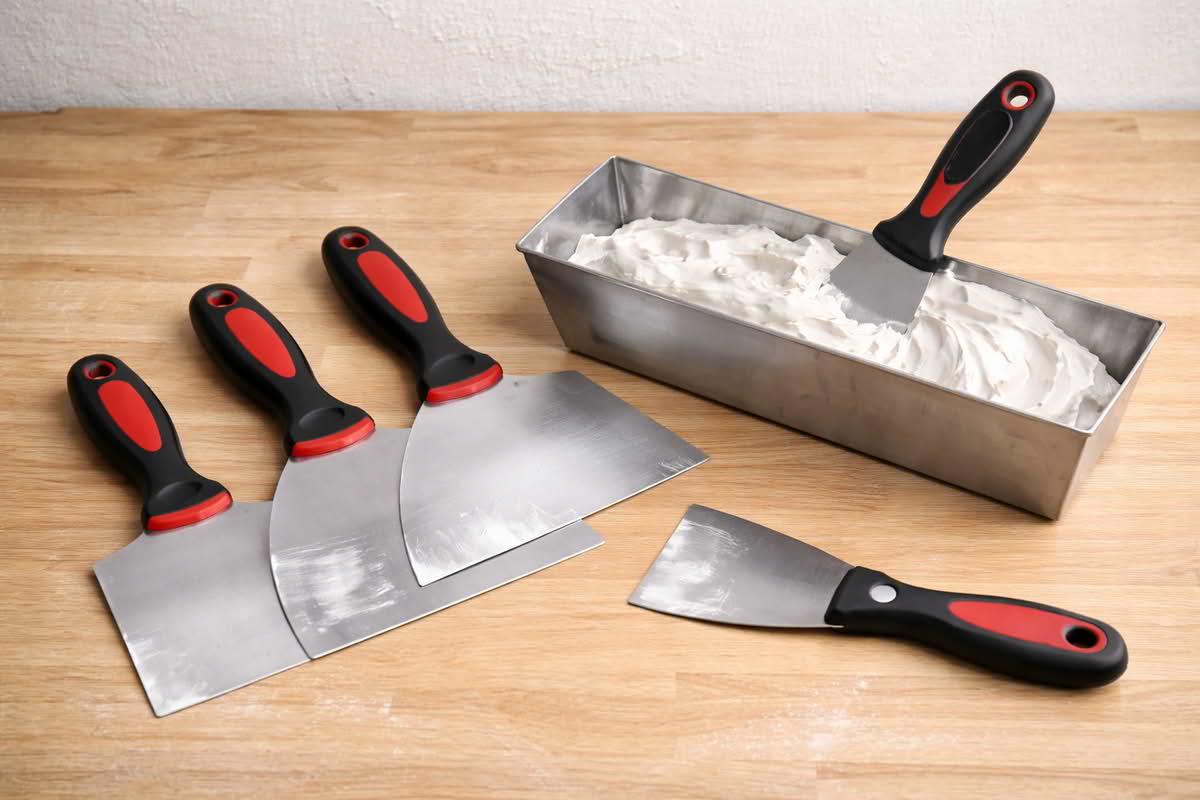
This is why knife sets are often appealing. A set lets each size do the job it is naturally better at rather than asking one blade to cover every stage. But sets are only useful if the included sizes reflect real workflow. A collection of similar narrow knives may look generous without actually improving results. A better set usually includes a smaller blade for loading and tight work, a more general knife for patch shaping, and a wider knife for flattening and feathering.
Choose smaller knives for detail work, tight repairs, and initial compound placement.
Choose mid-size knives for general patching where control and broader feathering both matter.
Choose wider knives for seam work, larger patches, and smoother final passes.
Buy a set only if the blade sizes serve distinct purposes instead of duplicating each other.
Another common mistake is buying too narrowly because the repair itself looks small. The actual finished area often needs to be wider than the damaged spot, especially if the goal is to blend the repair visually into the surrounding wall. A small hole may still benefit from a broader finishing pass. Buyers who think only in terms of hole size often end up sanding more because the knife they chose could not feather the compound widely enough.
In practical terms, knife width should be judged by finish area, not just defect area. That shift in thinking usually leads to better tool choices and cleaner wall results.
Blade Material, Handle, and Pan Design
Once the knife sizes make sense, the next questions are material, feel, and mud pan design. These details sound secondary, but they shape how predictable the tools feel during actual use. Patching compound behaves differently depending on blade stiffness, edge quality, and how comfortably the user can reload and spread material. A tool that looks simple on a shelf can either support smooth workflow or quietly fight it.
Blade material usually comes down to corrosion resistance, edge consistency, and feel. Stainless blades are attractive for long-term ownership because they resist rust better and tend to stay presentable even when occasionally stored less carefully than ideal. For homeowners who do intermittent repairs, that matters. A drywall knife may sit for months between uses, and rust or staining can make the next project less pleasant than it needs to be. Stainless also tends to feel like the lower-maintenance choice for a tool that regularly touches wet compound and rinse water.
Other blades may cost less and work perfectly well when cleaned promptly and used consistently. The tradeoff is that they ask more of storage and maintenance habits. For frequent drywall workers with established cleanup routines, that may be acceptable. For occasional DIY use, lower-maintenance tools usually create less regret because they are easier to pull out and trust without extra attention first.
Flex matters as much as material. A blade that is too stiff can feel harsh on finish passes, especially when trying to flatten compound over a broader area. A blade that is too flexible may chatter or leave inconsistent pressure lines when the user is still learning. The right amount of flex depends partly on knife width and partly on the task. Wider finishing knives benefit from controlled flex because they need to glide across a repair. Smaller utility knives often benefit from feeling a little more direct.
Handles deserve more attention than they usually get. Drywall compound is repetitive work, and a handle that feels only slightly awkward at first often becomes tiring or slippery after several minutes of loading, spreading, scraping, and wiping. Comfort matters, but so does control. A bulky handle may feel cushioned yet reduce finesse, while a narrow handle may feel precise but become fatiguing faster. The best choice is usually the one that remains stable in a damp hand and lets you maintain a consistent knife angle without gripping too hard.
Mud pans influence the workflow just as much as knives do. A pan that is too small forces frequent reloading and makes broader work feel interrupted. A pan that is too large or awkward can feel heavy and cumbersome, especially for one-handed use during patching. Stainless mud pans are often attractive because they clean well, resist rust, and generally hold up better to repeated scraping from metal knife edges. Plastic pans can be lighter, but their feel and durability vary. A pan that flexes too much or traps dried compound in its corners becomes more annoying over time.
Drywall knives work best as a system, with blade width, handle feel, and mud pan design all affecting how cleanly compound can be loaded and feathered.
Pan shape also matters. A good mud pan should let the knife scrape cleanly along the edges so the user can load compound evenly rather than fighting clumps or inconsistent blade coverage. This sounds minor, but poor loading creates poor spreading. Many ridges blamed on knife technique actually begin with uneven compound distribution on the blade.
Choose stainless tools when easier maintenance and long shelf life matter.
Match blade flex to task: more controlled glide for wider finishing work, more direct feel for smaller repair work.
Prioritize handle stability and comfort over decorative grip features.
Choose a mud pan that reloads cleanly and feels manageable in one hand during real use.
Buyers often focus on knife count and ignore the pan entirely, but the pan determines how smoothly the knives can be used from one pass to the next. A better pan and a few well-chosen knives usually outperform a large bargain set with a frustrating loading system.
In other words, these tools should be chosen as a working pair. Knife and pan quality are linked. One good tool cannot fully compensate for the other if the workflow feels clumsy.
Workflow, Control, and Long-Term Use
Drywall knives and mud pans are best judged not by how they look in the package, but by how they support the full repair sequence. Compound work is repetitive and slightly unforgiving. The user loads the knife, applies compound, feathers the edge, removes excess, reloads, and repeats. If the tools feel balanced and predictable, the repair stays manageable. If the tools feel awkward, the user often compensates by pressing harder, applying too much material, or skipping refinement steps that matter later.
For patching work, control is usually more important than speed. Small and mid-size repairs benefit from steady spreading and smooth edge transitions more than rapid material movement. This is why beginner drywall kits that include only very small putty knives can be limiting. They make the repair feel simple at first, but they often leave the user without a way to flatten the final surface more broadly. A better workflow tool set makes the early pass easier and the finishing pass cleaner.
For seam work or repeated larger patches, efficiency starts to matter more. Wider knives and a better mud pan can reduce time and create smoother results because fewer passes are needed. But that efficiency only helps if the tool size matches the room and the user’s comfort level. An oversized finishing knife can be excellent on open wall sections and still feel frustrating around corners, door frames, or patch zones near trim. The right tool is the one that stays useful throughout the actual repair environment, not just on an ideal flat test area.
Cleanup and storage matter because these are tools many homeowners use intermittently. Compound dries quickly in neglected corners, along pan edges, and in poorly rinsed handle joints. Tools that clean easily are more likely to stay in good condition and be ready for the next job. This is one reason straightforward stainless tools often hold long-term appeal. They reward reasonable cleaning without demanding perfect workshop discipline.
Another factor is how often you expect to do wall work. If your use is mostly occasional anchor holes, furniture scuffs, or minor repairs after moving items, a compact but capable setup usually makes the most sense. If you expect recurring patching, room refreshes, or more serious seam and finish work, then broader knives and a better pan become worth the extra footprint. Buying for future maintenance rather than just one current repair often leads to better value in this category because wall fixes rarely happen only once.
There is also a strong connection between tool quality and sanding burden. Better control with the knife often means less cleanup with abrasives later. A tool that helps you apply compound flatter and feather edges more evenly reduces the need to aggressively sand back ridges and lines. That matters for finish quality, dust control, and overall project time. The knife stage is not separate from the sanding stage. It determines how much sanding becomes necessary.
Choose tools that support smoother compound placement so sanding becomes lighter, not heavier.
Prioritize control for patching work and efficiency only when the scale of the job clearly justifies it.
Buy for likely future maintenance, not just the one repair in front of you.
Favor tools that clean quickly and store well between infrequent projects.
One helpful way to judge these tools is to ask whether they encourage better technique. If a knife size helps you spread compound with less pressure and fewer corrective passes, it is probably a good fit. If the pan makes reloading smooth and predictable, it is likely supporting the workflow well. If the tools constantly feel as though they are one step behind the repair, they are probably mismatched to the task.
In the long run, low-regret buying in this category usually means choosing a modest but coherent system: a few genuinely useful knife widths and a pan that supports them well. That is more valuable than chasing the largest set or the lowest price point.
Final Recommendations — choosing drywall hand tools that make compound easier to control
For most households, the safest choice is a practical multi-knife setup paired with a durable mud pan rather than a one-size-fits-all putty knife. Smaller knives handle loading and tight repairs, a mid-size knife covers much of the common patching work, and a wider knife becomes useful for feathering and smoother finish passes. Stainless tools are often worth the extra cost for homeowners because they simplify maintenance and stay ready for intermittent use.
Choose at least two or three distinct knife widths if you expect to do more than very minor wall touch-ups.
Choose stainless tools when low-maintenance storage and repeat use matter.
Choose a mud pan that loads cleanly, feels balanced in one hand, and supports steady workflow.
Judge every purchase by whether it reduces ridges, rework, and sanding rather than by how many pieces come in the set.
The long-term low-regret approach in this category is simple: buy drywall knives and a mud pan as working finish tools, not as disposable accessories. When the blade widths match the repair stages and the pan supports clean loading, compound goes on flatter, sanding becomes lighter, and the wall has a better chance of looking normal again after paint. That is usually the real measure of success.