Shoe Storage Buying Guide: How to Keep Footwear Accessible Without Letting It Take Over
Shoe storage seems like a straightforward household problem until the wrong solution makes it worse. Buyers often count how many pairs they own, pick a rack or container with roughly enough capacity, and then realize later that bulky shoes do not fit the compartments, everyday pairs are hard to reach, seasonal footwear ends up mixed with current-use shoes, or the storage itself creates clutter near the closet or entry. Good shoe storage does more than get footwear off the floor. It should support the types of shoes you actually wear, the room where they live, and the frequency with which pairs need to be grabbed, returned, aired out, or kept protected. Whether you are organizing a bedroom closet, an entry zone, a hallway, or overflow storage elsewhere in the home, the best system is the one that keeps shoes easy to manage without forcing you into a format that only works for a narrow slice of your collection.
Shoe Type and Use Pattern Matter More Than Pair Count Alone
The most common mistake in shoe storage is shopping by number of pairs instead of by shoe behavior. Ten pairs of slim flats do not create the same storage challenge as ten pairs made up of boots, athletic shoes, sandals, work shoes, and occasional formal footwear. Yet many buyers choose storage as though every pair occupies roughly the same footprint. That leads to shoe racks with crowded tiers, stackable boxes that cannot handle larger sizes cleanly, or organizers that technically fit the count but not the actual collection.
Everyday footwear should be treated differently from seasonal or occasional pairs. Shoes that move in and out of the home several times a week need low-friction access. They should be easy to see, easy to grab, and easy to return without opening multiple lids or shifting other pairs out of the way. Seasonal boots, dress shoes, or backup athletic pairs can tolerate slower storage because they are not part of the daily routine. When buyers fail to separate these categories, they often overbuild one storage zone and still end up with the most-used shoes on the floor by the door.
Shoe shape matters too. Taller boots, wide sneakers, heels, children's shoes, and narrow sandals all behave differently in storage. Some formats work beautifully for standard low-profile shoes but become frustrating once larger or more delicate footwear enters the mix. A good shoe storage purchase should be judged not by whether it can technically hold footwear, but by whether it can hold your actual footwear without crushing, hiding, or awkwardly overlapping pairs.
Choose shoe storage around the types of shoes you own most, not just the total number of pairs.
Choose separate logic for daily-use shoes and lower-frequency or seasonal footwear.
Choose storage formats that can handle bulky, tall, or irregular shoes without wasting the rest of the system.
Location also shapes what kind of shoe storage makes sense. Entry storage needs quick turnover and easier cleanup. Closet storage often needs better space efficiency and category grouping. Bedroom overflow may need more concealment or a calmer look than either of those spaces. One reason shoe storage disappoints so often is that buyers pick a product category they like in theory and then place it in a zone that asks for very different behavior. A neat-looking shoe rack in an entryway may become messy quickly if it offers no protection from dirt or no room for changing seasonal footwear. A closed storage box system in a closet may look tidy but create too much effort for daily rotation.
Another issue is growth. Shoe collections rarely stay fixed, especially in family homes or shared closets. A system chosen right at current capacity often becomes frustrating quickly. Leaving some expansion room, or using a format that can be extended without becoming chaotic, usually creates a better long-term result than buying something that feels perfectly full from the start.
Shoe storage works better when footwear is grouped by type and frequency of use instead of trying to force every pair into one repeated storage pattern.
Racks, Boxes, and Vertical Formats Solve Different Storage Problems
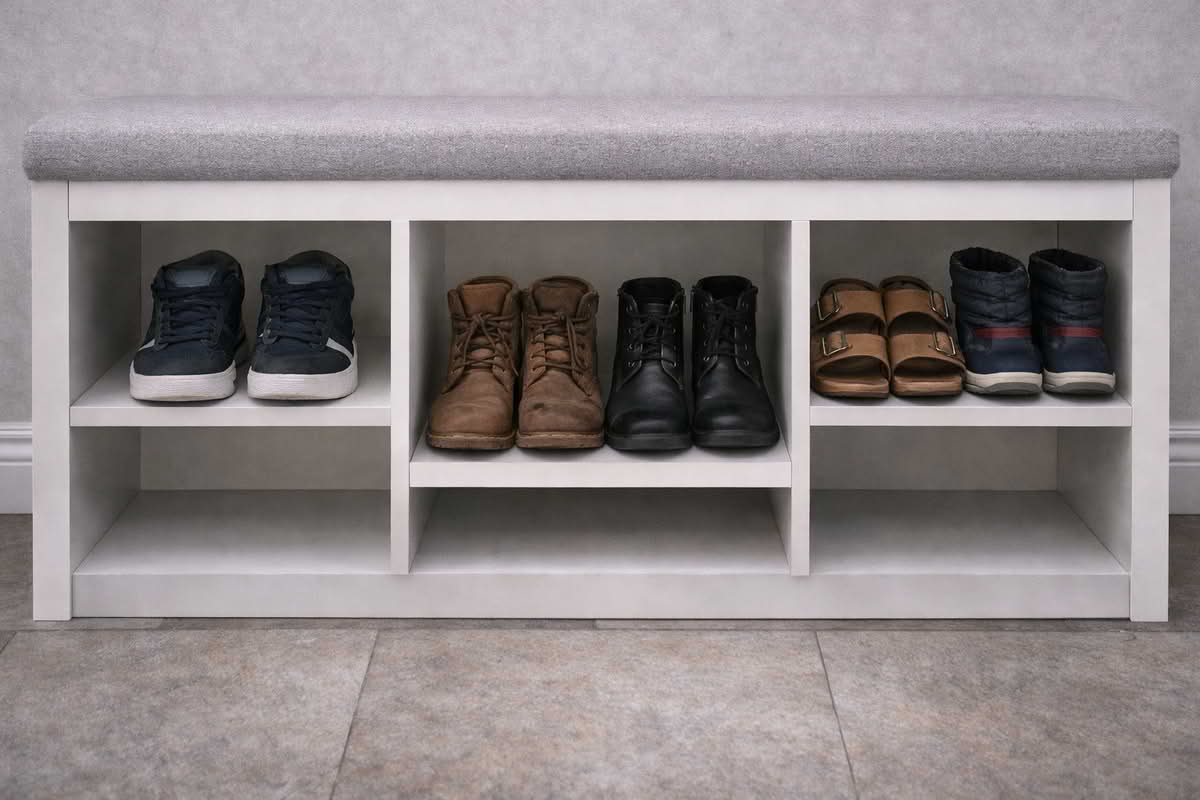
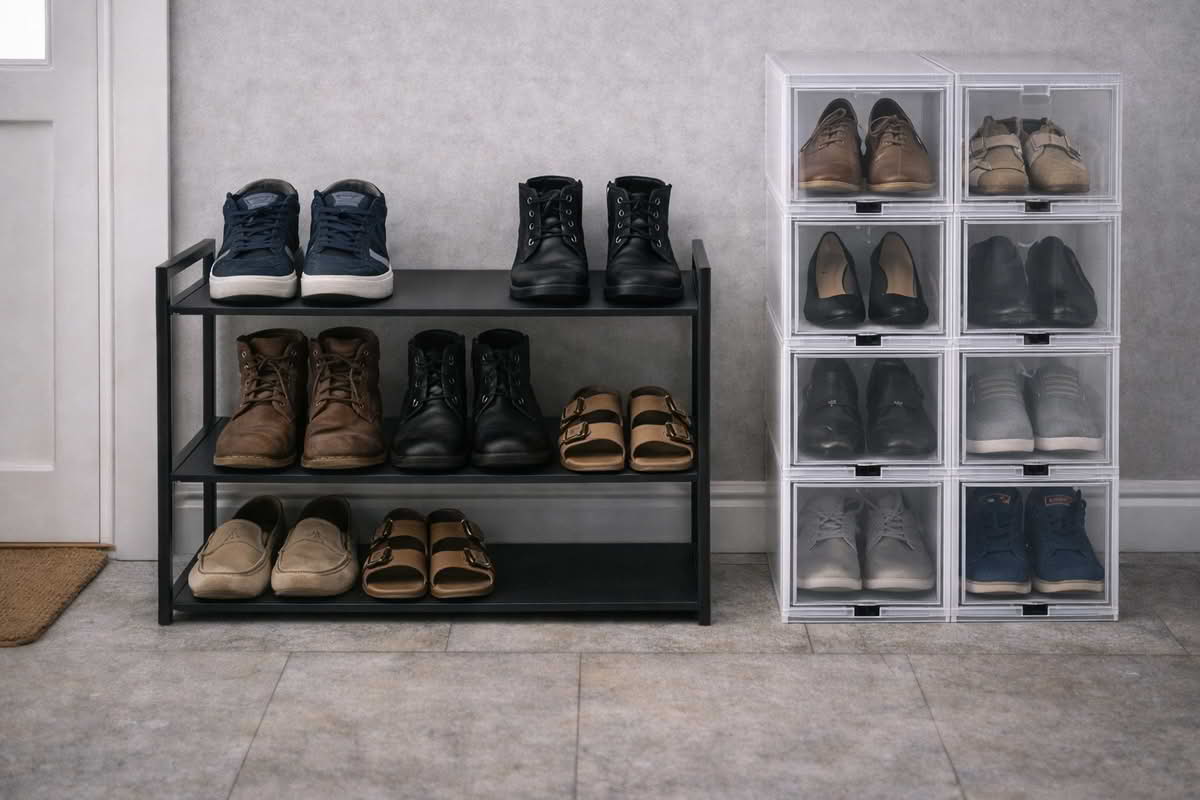
Once the shoe categories are clear, the next step is choosing the right storage format. Open shoe racks are one of the simplest solutions and often the most practical for everyday use. They keep shoes visible, encourage quick return, and make it easier to scan what is available. That makes them strong for entry closets, mud-adjacent spaces, or households where several pairs rotate frequently. Their weakness is that they offer little concealment and limited protection. In tight or highly visible rooms, open racks can make a storage problem feel solved functionally while still looking cluttered.
Stackable shoe boxes create a different kind of system. They provide better visual control, protect footwear from dust, and often use vertical closet space more efficiently than open racks. They are particularly useful for shoes that are not worn every day, shoes that benefit from shape preservation, or collections where identifying pairs matters. The tradeoff is access friction. A box system that seems neat at first can become annoying if the most-used shoes are buried in stacked containers or if the boxes are not clear enough to make identification easy. For many households, boxes work best for slower-moving footwear rather than for the core daily lineup.
Over-the-door shoe organizers appeal because they exploit vertical space that would otherwise go unused. They can be effective in small homes, children's rooms, secondary closets, or for lightweight footwear categories that do not need shelf-like support. But they are not universally ideal. Heavier shoes may pull awkwardly on the organizer, pockets may fit only certain styles well, and door-based storage can become visually busy or harder to access if the closet is already crowded. As with many vertical solutions, the value depends on whether the format truly matches the shoe types rather than simply adding more capacity.
Choose open shoe racks when easy access and fast daily turnover matter more than concealment.
Choose stackable shoe boxes when protection, visual control, or slower-moving shoe storage matters more than instant access.
Choose over-the-door systems when floor and shelf space are limited and the shoe types are light enough to suit pocket storage.
Shoe cabinets and more concealed storage formats solve a different problem again. They are often attractive in entries, hallways, or bedrooms where visible shoe clutter makes the room feel untidy. These systems can help a space feel calmer, but they should still be judged by interior usability. A cabinet that holds many slim shoes may be a poor fit for larger sneakers, boots, or family-size mixed collections. Concealment is valuable only when the storage remains believable in daily use. If people stop returning shoes because the cabinet feels cramped or inconvenient, the visual benefit disappears quickly.
Space fit is often the deciding factor. Low racks and benches can make sense under hanging clothes or along closet floors. Vertical stacking systems may be better in narrow closets with limited horizontal room. Entry spaces may need storage that can handle wet or dirty shoes without making cleanup harder. In many homes, no single format solves all of these problems. The strongest results often come from using one format for everyday shoes and another for protected or seasonal overflow rather than trying to force everything into a universal product type.
Different shoe storage formats serve different jobs. Open racks support daily access, while boxes and more contained systems often work better for protected or lower-frequency storage.
Another subtle issue is interior clearance. Multi-tier shoe racks may advertise strong capacity, but that number often assumes fairly low-profile footwear. Once taller sneakers, boots, or larger sizes are involved, real capacity drops. Buyers who count total pairs without accounting for shoe profile often end up with a rack that feels instantly undersized. A more honest assessment of shoe height and width usually leads to better choices than the headline pair count on the product listing.
Visibility, Cleanliness, and Long-Term Use Determine Whether the System Holds Up
Shoe storage should be judged by how well it handles ordinary household mess, not just by how tidy it looks when empty. Shoes bring in dirt, moisture, debris, and wear patterns that make them one of the more demanding storage categories in the home. Systems that look elegant but are difficult to wipe down, awkward to ventilate, or too fussy for quick return often lose ground fast in real use. This is especially true in entries and shared closets, where convenience matters at least as much as neatness.
Visibility is particularly important. People tend to wear the shoes they can see and reach most easily. When storage hides too much or makes identification difficult, daily pairs gravitate back to the floor, while less-used pairs occupy prime space inside the organizer. This is why clear-front boxes, open shelving, or clean category labeling can make such a difference. They help the system function as real storage rather than as a holding area that people work around. Good shoe storage should reduce the effort needed to maintain order, not introduce just enough friction that the room reverts to visible clutter.
Cleanliness matters too. Some households need shoe storage that can tolerate damp footwear, muddy soles, or children's seasonal rotation. In those cases, easy-to-clean surfaces and more forgiving structures usually matter more than decorative finish. Other households may prioritize dust protection or visual calm for closet-stored footwear. The right balance depends on where the shoes live and how they enter the space. A storage format that is perfect for a bedroom closet may be a poor match for an entry used every day in wet weather.
Choose visible storage for the pairs used most often so the system supports real daily habits.
Choose easier-to-clean materials and surfaces when the storage zone regularly handles dirty or damp footwear.
Choose more protective or enclosed storage for shoes that need dust control or longer-term preservation.
Long-term use also depends on category discipline. Shoe storage often drifts because it starts as a plan for everyday pairs and then absorbs slippers, sandals, boots, sports shoes, and occasional shoes with no clear logic for who belongs where. The best systems tend to assign roles. One area for current-use footwear. One zone for seasonal or special-occasion shoes. One overflow area for less-used pairs. This keeps prime access space from becoming congested and helps the storage remain understandable over time.
Visual calm is another real factor, especially in visible parts of the home. Shoes are irregular objects, and when too many pairs remain exposed in one place, even a technically organized area can still feel messy. This is why some households do well with a hybrid approach: a smaller visible rack or tray for current-use shoes and more contained storage for everything else. The best-looking shoe storage is usually the system that limits what has to stay out, not the one that tries to display every pair attractively.
In the long run, good shoe storage works because it matches the room, the shoe types, and the household routine. When visibility, access, and maintenance all align, the system becomes something people actually use instead of something they silently avoid. That difference is what turns shoe storage from a recurring floor-clutter problem into a stable, manageable part of the home.
Final Recommendations — Choosing Shoe Storage With Less Daily Friction
The right shoe storage is the one that fits your actual footwear mix and the room where it needs to function. Buyers usually get the best results when they separate daily-use shoes from lower-frequency pairs and choose storage formats around those different access needs. A simple system that supports real habits almost always outperforms a more elaborate one that makes every pair slightly harder to use.
Choose open shoe racks when daily access, quick return, and straightforward visibility matter most.
Choose stackable shoe boxes when you need better dust protection, vertical use of closet space, or cleaner storage for slower-moving pairs.
Choose over-the-door systems when floor space is tight and the footwear is light enough to suit vertical pocket storage.
Choose a hybrid setup when the home needs both fast access for everyday pairs and more contained storage for overflow or seasonal shoes.
A low-regret shoe storage decision should make footwear easier to see, easier to put away, and easier to keep from spreading into the rest of the room. When category logic, room fit, and everyday access all work together, shoe storage becomes less about hiding a problem and more about building a system that stays usable over time.