Drawer Organizer Buying Guide: How to Create Order That Actually Holds Up
Drawer organizers seem like a small purchase, but they often determine whether a storage problem is truly solved or merely hidden. Many buyers measure the drawer loosely, buy a tray or divider set that looks close enough, and then discover that the organizer slides around, wastes space at the edges, fails to fit the actual items inside, or stops working as soon as the drawer contents change. A good drawer organizer does more than separate objects into neat compartments on day one. It should match the drawer dimensions, the item shapes, and the daily access pattern without turning simple storage into constant re-sorting. Whether you are organizing kitchen utensils, office supplies, bathroom items, tools, or household odds and ends, the right system is the one that supports the way the drawer is really used over time rather than creating a tidy-looking layout that quickly falls apart under normal life.
Fit and Drawer Geometry Matter More Than Organizer Style
The most common mistake in this category is shopping by organizer type before understanding the drawer itself. Buyers often decide they want a bamboo tray, a set of modular bins, or an expandable organizer, then try to make that format work inside a drawer with its own depth, width, glide behavior, and storage demands. In practice, the drawer should lead the decision. A shallow office drawer, a wide kitchen utensil drawer, a deep bathroom drawer, and a narrow utility drawer do not benefit from the same organizing approach even when the products look similar online.
Width and depth are obvious starting points, but usable interior space matters more than rough outer dimensions. Drawers often have interior hardware, sloped sidewalls, curved corners, or drawer slides that slightly reduce clean rectangular space. An organizer that is technically the right size on paper may still fit poorly if the usable interior footprint is smaller than expected. That is one reason loose modular bins often outperform rigid one-piece organizers in awkward drawers. They can work around small dimensional imperfections rather than forcing the drawer to behave like a perfect box.
Height is just as important. An organizer that fits the base of the drawer but sits too tall can catch on stored items, interfere with drawer closure, or limit what can be placed inside each compartment. This is especially common in bathroom, office, and vanity drawers where buyers focus on footprint but underestimate the vertical space needed for taller items. A lower-profile organizer may seem less substantial, yet it often creates a better daily experience because it allows the drawer to open and close easily while keeping categories visible.
Choose organizers based on the true interior drawer dimensions, not just the cabinet or furniture measurements.
Choose lower-profile solutions when drawer height is tight or the stored items vary in size.
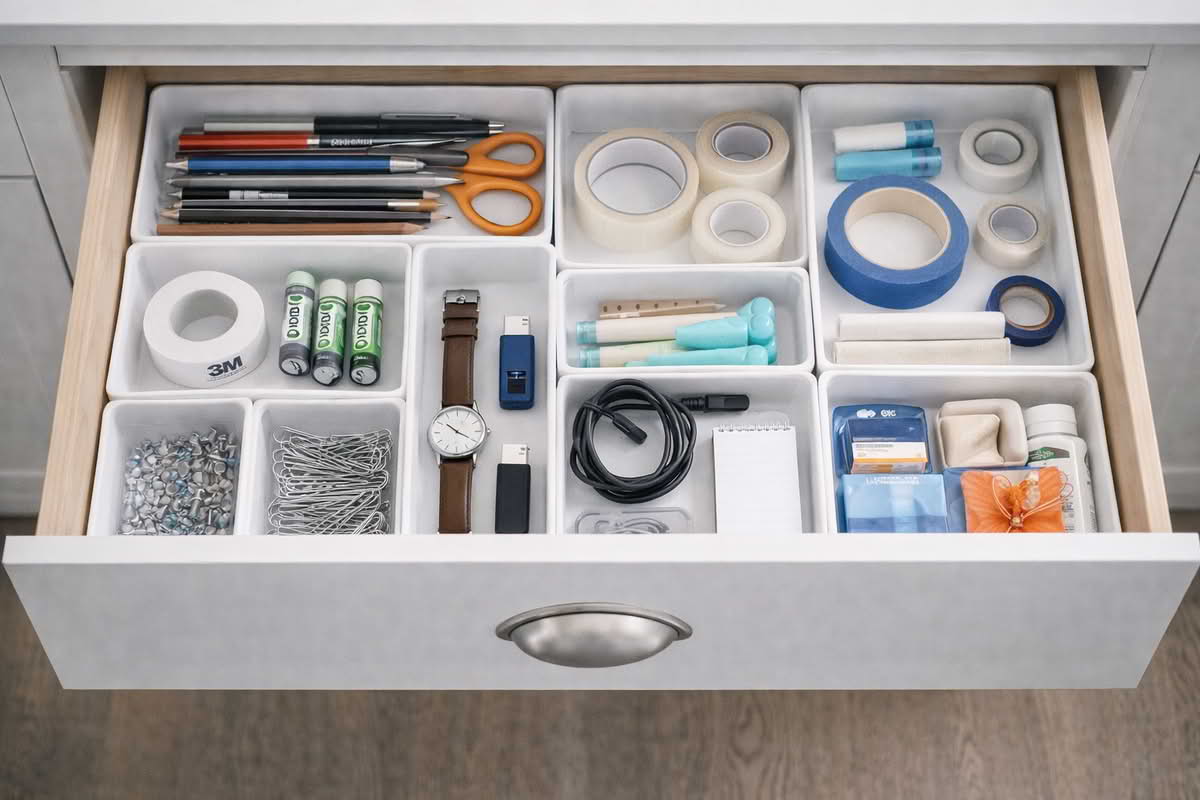
Choose modular pieces when the drawer has awkward dimensions, internal obstructions, or categories that do not fit standard tray layouts.
Drawer geometry also affects how items should be grouped. Wide drawers often need zoned organization so that categories stay stable instead of drifting across a large empty base. Narrow drawers benefit from more linear compartment logic that prevents one category from becoming a long mixed strip of clutter. Deep drawers may allow stacked or larger compartments, but they can also encourage hidden disorder if the organizer does not make items easy to sort and retrieve. The better system is usually the one that matches how the drawer behaves, not just how the organizer looks in isolation.
Another overlooked issue is whether the organizer should fill the drawer almost completely or leave purposeful open space. Fully filling the drawer can create a more deliberate look, but it can also reduce flexibility if one category changes or an item with a different shape needs to be stored later. Leaving a small amount of adaptable space often works better in real households because drawers rarely stay fixed forever. The goal is not to create a perfectly packed layout that only works for one moment. It is to support repeated use with minimal friction.
Drawer organization works best when the compartment layout is chosen around the actual drawer interior and the shape of the stored items, not just around a generic tray format.
Compartment Logic and Materials Decide Whether the System Stays Useful
Once the fit is right, the next question is whether the compartments actually suit the categories being stored. This is where many organizers fail quietly. A tray with many small sections may look efficient, but it can become frustrating if the items are long, bulky, or inconsistent. A few larger compartments can seem simpler, yet they may allow smaller items to mix together until the drawer becomes only slightly more organized than it was before. The right compartment logic depends on whether the drawer holds like-with-like items or a mixture of categories that need stronger separation.
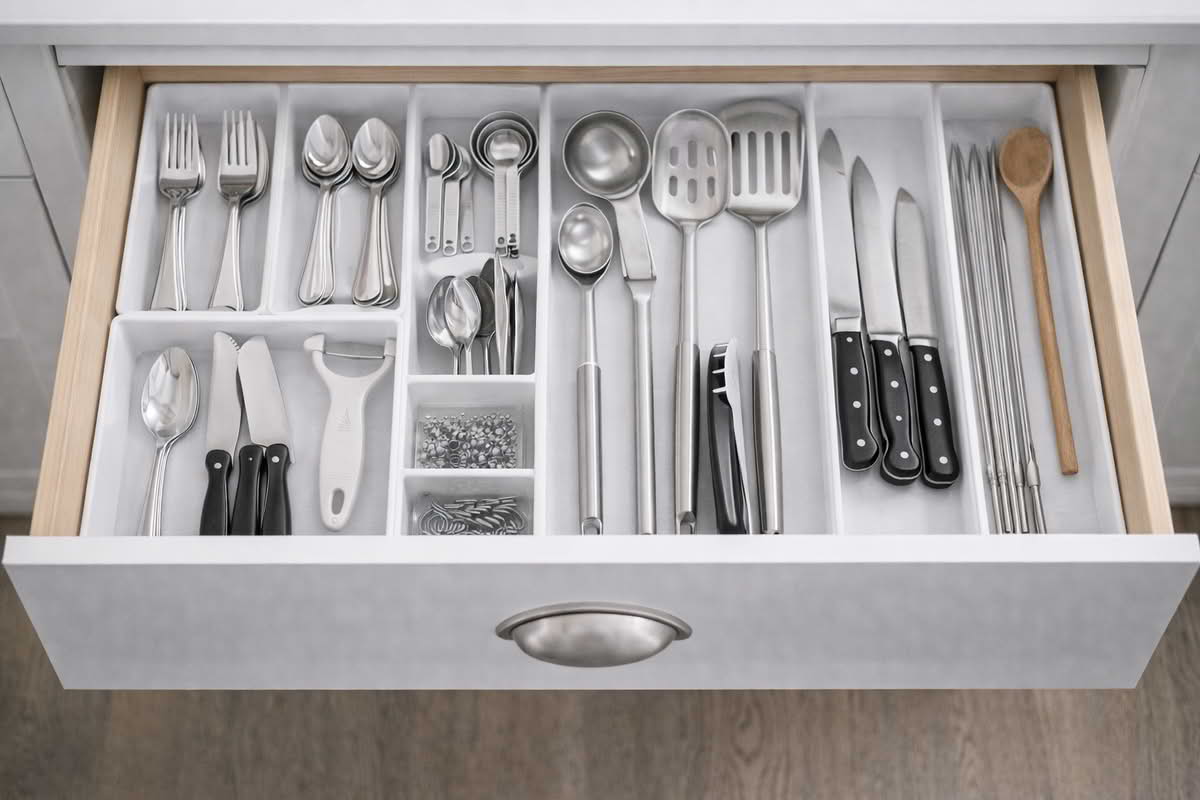
In kitchens, for example, organizers often need to deal with long utensils, oddly shaped tools, and items that are grabbed frequently without much thought. In offices, the contents may include clips, pens, charging adapters, sticky notes, and other small objects that benefit from tighter containment. Bathrooms and vanities often mix short daily-use items with taller backup supplies that do not suit one fixed pattern. Utility drawers can be even more uneven, combining batteries, scissors, tape, hardware, and miscellaneous household tools. The more mixed the category, the more important it becomes to choose a system that supports clear compartment boundaries without becoming overcomplicated.
Material influences both appearance and performance. Bamboo and wood organizers can look warm and stable, which makes them appealing in kitchens, offices, and visible furniture pieces. Plastic organizers are often easier to clean and better suited to bathrooms, utility drawers, and any space where spills, dust, or residue are part of normal life. Fabric-lined or very soft materials are less common here because drawer organizers usually need enough rigidity to keep categories distinct. The better material is the one that matches both the room and the kind of maintenance the drawer will realistically receive.
Choose larger compartments when the drawer holds longer or bulkier tools that do not fit small rigid slots well.
Choose tighter compartment separation when the drawer contains many small loose items that would otherwise mix quickly.
Choose materials that suit the room conditions, especially where moisture, crumbs, or routine wipe-downs affect long-term satisfaction.
Another issue is edge behavior. Some organizers have smooth, well-finished edges and stable bases that make them feel planted in the drawer. Others are lighter or more slippery, which can lead to subtle shifting every time the drawer opens and closes. That movement may seem minor, but it gradually weakens the organizational system because compartments stop staying where users expect them to be. A drawer organizer should reduce motion, not add a second layer of it.
Expandable organizers are popular because they promise a more customized fit, and they can be very useful in medium-to-wide drawers where standard trays leave wasteful gaps. But expandability should not be treated as an automatic advantage. Some expandable designs create side sections that are less useful than the center layout, or they work best only when the drawer contents suit the imposed geometry. Modular bins can be more flexible because they let you build compartments around actual categories instead of accepting a fixed divider pattern. The better choice depends on whether your storage categories are stable and predictable or varied and likely to evolve.
Good drawer organization depends on matching compartment size and shape to the items being stored rather than assuming one repeated divider pattern will suit every category.
It also helps to remember that not every drawer should be optimized the same way. Some drawers benefit from precise segmentation because the contents are numerous and easy to mix. Others are better served by just a few bins or dividers that create loose zones instead of rigid assignments. Over-organizing can be almost as frustrating as under-organizing when it turns a practical drawer into a layout that is too specific to survive ordinary household variation.
Adjustability, Maintenance, and Long-Term Use Separate Good Organizers From Drawer Clutter
The strongest drawer organizers are the ones that still make sense after the contents change. That matters because drawers are rarely static. A kitchen drawer may absorb new gadgets, an office drawer may shift from paper supplies to device accessories, and a bathroom drawer may cycle between daily-use items, backup stock, and travel products. Organizers that are too rigid can look excellent at setup and then become irritating once the household evolves. This is why some degree of adjustability often creates lower-regret storage, especially in multipurpose drawers.
Adjustability does not always mean highly complex systems. Sometimes it simply means modular bins that can be re-grouped, removable dividers that can shift, or a layout with enough open tolerance to accommodate new items without destroying the overall structure. The goal is not endless reconfiguration for its own sake. It is to keep the drawer functional when categories drift slightly, which they usually do. A drawer system that tolerates ordinary change is more valuable than one that looks more exact but breaks down quickly.
Maintenance is another major factor. Drawers collect crumbs, dust, residue, clipped packaging, and small debris that people rarely think about until the organizer has to be cleaned. Systems that are difficult to remove, wipe, or reset tend to lose favor over time. Buyers often underestimate how important easy cleaning is, especially in kitchens, bathrooms, and utility areas. An organizer should not be so elaborate that routine upkeep becomes a project.
Choose adjustable or modular organizers when the drawer serves mixed purposes or the item categories may evolve.
Choose simpler systems when the drawer needs to be cleaned regularly and quick removal matters.
Choose enough structure to preserve categories, but not so much that the organizer becomes fragile or fussy to maintain.
Another long-term consideration is user behavior. The best drawer organizer is not the most intricate one. It is the one that household members will actually follow. If compartments are too specific, too small, or too difficult to reset, people stop respecting the system and begin dropping items wherever they fit. That is why organizers should reflect realistic behavior rather than idealized discipline. High-use drawers benefit from intuitive layouts that make the right spot obvious without much thought.
Visual calm matters too, even inside a drawer. A well-organized drawer reduces daily friction because items are easier to find and easier to put back. But overly crowded compartments, inconsistent bins, or unused sections can create a subtle sense of disorder even when the drawer is technically organized. The strongest results usually come from a measured approach: enough separation to control the categories, enough flexibility to remain useful, and enough simplicity to keep the drawer easy to maintain.
In the long run, good drawer organization is less about achieving a perfectly styled interior and more about building a stable system for repeated use. When fit, compartment logic, and maintenance all work together, the drawer stops being a low-level source of daily irritation. It becomes one of the quiet places in the home where good storage design actually saves time and reduces friction.
Final Recommendations — Choosing Drawer Organizers That Stay Functional Later
The right drawer organizer is the one that matches the drawer dimensions, the item mix, and the way the space is actually used every day. Buyers usually get better results when they begin with the drawer geometry and storage behavior rather than with a preferred organizer style. A slightly simpler system that truly fits often outperforms a more elaborate one that looks impressive but does not match the task.
Choose modular bins when the drawer contains mixed categories or awkward dimensions that fixed trays cannot handle well.
Choose expandable organizers when the drawer is broad and the item types are stable enough to suit a more defined layout.
Choose easier-to-clean materials in kitchens, bathrooms, and utility spaces where residue and regular wipe-downs matter.
Choose compartment sizes around real item shapes and access habits rather than trying to force every drawer into the same organizing template.
A low-regret drawer organizer helps a drawer stay useful without demanding constant correction. When fit, flexibility, and practical category logic align, drawer organization becomes less about appearance and more about building a system that quietly works every day.