Plastic Storage Bin Buying Guide: How to Choose Containers That Stay Useful Over Time
Plastic storage bins seem like one of the simplest household purchases, which is exactly why people so often end up with the wrong ones. Many buyers focus on price, rough size, or whether the container looks stackable, then discover later that the lid does not stay secure, the bin shape wastes shelf space, the plastic cracks in colder areas, or the contents become impossible to identify and retrieve efficiently. A good plastic storage bin does more than hold objects out of sight. It should match the room, the category, the load, and the frequency of access without turning everyday organization into a repetitive chore. Whether you are storing seasonal décor, garage supplies, pantry overflow, toys, clothing, or project materials, the best bin is the one that protects the contents, stacks predictably, and still makes sense after your storage needs change rather than becoming one more awkward container in a pile of mismatched plastic.
Size, Shape, and Bin Logic Matter More Than Raw Volume
The biggest mistake in this category is buying bins by approximate size rather than by storage purpose. A container may seem large enough in a product photo, but that tells you very little about how efficiently it will work in a closet, on a shelf, under a bed, in a garage stack, or inside a storage system built around labels and categories. Good bin buying starts with a more useful question: what exactly will this container hold, and where will it live most of the time?
Shape matters more than many buyers expect. Tall bins can be helpful for bulky but lightweight items, yet they are often inefficient for categories that are easier to sort in shallow layers. Deep bins encourage overfilling, which makes it harder to see what is inside and easier to create hidden clutter at the bottom. Low-profile bins are easier to scan and often work better on shelves, but they may become inefficient if the contents are soft, tall, or awkwardly shaped. The right bin height depends on whether you want vertical storage density or easier retrieval and visual control.
Width and length matter too because bins rarely live in isolation. They usually occupy shelves, closet floors, overhead racks, utility cabinets, garage walls, or under-bed zones where footprint efficiency matters. A bin that wastes a few inches on every side may not seem like a problem until you try fitting multiple containers into one storage area. This is where households often end up with stacks of containers that technically hold a lot but use space poorly because they were chosen one at a time without any system logic.
Choose bin dimensions around the storage zone first, then around the contents, rather than shopping by volume alone.
Choose shallower bins when visibility, sorting, and easier retrieval matter more than maximum fill capacity.
Choose consistent shapes when you plan to store several bins together on shelves, in closets, or in the garage.
Another overlooked issue is whether the storage category is stable or constantly changing. Stable categories, such as holiday décor, archived papers, spare bedding, or off-season clothing, often work well in dedicated bins sized specifically to that task. Mixed or changing categories, such as children's toys, craft supplies, hardware, or household overflow, usually benefit from more flexible bin sizes that can be reassigned without wasting too much space. A highly specialized bin can feel efficient at first but become oddly limiting later if the storage category changes.
It also helps to think in layers of access. The bins you reach often should not be the deepest, heaviest, or most awkward containers in the house. High-frequency storage tends to work better in bins that open easily, can be lifted comfortably, and do not require unstacking a tower every time something is needed. Large bins have their place, but they are often better for slower-moving categories than for daily-use storage.
Plastic storage bins work better as a system when the sizes are chosen to match shelves, labels, and repeatable storage categories rather than one-off convenience buys.
Durability, Lid Design, and Stackability Determine Real-World Performance
Once the size and shape make sense, the next question is whether the bin can handle the way it will actually be used. Plastic storage bins are often judged too casually because they are seen as simple containers, but lid design, wall thickness, base rigidity, and handle structure make a major difference over time. A bin that works fine sitting untouched on a closet shelf may fail quickly if it is dragged across a garage floor, moved in and out of storage often, or stacked under uneven load.
Durability is partly about material thickness, but it is also about how the bin is shaped. Reinforced corners, better lid fit, and more rigid sidewalls usually matter more than marketing terms that suggest toughness without explaining it. Thin plastic can be perfectly adequate for lighter-duty indoor categories, but it becomes a weak point when bins are heavily loaded, stored in garages, used in colder temperatures, or lifted by the handles repeatedly. A bin should be chosen for the strain it will actually experience, not just the fact that it is made of plastic.
Lid design is especially important because the lid controls how well the system stacks, how protected the contents remain, and how frustrating the bin is to use. Simple drop-on lids may be adequate for light closet storage, but they can shift, bow, or come loose more easily under stacked conditions. Latching lids provide more secure closure and are often the better choice when bins are moved frequently or stored in less controlled environments. That said, not all latches are equally useful. Some feel sturdy and predictable. Others are more like token closures that add complexity without much long-term confidence.
Choose sturdier bins when they will be stacked, moved often, or used in garages, sheds, or other harder-working spaces.
Choose secure lid designs when protection, dust control, or transport stability matters more than quick drop-in access.
Choose lighter-duty bins only when the contents are modest and the container will live in a calmer indoor environment.
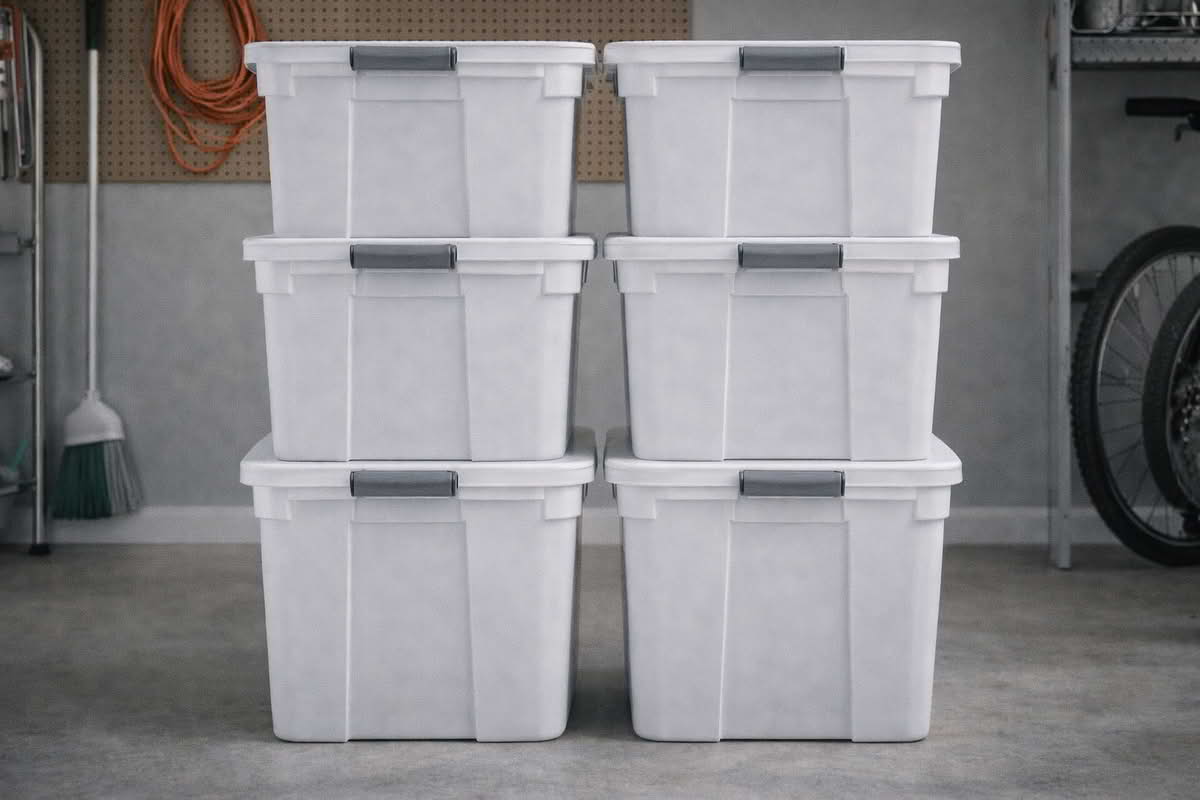
Stackability sounds straightforward, but many bins that technically stack do not stack especially well. Some nest securely when empty but become unstable once filled. Others stack only when the lid is perfectly seated and the loads are evenly distributed. In practical home storage, loads are rarely perfect. One bin may contain soft decorations, another heavy books, another irregular supplies. Better stackability comes from a combination of lid stability, base design, and consistent sizing across multiple containers. A stack of identical bins generally performs far better than a tower of mismatched shapes purchased over time.
Handles and grip points matter too. Buyers often overlook them until a full bin has to be lifted from a high shelf, carried down stairs, or shifted out of a crowded garage stack. A bin that is awkward to grip encourages overhandling, dragging, or avoiding access altogether. This is one of the quiet ways storage systems fail: the bin technically works, but it is annoying enough that people stop using it well.
Real stackability depends on lid stability, bin shape, and consistent sizing, not just on whether one container can sit on top of another.
Another practical consideration is whether the bin needs to resist moisture, dust, pests, or rough handling. Not every household category requires the same level of protection. Clothing stored in a closet has different needs than tools in a garage or decorations in an attic-adjacent zone. Buying every bin as if it must handle the harshest possible conditions can waste money, but buying all bins as if they live in a gentle indoor environment can create preventable problems. The better approach is to match protection level to the real storage conditions.
Visibility, Access, and Long-Term Organization Separate Good Bins From Cheap Clutter
The most successful plastic storage bins do more than contain things. They support a storage system that remains understandable months later. This is where visibility and access become more important than simple capacity. Clear bins, translucent bins, and opaque bins each have a place, but they encourage different storage behavior. Clear bins make it easier to identify contents quickly, which can reduce friction and help households maintain organization. Opaque bins can create a cleaner visual look and may be fine for highly stable categories, but they depend more heavily on labeling and category discipline.
Visibility is especially useful in mixed-use spaces such as garages, utility rooms, linen zones, or family storage areas where categories can change or overlap. Being able to confirm contents without opening every container saves time and reduces rummaging. At the same time, full visibility is not always ideal. In living-adjacent spaces, bedrooms, and more polished storage zones, opaque or semi-opaque bins may create a calmer appearance. The right choice depends on whether the priority is fast identification, visual quiet, or a balance of both.
Access patterns are just as important. A good bin system should not require constant lifting, unstacking, or lid removal for ordinary use. Buyers often build vertical stacks that look efficient but become frustrating because the items they need most often are trapped beneath slower-moving containers. This is not really a bin problem. It is a system problem. Still, the design of the container affects how easy it is to correct. Bins that are too heavy when full, too deep to sort well, or too awkward to move make access problems much worse.
Choose clear or translucent bins when quick identification reduces friction and helps maintain the system.
Choose opaque bins when the storage category is stable and the room benefits from a calmer, less visually busy look.
Choose sizes you can realistically lift and reposition once the bin is actually filled.
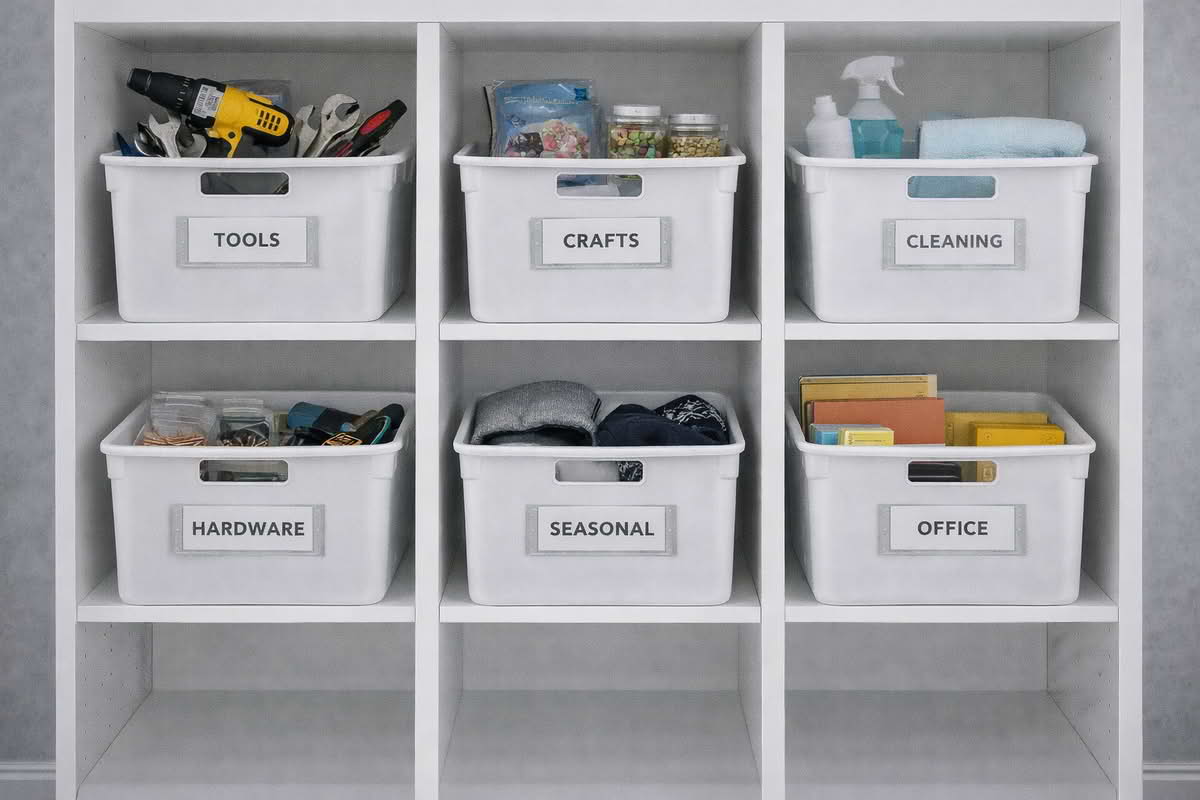
Long-term organization also depends on standardization. One of the easiest ways to make storage worse is to accumulate random bins over time. Different footprints, lid styles, heights, and materials create inefficiency on shelves and reduce the reliability of stacking. A more standardized system may seem less flexible at first, but it often performs far better because labels align, stacks behave predictably, and storage zones become easier to understand at a glance. Even using just two or three repeatable sizes can create a much stronger household system than buying a different bin for every problem.
Labels matter, but bin design determines whether labels can work well. Smooth surfaces, consistent front faces, and predictable placement all make category labeling easier to maintain. When bins lack usable label zones or vary too much in size, labeling becomes less consistent and the storage system becomes harder to scan. This is a small detail, but it plays a large role in whether a bin system stays useful across seasons and reorganizations.
In the long run, the best plastic storage bin purchases are usually the least dramatic ones. They are not necessarily the largest, cheapest, or most heavily advertised. They are the bins that fit the space, match the storage category, stack reliably, and remain easy to live with when real household life gets messy. That combination matters more than any single feature because a bin is only successful if people still want to use it correctly months later.
Final Recommendations — Choosing Plastic Storage Bins With Fewer Regrets Later
The right plastic storage bin is the one that works as part of a storage system rather than as an isolated container. Buyers usually get better results when they think in terms of category, location, and access frequency instead of buying whichever bin seems close enough in size. A slightly better fit almost always outperforms a slightly larger or cheaper container that creates stacking, lifting, or visibility problems later.
Choose standardized bins when you want cleaner stacking, easier labeling, and a more maintainable long-term storage system.
Choose sturdier, latching-lid bins for garages, seasonal storage, and categories that are moved or stacked regularly.
Choose clearer bins when quick identification matters more than visual concealment.
Choose smaller or shallower bins when access frequency and realistic lifting comfort matter more than maximum container volume.
A low-regret bin purchase makes storage easier to manage, not just easier to postpone. When size, durability, lid design, and visibility all align with the real job, plastic bins stop being generic containers and become reliable infrastructure for a calmer, more workable home storage system.