Smart Space Heater and Heating Control Buying Guide for Practical Room-by-Room Warmth
Space heaters are often bought in response to a very specific frustration: one room feels colder than the rest of the home, and the main HVAC system does not solve it efficiently. The smart version of that purchase adds app control, scheduling, and remote status checks, which can be useful, but also easy to misunderstand. A heater with smart features is not automatically a better heater, and app control does not remove the need to think carefully about room size, placement, noise, daily use, and how the household actually wants warmth to work. The best purchase usually comes from treating the heater as part of a room-level comfort strategy rather than as a gadget. This guide focuses on those practical tradeoffs so you can choose a smart space heater or control setup that fits the room, supports consistent daily use, and adds convenience without turning seasonal heating into another overcomplicated routine.
Start with the room and the heating job you actually need done
The most useful way to shop for a smart space heater is to begin with the room, not the feature list. A bedroom that feels chilly at night, a home office used during work hours, a drafty finished basement, and a bathroom that only needs a short burst of warmth all create different heating demands. Buyers often treat space heaters as broadly interchangeable, but the heating role matters because it determines whether the right answer is steady supplemental warmth, quick spot heating, light comfort support during cold mornings, or something closer to all-day room-level assistance.
This is where many purchases go wrong. Someone buys a heater because the room is uncomfortable, but never defines why it is uncomfortable. Is the problem that the HVAC system leaves the room behind? Is the room only used at certain hours? Is the chill mainly at floor level or only during certain weather? Is the goal personal comfort at a desk, or warming a whole room enough that everyone notices the difference? These are all valid needs, but they do not point toward the same heater size, shape, or control style.
Room size and insulation matter as much as the heater itself. A compact heater may feel effective in a small office or bedroom corner but underwhelming in a large open room with high ceilings or strong drafts. Likewise, a heater that seems powerful on paper may still struggle in a cold garage-adjacent room or an older space with poor insulation. Buyers sometimes assume a more connected heater will solve a harder room problem, when the real limitation is not the smart control layer but the building conditions around the room.
Define whether you need personal warmth, small-room support, or broader supplemental heating.
Match the heater to the room’s actual size, layout, and insulation quality.
Think about whether the room is used occasionally, on a schedule, or all day.
Do not expect app features to compensate for a heater that is undersized for the space.
It also helps to decide whether the heater is replacing a manual habit or supporting a broader climate-control plan. In some homes, the value is simply not having to walk into a cold office every morning. In others, the heater is part of a strategy to avoid pushing central heating harder for one difficult room. That distinction matters because a heater intended for occasional comfort boosts should be judged differently from one expected to become part of the household’s normal temperature rhythm.
Portable heater style influences that experience too. Compact tower-style heaters, more directional personal heaters, and room heaters designed for steadier output can all feel different in use even when they share similar marketing language. A small heater near a desk solves a different problem from a heater meant to support an entire bedroom before bedtime. The better the room problem is defined, the easier it becomes to evaluate whether a given smart heater category is truly appropriate.
Smart space heaters work best when their size, output style, and control features are matched to a specific room-level comfort problem.
A common mistake is trying to solve a full-home comfort issue with a single smart heater in one room. If the house has systemic heating imbalance, a space heater can be helpful, but only as a targeted support tool. It is most valuable when it handles a specific comfort gap rather than being asked to mask a much larger HVAC or insulation problem.
The safest starting point is to treat the heater as a room-specific climate tool. Once the room’s actual problem is clear, smart features become easier to judge realistically instead of acting as a shortcut around basic heating fit.
Choose smart controls and scheduling that fit real daily habits
Smart features matter in this category most when they reduce repeated friction. That usually means remote on-off control, scheduling, temperature setting visibility, or the ability to warm a room before someone enters it. These are useful improvements, but only when the heater is being used in a routine that actually benefits from them. Buyers are often tempted by the idea of “app-controlled heat” before asking whether the room’s heating pattern is regular enough for those tools to matter.
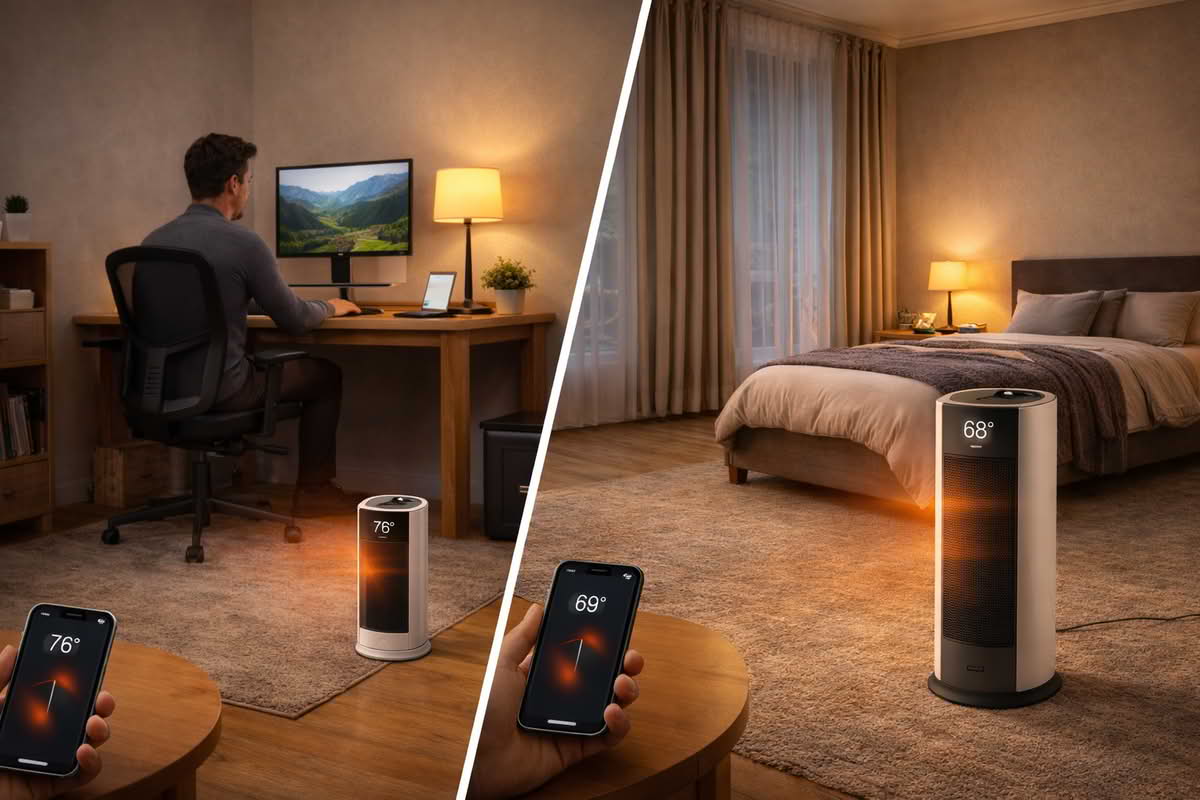
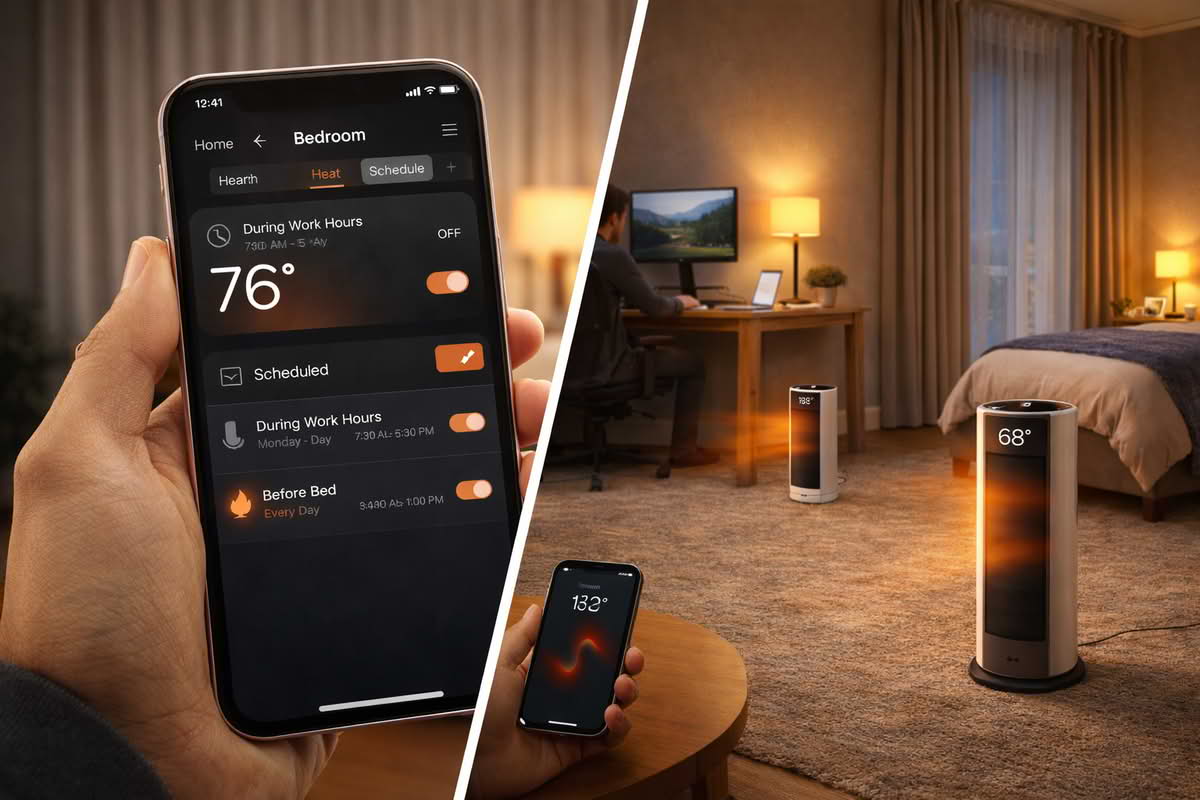
Scheduling is one of the clearest benefits. A bedroom that needs gentle warmth before bedtime, a home office that should be more comfortable at the start of work, or a spare room used only at certain times can all benefit from a heater that starts and stops with some predictability. In those situations, scheduling removes manual repetition and can make the heater feel integrated into the room rather than like a temporary seasonal device that someone has to remember every day.
Remote control can also be helpful, especially when the room is separate from the main living area or when the heater is tucked into a space that is inconvenient to reach directly. But remote control should not be romanticized. The real value is not that you can operate the heater from anywhere. It is that you can adjust warmth without extra friction when the household routine actually calls for it. If you rarely change settings once the heater is running, app access may matter less than basic control clarity and steady performance.
This is also where some buyers start considering smart plug control as an alternative. That can sound appealing because it seems to turn a normal heater into a smart one. But heating devices should be judged carefully based on how they are designed to be controlled and whether they return to a usable state after power interruption. A heater control setup is only practical when the heater itself supports predictable behavior safely and consistently. The better path is usually the one that respects how the heater is actually meant to operate rather than forcing smart control onto a device that was not designed around it.
Choose app control and scheduling when the room’s heating need follows a regular daily pattern.
Use remote access as a convenience layer, not as the main reason the heater is worthwhile.
Be realistic about whether you need true smart control or simply a heater that is easy to use manually.
Think about heating-control setups in terms of predictable room comfort, not just device connectivity.
The interface matters too. A heater that is mainly controlled through an app still exists in a physical room and will still be touched directly. The onboard controls should be easy to understand, because heating is one of those categories where people often want quick adjustments during ordinary life. If the heater works well only when the app is open, it may feel less practical in a shared household where other people simply want the room warmer or cooler without learning a new system.
Shared use is especially important in bedrooms, family rooms, and home offices that may serve more than one purpose. A person working from home may want one heating pattern. Another adult entering the room later may want something different. A smart heater should make those transitions easier, not become one more point of negotiation because only one person understands the settings or schedules.
Smart heater features are most useful when they support predictable room routines such as work hours, bedtime warmth, or scheduled cold-weather use.
This is also a category where feature depth can be overrated. A heater does not become more useful just because it offers several automation layers. In many homes, the ideal control pattern is simple: warm the room before use, maintain comfort during occupation, and stop when the room is no longer needed. The best smart heaters often succeed through modest convenience rather than through extensive automation complexity.
The better buying mindset is to ask whether the controls help the room fit daily life more cleanly. If the answer is yes, the smart features are likely adding value. If not, a simpler heater may be the better long-term choice.
Judge heaters by long-term usability, not just app features
Once a space heater is in the room, daily satisfaction is shaped far more by its lived behavior than by the product page. This includes how steady the warmth feels, how noticeable the noise is, how well the heater fits the room physically, and whether it becomes part of the space without constant adjustment. Smart features matter, but they are only one layer of ownership. The heater still has to work as a heater first.
Noise is one of the most underestimated factors in this category. A heater used in a bedroom, office, or quiet reading room will be experienced very differently from one used in a utility space or busy family area. Buyers often tolerate more sound during initial winter use than they expect to in the long run. If the heater runs during sleep, calls, focused work, or evening downtime, the difference between acceptable background sound and persistent irritation becomes important very quickly.
Physical presence matters too. Some heaters tuck naturally beside a desk or wall, while others take up noticeable floor space or compete with furniture layouts. A heater that blocks movement paths, feels awkward near seating, or becomes a seasonal object that is always being repositioned can lose value even if its smart controls are solid. This is especially true in smaller homes, apartments, and bedrooms where every floor-standing device changes the feel of the room.
Prefer heaters that match the room’s noise tolerance and physical layout.
Judge the heater as a daily room object, not just as a connected appliance.
Value steady comfort and easy use over feature-heavy control that adds little practical benefit.
Think about whether the heater will still feel worthwhile after a full heating season, not just during the first cold week.
Long-term cost should also be framed practically. A space heater may feel like a cheaper or more flexible solution than increasing whole-home heating, and in the right room that can be true. But the better comparison is not simply “heater versus furnace.” It is whether the heater provides enough targeted comfort to justify its daily use, space footprint, and control complexity. In a well-defined room problem, the answer may absolutely be yes. In a vague or inconsistent use case, the heater can become a seasonal compromise rather than a satisfying solution.
Another quiet issue is trust. Heating devices are less forgiving than some other smart-home purchases because people notice immediately when comfort is off. If the app is unreliable, the schedule behaves unpredictably, or the heater feels inconsistent from one day to the next, the household quickly stops relying on the smart layer. That is why the best smart heaters are often the ones that behave calmly and clearly. The smart functions should support the heating routine, not make it feel more fragile.
It is also worth remembering that a smart space heater is only one piece of a room-comfort strategy. Curtains, drafts, insulation gaps, flooring, window exposure, and room occupancy patterns all shape whether a heater feels effective. Buyers sometimes expect the heater alone to transform a difficult room. Sometimes it helps significantly. Sometimes the heater works best as part of a broader comfort improvement plan. That is not a flaw. It is simply a reminder to judge the device within the real conditions of the room.
The lowest-regret buying mindset is to favor the simplest heater that fully meets the room’s comfort need while offering smart control only where it genuinely reduces daily friction. That may mean an app-controlled heater with good schedules in one room and a more basic solution elsewhere. Better fit matters more than broader ambition, especially in a seasonal category that must justify itself through steady practical use.
Final Recommendations — choosing room heating that adds comfort without extra hassle
The right smart space heater is usually the one that fits a clear room-level heating problem, supports a realistic daily routine, and stays easy to live with once the season settles in. Start with room size, room use, and comfort expectations, then choose the level of scheduling and app control that actually improves the heating pattern without adding unnecessary complication.
Choose app-controlled space heaters when the room follows a predictable schedule and remote warmth adjustments truly add convenience.
Choose compact room heaters when the goal is focused supplemental warmth in smaller spaces rather than broader room support.
Choose scheduling-focused options when the real problem is repeated manual heating at the same times each day.
Prioritize room fit, steady comfort, understandable controls, and long-term usability over feature-heavy connectivity claims.
In the long run, the best smart heater setup is the one that makes a cold room easier to use without becoming another device that constantly asks for attention. Good room heating should feel calm, predictable, and easy to trust, with smart features serving the comfort routine rather than distracting from it.