How to Choose a Slow Cooker or Multi-Cooker for Everyday Home Meals
Slow cookers and multi-cookers often get grouped together because they both promise easier meals, but they solve kitchen problems in very different ways. That difference is where many buying mistakes begin. Some buyers want a dependable set-it-and-leave-it cooker for soups, shredded meats, stews, and low-effort dinners, then get pulled toward a more complex appliance they do not actually want to manage. Others buy a basic slow cooker because it feels simple and familiar, then realize later that they wanted faster cooking, browning, rice, beans, or broader one-pot flexibility. The better decision is not about choosing the machine with the longest list of modes. It is about choosing the one that fits how you plan meals, how much control you want, and how the appliance will live in your kitchen. Capacity, insert design, control layout, cleanup burden, and cooking style all matter more over time than broad claims about convenience alone.
Start with the kind of cooking you actually want
The most useful place to begin is not the feature list. It is the cooking pattern you want the appliance to support. Some households want low-effort meal prep that starts in the morning and quietly finishes by dinner. In that case, the appeal is often predictability, simplicity, and minimal hands-on time. Other households want one appliance that can handle weeknight speed, pressure cooking, rice, beans, soups, and a wider range of one-pot tasks. Those kitchens are usually not just looking for passive cooking. They are looking for flexibility and time compression. The correct purchase depends heavily on which of those goals matters more.
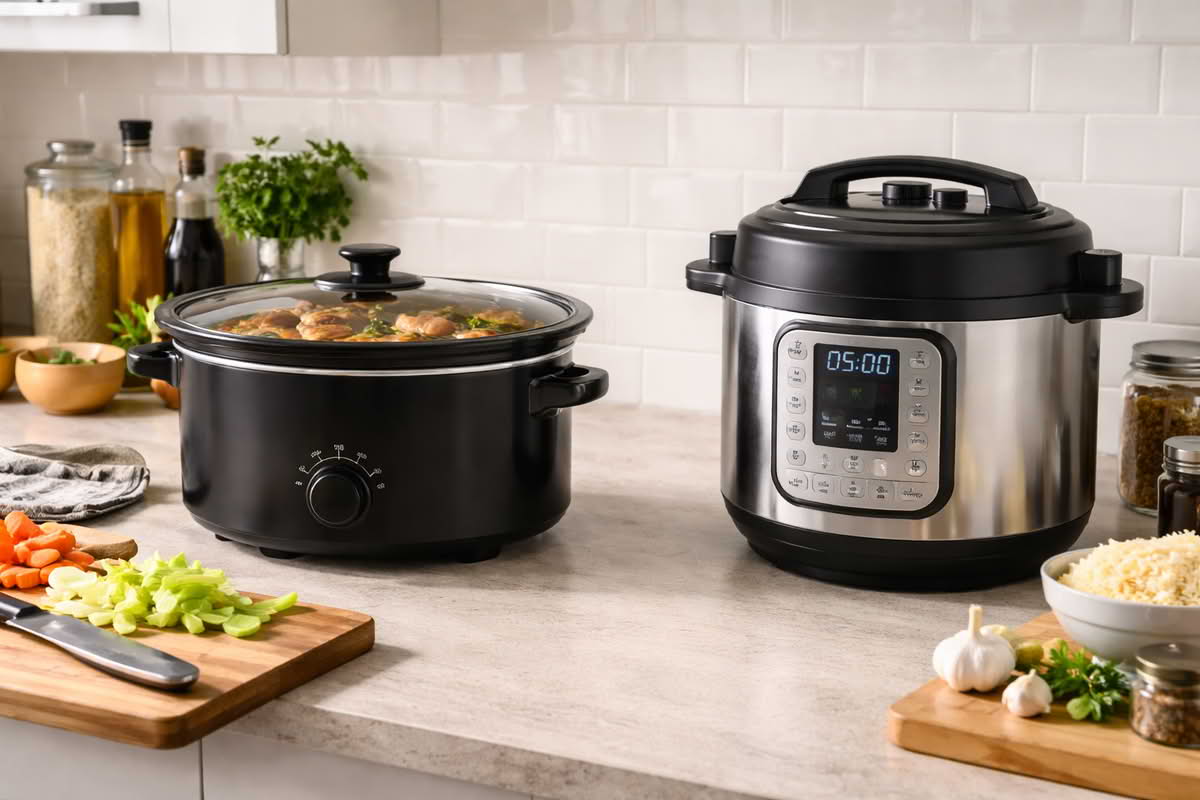
Slow cookers and multi-cookers may seem similar at a glance, but they usually serve different kitchen roles and ownership styles.
This is where confusion often sets in. A slow cooker sounds limited compared with a multi-cooker, so buyers sometimes treat it as the less serious option. But limitation is not always a weakness. In many kitchens, a simple appliance is exactly the point. A slow cooker can be easier to understand, easier to trust, and better aligned with households that want reliable long cooking without extra decisions. The appliance does one core job, and if that job matches the way you feed the household, then complexity may add less value than buyers expect.
Multi-cookers appeal for the opposite reason. They seem to reduce appliance sprawl by promising multiple functions in one body. That can be genuinely useful, especially for kitchens that want faster cooking and are comfortable interacting more actively with settings, modes, and timing. The problem is that buyers sometimes pay for flexibility they will not use. A multi-cooker that ends up repeating only one or two basic tasks may still be worthwhile, but it may also be more machine than the household really needed.
Another common mistake is imagining the appliance as a lifestyle transformation instead of a kitchen tool. Buyers may picture themselves batch cooking constantly, using every program, or planning meals around the machine several times a week. In practice, the real question is simpler: what meal problems keep showing up now? If the issue is wanting dinner to develop slowly without supervision, one path makes sense. If the issue is wanting to cook dried beans faster, move from sauteing to pressure cooking in one pot, or replace several smaller countertop tools with one device, another path makes more sense.
Choose based on whether you want passive long cooking or broader all-in-one flexibility.
Do not assume more functions automatically create more practical value.
Match the appliance to repeated meal problems, not to an imagined future routine.
Think about how much interaction you want during cooking, because that changes the better fit.
Frequency of use matters too. A slow cooker that comes out once a week for dependable soups, shredded meats, or stews can be a smart purchase even if it does not do much else. A multi-cooker becomes easier to justify when it is handling several regular roles throughout the week rather than sitting idle between occasional recipes. This is why the better purchase is often the one with the clearest role rather than the broadest promise.
It also helps to think about meal timing. Slow cookers tend to fit kitchens that plan earlier and want dinner readiness later without much attention. Multi-cookers tend to fit kitchens that need more flexibility at the moment of cooking, especially when dinner decisions happen later in the day or when speed matters. Neither timing model is inherently better. The important thing is choosing the appliance that matches your actual schedule instead of the schedule you wish you had.
A good purchase in this category usually feels realistic. It supports the household's pace, meal style, and planning habits without asking everyone to adapt too much around the appliance itself. That is what turns it into a dependable kitchen tool rather than a temporary countertop experiment.
How slow cookers and multi-cookers change the workflow
Once the meal pattern is clear, the next question is how each appliance changes the actual cooking workflow. Slow cookers and multi-cookers are both sold as convenience tools, but their convenience works differently. A slow cooker reduces involvement. A multi-cooker often compresses steps. That may sound like a small distinction, but it becomes very important once the appliance is used week after week.
Slow cookers usually make the most sense when simplicity is the advantage. Add ingredients, choose a setting, and let the appliance do the rest. That kind of low-intervention cooking can be genuinely useful for households that value predictability and want a meal to develop gradually without active management. It is especially helpful when recipes are forgiving and the goal is not fine-grained control but consistent, hands-off cooking. The tradeoff is that slow cookers are not especially fast, and many do not reduce cookware steps if the recipe still requires browning or sauteing elsewhere first.
Multi-cookers are attractive because they promise a more integrated workflow. The same appliance may allow sauteing, pressure cooking, warming, rice preparation, and sometimes additional functions that reduce the need to move food between pans. In kitchens where speed and consolidation matter, this can be a meaningful advantage. But it comes with a different kind of ownership style. Multi-cookers usually ask more from the user in terms of settings, sequence, and understanding how the appliance behaves under different modes. For some households that is a worthwhile trade. For others it creates more friction than the extra flexibility is worth.
Control layout matters more here than in many other appliance categories because it shapes confidence. A slow cooker with clear low, high, and keep-warm logic can be easier to trust than a multi-cooker loaded with labeled buttons that are not all equally relevant to the way you cook. On the other hand, buyers who want timing flexibility, programmable starts, or one-pot cooking steps may find basic slow-cooker controls too limiting. The right interface is not the most sophisticated one. It is the one that makes the appliance easy to use well in your actual kitchen.
Insert style is also important. A removable crock or pot changes how the appliance is filled, cleaned, and sometimes used for serving. Heavier inserts may feel durable but can be more cumbersome at the sink. Lighter inserts may be easier to handle but feel less substantial. In some appliances, the insert contributes to the feeling of slow, steady heat. In others, it is more about enabling function changes across cooking modes. Buyers often focus so heavily on headline functions that they miss how much the insert influences daily ownership.
Choose slow cookers when lower involvement matters more than maximum speed or multi-step functionality.
Choose multi-cookers when consolidating several cooking steps in one appliance solves a real problem in your kitchen.
Pay attention to control clarity because confidence affects whether the appliance gets used often.
Think about insert weight, shape, and handling as part of the ownership experience, not as a minor detail.
Capacity and shape affect workflow too. Some recipes benefit from wider space and gentle long cooking, while others depend more on pressure, liquid management, or vertical capacity. A pot that is technically large enough can still feel awkward if its shape does not support the way the household actually cooks. This shows up especially in batch soups, roasts, shredded meats, beans, and grain-based meals. The pot should support the foods you repeat, not just hit a general size target.
Another overlooked factor is whether you want the appliance to simplify your thinking or expand your options. Slow cookers usually simplify decisions. Multi-cookers expand them. That sounds abstract, but it affects real behavior. Some households thrive with a machine that offers more flexibility. Others do better with an appliance that makes dinner feel easier precisely because it does not ask many questions. The better purchase depends on which kind of help you actually want.
The strongest choices in this category usually come from seeing convenience honestly. Convenience can mean faster cooking, but it can also mean calmer cooking. Buyers who understand which kind of convenience matters in their home tend to choose the appliance that stays in rotation longest.
Capacity, counter space, and long-term value
Long-term value in this category depends heavily on proportion. The appliance needs to be large enough for the meals you repeat and compact enough that it does not become a burden to store, clean, or keep on the counter. Many buyers overshoot size because they want to feel prepared for larger meals or occasional gatherings. Others go too small for the sake of convenience and then feel cramped once the appliance is asked to handle normal family portions. Both problems usually come from buying around rare scenarios instead of repeated use.
A larger appliance can make sense for families, batch cooking, or households that rely heavily on soups, stews, shredded meats, or meal prep. But size only helps if the kitchen can support it. Countertop space, cabinet storage, sink size, and how often the machine needs to move all influence whether a larger cooker feels practical. A big appliance that lives awkwardly in the kitchen may become less useful than a slightly smaller one that is easier to reach and easier to use regularly.
Appliance size matters most when it affects how easily the cooker fits into normal kitchen workflow, storage, and repeated use.
Counter footprint matters especially with multi-cookers because they often replace several hoped-for roles and therefore tempt buyers to tolerate more bulk. Sometimes that makes sense. Sometimes it leads to an appliance that dominates the counter without earning its place through actual frequency. Slow cookers can create a similar issue if the household uses them only occasionally. This is why kitchen size alone is not the real question. The better question is whether the physical demands of the appliance are proportionate to how much it will genuinely improve the cooking routine.
Cleaning is part of value too. A cooker that simplifies dinner but leaves behind a frustrating lid, insert, gasket, or interior-cleaning routine may not feel especially convenient after the first few weeks. Slow cookers often appeal partly because they are conceptually simple, and that simplicity should extend into ownership. Multi-cookers often justify their extra complexity by reducing total cookware use, but that advantage only matters if the cleanup process still feels reasonable. Since these appliances are often chosen to make meal prep easier, hidden cleanup friction can quietly reduce long-term satisfaction.
Cost should be interpreted through role and repetition. A budget slow cooker can be a strong purchase if the goal is reliable, passive cooking for a narrow but important set of meals. A mid-range appliance often makes the most sense for many households because it improves capacity, controls, and handling without forcing the buyer into maximum complexity. Higher-priced multi-cookers make more sense when the household truly benefits from the broader cooking modes and will use them often enough to matter. The mistake is paying for expansive flexibility when the kitchen mainly wants one dependable function.
Choose capacity around repeated household meal size, not occasional maximum-demand events.
Let counter space and storage reality influence the decision as much as the feature list.
Judge cleanup burden as part of convenience, because hard-to-maintain appliances often get used less.
Spend more only when added functions clearly support meals you already make or plan to make regularly.
Another common regret pattern is buying the more impressive-looking appliance even when the simpler one was the better fit. The reverse also happens: buyers choose the simpler appliance to save money or avoid complexity, then feel limited once their real cooking habits demand more flexibility. Both outcomes come from treating the category like a ranking instead of a fit decision. A good purchase should feel appropriate to the household, not just technically capable.
Replacement logic is also worth considering. Some kitchens do best with one simple slow cooker because other appliances already cover the rest of the workflow. Other kitchens benefit from a multi-cooker because it becomes the main one-pot appliance for several recurring jobs. There is no single correct answer. What matters is whether the machine clearly fits into the broader kitchen system instead of duplicating roles without improving the process.
The best long-term purchase usually feels quietly useful. It handles the meals you actually make, fits the kitchen without constant inconvenience, and remains approachable enough that using it does not feel like a separate project. That kind of low-regret fit is what creates value over time.
Final Recommendations — choosing the cooker that matches your meal planning and your kitchen
A good slow cooker or multi-cooker should be chosen by cooking style, household timing, and ownership fit rather than by mode count alone. Buyers who want calm, low-intervention meals usually do best with a straightforward slow cooker that supports dependable long cooking without extra complexity. Buyers who want broader one-pot flexibility, faster cooking, and more task consolidation usually benefit more from a multi-cooker, but only when those extra functions genuinely match the way the kitchen already works. In both cases, the goal is the same: make regular meals easier without adding more appliance friction than the convenience is worth.
Choose based on the kind of convenience you want: passive long cooking or broader all-in-one flexibility.
Match capacity and footprint to your normal meals and your actual kitchen space.
Prioritize control clarity and cleanup practicality alongside cooking features.
Spend for better long-term fit, not just for the appliance that promises the most functions.
The lowest-regret purchase is usually the one that feels proportionate to your routine. It fits the way you plan dinner, the meals you repeat, and the amount of kitchen complexity you are actually willing to manage. When that match is right, the appliance becomes part of everyday cooking instead of a machine you keep meaning to use more often.