How to Choose an Immersion Blender for Everyday Kitchen Use
Immersion blenders are easy to underestimate because they look simple, compact, and narrowly specialized. In practice, they can become one of the most convenient small appliances in a kitchen when the fit is right. They can also become drawer clutter if the model is underpowered, awkward to grip, too messy in use, or sold with attachments that sound versatile but add little real value. Many buyers choose one as an impulse convenience purchase and only later realize that control, shaft length, blade guard design, and cleanup matter much more than the product photos suggest. The better approach is to treat an immersion blender as a workflow tool. It should make soups, sauces, dressings, small-batch blending, and quick prep easier without adding more setup and cleanup than the task deserves. When it fits the way you cook, it saves time and counter space. When it does not, it becomes another appliance that seemed more useful in theory than it feels in daily use.
Start with the jobs an immersion blender does best
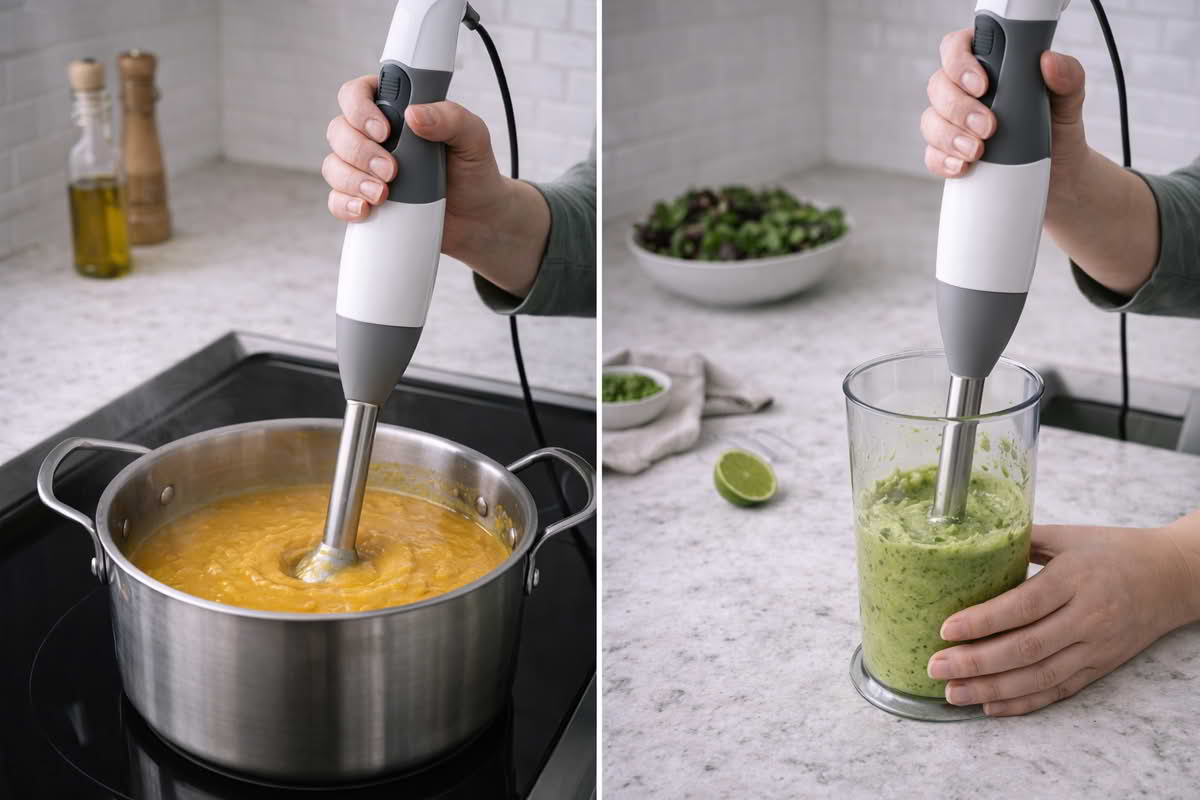
The best way to buy an immersion blender is to begin with its actual strengths rather than its marketing promises. This type of blender is usually most useful when you want to blend directly in a pot, bowl, beaker, or container without transferring ingredients into a full-size machine. That makes it especially practical for soups, sauces, dressings, baby food, refried beans, small-batch purees, whipped mixtures, and quick emulsified tasks where convenience matters more than maximum batch size. If those are the jobs causing repeated friction in your kitchen, an immersion blender can be a smart and efficient tool.
An immersion blender is most useful when it simplifies repeated kitchen jobs like blending soups, sauces, and small-batch mixtures directly in the vessel already being used.
This is also where many buying mistakes begin. Buyers often expect an immersion blender to replace a countertop blender, food processor, and mixer all at once. Some models can stretch into adjacent tasks, but that does not mean they are equally good at all of them. An immersion blender is strongest when the recipe is relatively contained, moderately sized, and benefits from direct blending in the cooking vessel. Once you ask it to handle large frozen drinks, heavy dough-like mixtures, or high-volume blending for multiple people, the limitations become much more obvious.
Small-batch utility is often the core value here. A full-size blender can feel excessive for a quick sauce or a pot of soup that just needs smoothing. Pulling out a large machine, transferring hot ingredients, securing the lid, and washing a big jar may create more work than the blending itself. An immersion blender can remove that friction. But only if the kitchen genuinely needs that kind of convenience. If most blending tasks are larger, colder, or more smoothie-driven, a full-size blender may still be the more logical primary tool.
Another important distinction is between occasional convenience and routine dependence. Some households want an immersion blender as a supporting appliance for a few specific tasks each month. Others will use it several times a week because soups, sauces, dressings, and quick blending are already part of normal kitchen life. Those are different buying situations. A lighter-duty model may be perfectly reasonable when the appliance is only handling simple, short tasks. A more robust model makes more sense when the blender is expected to be a regular kitchen workhorse.
Choose an immersion blender when you want to blend directly in pots, bowls, or smaller containers.
Think about whether your main use is soups and sauces or whether you actually need a larger blender for bigger batches.
Match the tool to repeated kitchen friction, not to the broadest list of occasional possibilities.
Do not assume a hand blender should replace every other blending appliance you already own.
Texture goals matter as well. Some buyers simply want to smooth soups and combine ingredients evenly. Others want finer emulsions, smoother purees, or better results with tougher ingredients. An immersion blender can absolutely improve speed and convenience, but it does not eliminate the need to think about how smooth you expect the end result to be. If precision texture matters a great deal, then control, motor consistency, and blade design become more important than basic category fit.
It also helps to think about the physical act of blending. Unlike a countertop unit, an immersion blender keeps the user involved the whole time. You guide it, move it through the ingredients, and control how long it works in each area. That can be a strength because it offers flexibility and direct control. It can also become tiring or messy if the model is poorly balanced, heavy in the wrong places, or difficult to hold steadily. The right immersion blender should make the work feel lighter, not merely more mechanized.
A smart purchase in this category usually comes from clarity. If the appliance is being chosen to simplify a small set of repeated kitchen jobs, it can be extremely useful. If it is being chosen because it sounds versatile in a vague way, disappointment becomes much more likely.
Power, control, and attachments in real kitchen use
Once the role is clear, the next questions are how much power, control, and accessory support you actually need. These are often treated as straightforward upgrade points, but with immersion blenders they are more interconnected than they seem. More power can help, but not if the tool becomes harder to control. More attachments can increase versatility, but not if they mostly add storage bulk and cleanup. The best choice usually comes from balancing performance with handling.
Basic immersion blenders often make sense for straightforward kitchen use. If the goal is blending soups, sauces, and dressings without much resistance, a simpler model may cover the job well. The danger is assuming that basic always means sufficient. When ingredients get thicker, hotter, or more fibrous, underpowered models can feel slow, inconsistent, or frustrating. Instead of smoothly reducing texture, they may require longer blending times, more scraping, or repeated repositioning. That does not mean every buyer needs the strongest motor available. It means power should be matched to the kinds of ingredients that appear most often.
Control matters just as much as raw strength. A hand blender that only feels effective at one aggressive speed can be difficult to use cleanly, especially in shallower containers or softer mixtures where splashing is a risk. More variable control can be useful when you want to build texture gradually, blend hot ingredients more carefully, or avoid overprocessing. Some kitchens will appreciate that nuance immediately. Others may prefer simpler operation. The important thing is not to confuse maximum force with better blending. Predictability matters more in daily use.
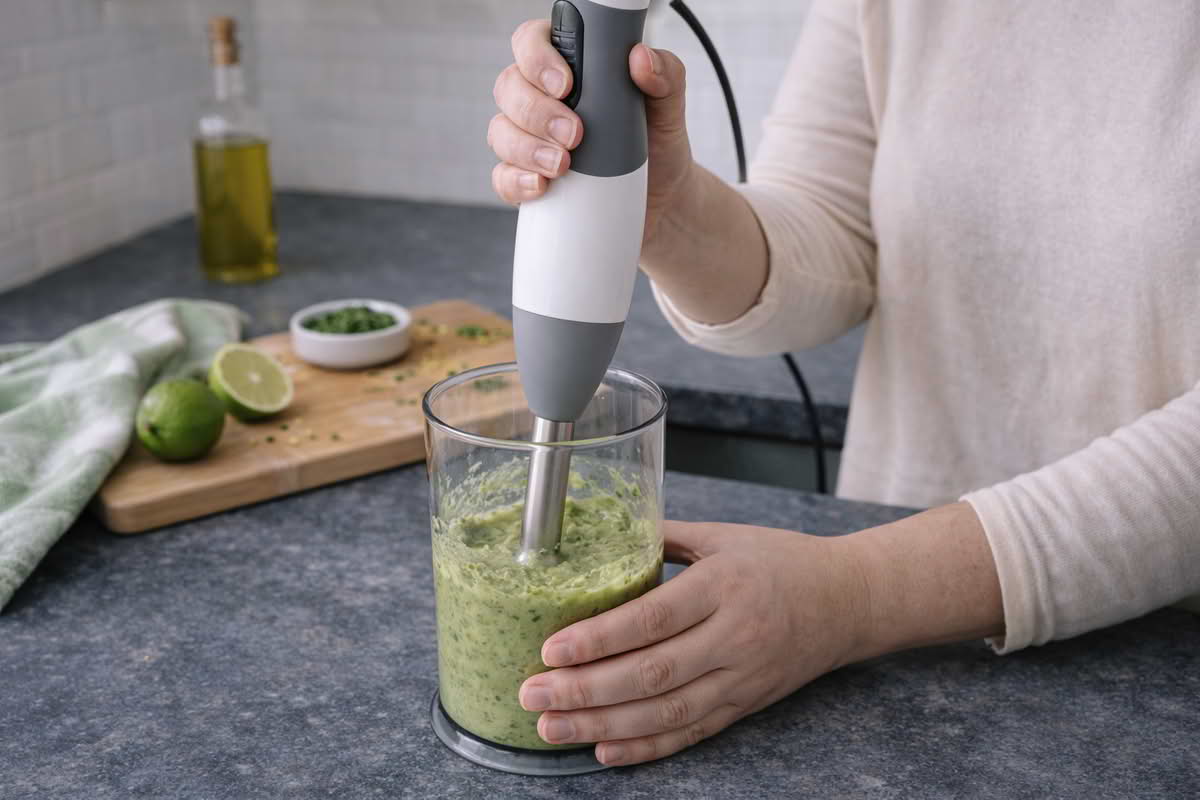
A good immersion blender should feel controlled and predictable in the hand so blending stays smooth, manageable, and less messy in everyday kitchen use.
Shaft design and blade guard shape are also more important than they first appear. These affect how the blender moves through ingredients, how close it can get to the bottom of a pot or cup, and how likely it is to splash. A design that traps food awkwardly, creates dead zones, or sends liquid upward too aggressively can make the appliance feel messy and imprecise. A better-designed head usually feels calmer in use, which is especially important for hot liquids and small containers where mistakes are more noticeable.
Attachments are where many models try to justify higher prices. Chopper bowls, whisk attachments, beakers, mashers, and mini processor systems can all sound appealing. Sometimes they are genuinely useful. A whisk can help with lighter whipping and mixing jobs. A chopper bowl can make quick work of onions, herbs, or nuts when used often enough to matter. But many households overestimate how often these extras will come into rotation. Every added attachment introduces another part to wash, store, and remember. A set with many extras is not automatically a better value if the main blending unit remains the only part that gets used consistently.
Choose more power when you regularly blend thicker, hotter, or more demanding ingredients.
Look for control that helps you blend gradually, especially in smaller containers or delicate tasks.
Pay attention to blade guard and shaft design because they affect splashing and overall handling.
Choose attachments based on repeated use, not just on the appeal of extra versatility.
Corded versus cordless design also changes the ownership experience. Cordless models can feel more flexible and less cluttered in motion, especially for quick jobs and kitchens where outlet access is awkward. But that convenience only matters if battery upkeep and runtime limits fit the routine. A corded model may feel less elegant, yet provide more dependable readiness and fewer charging concerns. The right choice depends on whether you value spontaneous grab-and-go handling or more predictable uninterrupted use.
Grip comfort deserves serious attention because immersion blenders are held throughout operation. A slippery finish, awkward handle angle, or bulky grip can make even a technically capable blender feel tiring. This matters most in hot soup pots, larger batches, or thicker mixtures where the appliance stays in the hand longer. The tool should feel balanced enough that control remains easy, not tense or awkward. In this category, ergonomics are not secondary. They are part of performance.
The best immersion blenders usually feel well judged rather than overbuilt. They have enough strength for the intended jobs, enough control to stay manageable, and enough accessory support to be useful without turning the product into a box of seldom-used parts. That balance is usually what separates a daily tool from a promotional bundle.
Cleanup, storage, and long-term value
One of the biggest advantages of an immersion blender is that it can reduce both blending and cleanup effort at the same time. But that advantage only holds if the model itself is easy to clean and simple enough to keep accessible. Buyers often assume every hand blender is inherently convenient because the category looks compact. In reality, convenience varies quite a bit depending on removable parts, blade housing design, attachment count, and how messy the tool becomes during real use.
The strongest models in daily life are usually the ones that rinse off quickly, come apart easily, and do not trap food in awkward seams or around the blade guard more than expected. That may sound minor, but it matters because immersion blenders are often used specifically to save time on small or moderate tasks. If cleanup feels fussy, much of that convenience disappears. A quick soup blend or dressing mix should not create a cleanup routine that feels out of proportion to the task.
Storage is another major part of value. One reason this category works so well is that the appliance can often be tucked into a drawer, cabinet, or narrow space more easily than a larger blender or processor. But that advantage can shrink once multiple attachments, charging bases, oversized beakers, or accessory cups enter the picture. A set that seems compact in principle can become surprisingly bulky in practice. Buyers who want a truly easy-grab tool should think carefully about whether the full kit will actually store cleanly in the kitchen they have.
Accessibility changes behavior here just as it does with larger appliances. A simple immersion blender stored near the stove or prep area may get used often enough to become indispensable. A more elaborate set split across drawers and cabinets may be used much less, even if it is technically more capable. The lowest-friction tools tend to win in ordinary kitchens because they ask less before the work can begin.
Long-term value also depends on how honestly the appliance is positioned in the broader kitchen system. A budget immersion blender can make perfect sense when the goal is occasional soup blending, simple sauces, or light support alongside other appliances. A mid-range model often gives many households the best balance of strength, control, and everyday durability. Higher-priced models make more sense when the appliance is expected to be used often, handle tougher textures, or replace several smaller prep frustrations on a regular basis. The mistake is paying for a premium bundle when the kitchen only needs a dependable main unit.
Judge cleanup as part of the purchase, because convenience is one of the main reasons to buy this type of blender.
Choose a setup that stores easily enough to stay accessible for quick jobs.
Be cautious of attachment-heavy kits if the extra parts will complicate storage and washing.
Spend more only when better control, durability, or power clearly improves tasks you actually repeat.
Another common form of regret is buying too little tool for the kind of use you already know you have. A very basic model may seem sensible at checkout, then feel weak or frustrating in heavier soup batches, thicker purees, or regular use. The reverse mistake is buying a large accessory-rich kit because it looks comprehensive, then discovering that the kitchen mostly uses the main shaft and ignores the rest. Both outcomes come from the same problem: buying for category appearance rather than kitchen reality.
This is why immersion blenders benefit from a narrower, more disciplined buying mindset than many other appliances. They are most valuable when they solve a few jobs extremely efficiently. They become less impressive when expected to be everything at once. A strong long-term purchase keeps that boundary clear. It blends what you actually make, stores without drama, and stays simple enough that using it always feels worth the effort.
When the right balance is found, an immersion blender can become one of the lowest-friction appliances in the kitchen. It shortens cleanup, reduces transfer steps, and fits easily into routines that would otherwise feel slightly more tedious every time. That kind of repeated convenience is what creates real value.
Final Recommendations — choosing the hand blender that fits your routine without adding new friction
A good immersion blender should be chosen for repeated kitchen jobs, not for vague versatility. Buyers who mainly want to blend soups, sauces, dressings, and other smaller-batch recipes usually do best with a model that emphasizes comfortable handling, controlled blending, and easy cleanup. Buyers who expect heavier use or thicker ingredients can justify more power and perhaps a few well-chosen attachments, but only when those strengths clearly improve daily kitchen work. In both cases, the goal is to save effort without replacing one type of friction with another.
Choose the main unit first based on how often and how heavily you expect to use it.
Prioritize control, grip comfort, and easy cleanup alongside motor strength.
Pick attachments only when they solve repeated tasks rather than adding speculative versatility.
Spend for better long-term fit, not just for a bigger accessory list or a more aggressive spec sheet.
The lowest-regret immersion blender is usually the one that feels quick to grab, easy to manage, and genuinely useful in ordinary cooking. When it fits the scale of the task and the pace of the kitchen, it becomes less like a specialty appliance and more like a simple extension of everyday prep.