How to Choose a Food Processor for Everyday Kitchen Prep
A food processor can look like one of those appliances that solves everything at once, which is exactly why it is easy to buy the wrong one. Buyers often get drawn to wattage, attachment lists, or broad promises about versatility without first asking what prep work they actually want to make easier. In real kitchens, the difference between a useful food processor and an annoying one usually comes down to size, bowl design, lid fit, cleanup burden, and whether the machine handles repetitive prep better than a knife and cutting board already do. A processor that is too big for quick jobs may stay in the cabinet. One that is too small may become frustrating the moment meal prep scales up. The best purchase is usually not the one with the longest feature list. It is the one that fits your volume of prep, your storage space, and the kinds of chopping, slicing, shredding, and mixing you actually repeat week after week.
Start with the jobs you want to speed up
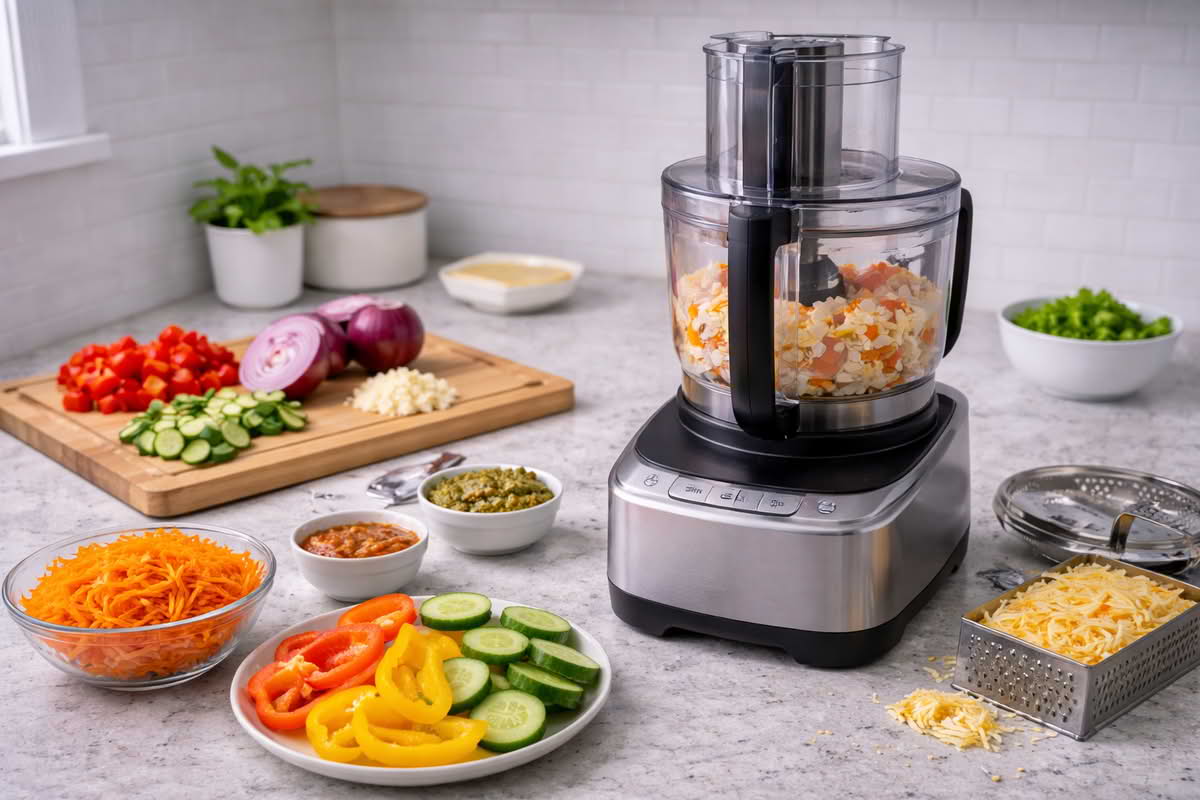
The most useful way to shop for a food processor is to ignore the marketing language for a moment and focus on repetitive prep tasks. Some households want help with chopping onions, mincing herbs, making sauces, or pulsing nuts and breadcrumbs. Others want a machine that can slice vegetables, shred cheese, prep slaws, or speed up larger batch cooking. Those are different jobs, and they do not all point toward the same machine size or feature set. A food processor becomes valuable when it removes real prep friction, not when it simply adds another motorized appliance to the counter.
A food processor is most useful when it saves time on specific prep tasks the kitchen repeats often, such as chopping, slicing, shredding, and sauce-making.
This is where many buyers get off track. They shop for theoretical versatility instead of actual need. A larger machine with multiple blades and discs sounds safer because it appears to cover every future scenario, but if the household mostly uses it for small dips, sauces, and occasional chopping, that size can become a burden rather than a benefit. On the other hand, a compact processor that feels ideal for quick jobs can become limiting if the real goal is weekly vegetable prep, shredding blocks of cheese, or handling ingredients for larger family meals. The more honestly you define the processor's day-to-day role, the easier the category becomes.
It also helps to separate food processors from adjacent appliances in the buyer's mind. People sometimes expect one machine to perform like a blender, a stand mixer, and a chopping station at the same time. That expectation usually leads to disappointment. A food processor is strongest when the job involves controlled cutting, pulsing, slicing, shredding, or mixing thicker ingredients where blade shape and bowl design matter. It is not automatically the best tool for every liquid, every puree, or every dough-like task, even if some models advertise broader capability.
Volume matters here too. A household that cooks in small batches may care less about maximum capacity and more about whether the processor works efficiently with modest ingredient quantities. A larger family or anyone who meal preps heavily may care more about how quickly the bowl fills, how wide the feed chute is, and whether the machine keeps prep moving without constant emptying. Buyers often think in terms of kitchen size alone, but meal size and prep frequency are just as important as square footage.
Choose the processor based on repeated prep tasks, not the broadest possible list of advertised uses.
Think about whether you mainly want chopping and sauces or larger slicing and shredding jobs.
Match capacity to meal size and prep frequency rather than buying only for occasional peak demand.
Do not assume a food processor should replace every other prep appliance in the kitchen.
Another source of regret is underestimating how often the machine needs to justify being pulled out. Appliances that live in cabinets have to earn the effort of retrieval, assembly, and cleanup. A food processor that is only marginally faster than hand prep for the jobs you actually do will often remain unused. That is why the best processor choices are usually tied to very specific pain points. If the machine meaningfully reduces chopping time, shreds produce in bulk, or simplifies repetitive prep that you genuinely dislike, it is much more likely to become part of normal kitchen workflow.
First-time buyers also tend to overvalue the idea of completeness. A model may seem more attractive because it includes multiple discs, specialty tools, or interchangeable bowls, but those additions only matter if they solve real prep problems. In many kitchens, a simple processor with a strong main blade and a couple of truly useful attachments will outperform a more complex model that demands more storage and more decisions without improving everyday results. Practical usefulness almost always beats feature sprawl in this category.
A food processor should ultimately feel like a time-saving tool, not like a machine that adds its own layer of work. When buyers start with that standard, they tend to choose appliances that fit the rhythm of the kitchen instead of chasing feature lists that sound impressive but do not change daily life.
Size, power, and attachments in real use
Once the core prep jobs are clear, the next decision is how much machine you actually need. Food processors are often sold through simple ideas like compact versus full-size or lower power versus higher power, but real-world usefulness depends on how those traits interact. More size and more motor strength can be helpful, but they are not automatically better if they create extra bulk, more complicated storage, or a machine that feels excessive for the work it actually does.
Compact models often make sense for households that want quick convenience without a large countertop commitment. They can be especially useful for sauces, dips, dressings, small chopping tasks, and everyday ingredient prep in smaller quantities. Their weakness is not necessarily performance. It is range. Once prep volume increases or slicing and shredding become more important, compact processors can start to feel constrained. The bowl fills too quickly, the feed opening is smaller, and tasks that should feel efficient begin to require multiple rounds.
Full-size processors are often the more practical tool for people who cook often, prep produce in bulk, or want consistent slicing and shredding performance. They usually make more sense when the processor is expected to be a real prep appliance rather than an occasional convenience tool. But they also ask more from the kitchen. They take more storage space, weigh more, and tend to create more parts to wash. A full-size model that remains in a cabinet because it feels like too much effort is not delivering its potential value, no matter how capable it is on paper.
Power is another area where buyers often get pulled into abstract comparisons. A stronger motor can absolutely matter, especially with denser ingredients, repeated slicing and shredding, or thicker mixtures. But power alone does not guarantee a better ownership experience. Bowl design, lid alignment, blade quality, and how well the machine handles ordinary tasks matter just as much. A machine can sound impressive in specifications and still feel awkward or inconsistent in normal prep if the overall design is not well balanced.
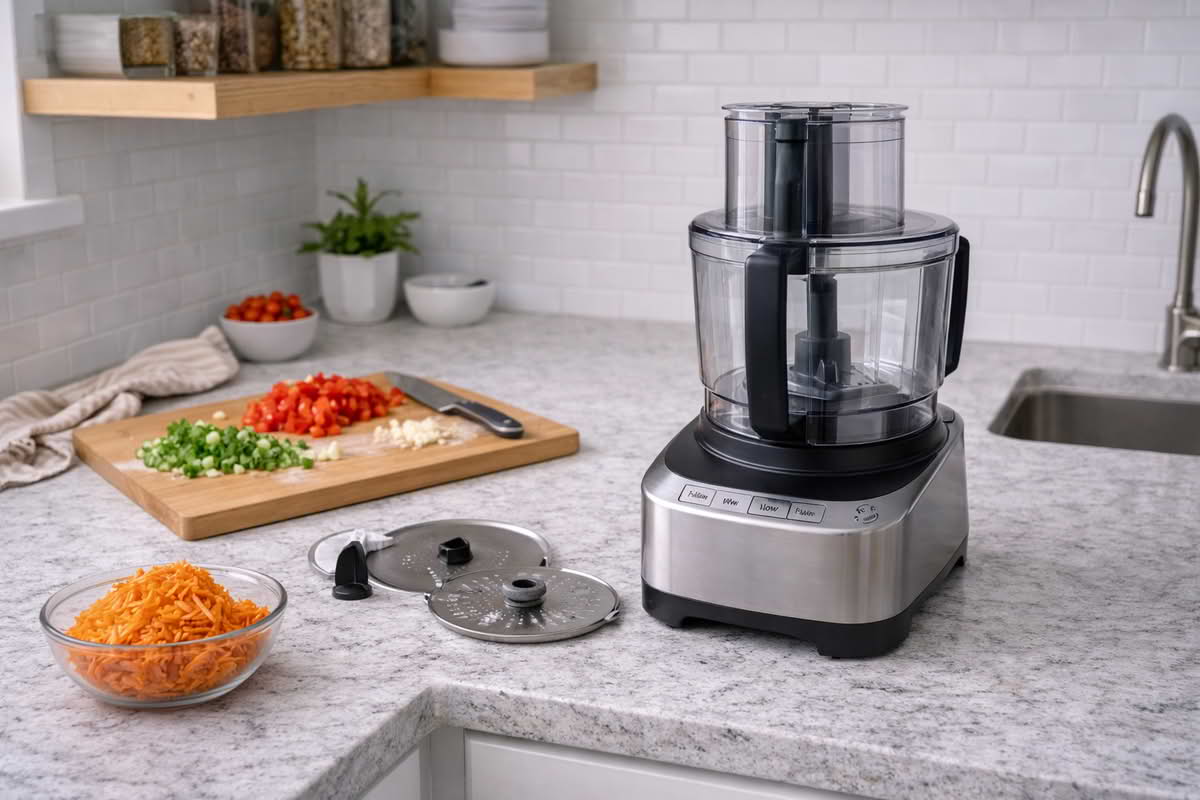
Attachments deserve a more skeptical look than they usually get. Slicing discs and shredding discs often make clear sense because they expand the processor's usefulness for common prep jobs. Dough tools, adjustable thickness options, or smaller prep bowls can also be helpful in the right kitchen. The problem is that many buyers overestimate how often specialty attachments will be used. Each added part takes up space, creates more cleanup, and increases the mental burden of choosing the right setup. A smaller number of highly relevant attachments is usually more valuable than a broad accessory list that mostly stays in storage.
Choose compact sizes for quick, smaller-batch prep where easy access matters more than maximum volume.
Choose full-size processors when slicing, shredding, and larger prep sessions are regular parts of kitchen life.
Treat motor power as one factor among many, not as a shortcut to overall quality.
Prioritize attachments that clearly match your cooking routine instead of collecting options you are unlikely to use.
Feed chute design also matters more than it appears in product photos. A wider, better-designed feed system can reduce pre-cutting and make the processor feel genuinely efficient when working through vegetables or cheese. A narrower chute may be completely fine for lighter use but feel tedious during bigger jobs. This is a good example of how real-world friction builds. A machine does not have to fail dramatically to be disappointing. Small inconveniences repeated over time are often what determine whether the processor becomes a favorite tool or an appliance you keep meaning to use more.
Another overlooked issue is control. Some food processors feel binary, either fully on or off, with little nuance in how ingredients move. Others provide better pulsing control and a more predictable feel when the goal is rough chopping instead of turning everything into a paste. For buyers who care about texture, that kind of control matters a great deal. It can be the difference between a processor that extends your prep abilities and one that simply forces everything toward overprocessing.
The strongest food processor purchases usually come from thinking in systems. Bowl size, motor strength, feed design, attachment value, and control all contribute to whether the machine actually improves prep. Choosing based on any one trait in isolation often leads to compromises that become obvious only after the appliance is already in the kitchen.
Cleanup, storage, and long-term value
Food processors are one of the clearest examples of an appliance category where ownership friction matters just as much as performance. A processor can chop beautifully and still be a poor purchase if it is annoying to assemble, difficult to clean, or awkward to store. Buyers often discover this only after the novelty wears off. The machine worked well the first few times, but then everyday life returned, and the total effort of using it started to matter more than its capability.
Cleanup is central to that equation. A processor with multiple blades, lids, pusher pieces, bowls, and discs can offer strong functionality, but every extra part creates another surface to rinse, dry, and manage. For some households, that is a fair trade because the machine saves significant prep time. For others, it turns quick cooking into a longer cleanup routine than the manual prep would have required. This is why a processor should not be judged only by what it can do. It should also be judged by whether the post-use experience feels reasonable for the kinds of meals you actually make.
Storage fit matters just as much. Full-size processors often make the most sense when they are easy to access. If the machine is heavy, stored high up, or split across different cabinets because of all its parts, the odds of regular use fall quickly. Compact models often win long-term simply because they are easier to reach and easier to put away. That does not mean smaller is always better. It means access changes behavior. A strong appliance that feels inconvenient to retrieve is often less valuable than a slightly less capable one that stays in rotation.
A food processor creates better long-term value when its parts, cleanup, and storage demands stay easy enough that the machine actually gets used regularly.
Counter space also shapes value. Some kitchens have room to keep a prep appliance available, which can turn a food processor into a genuinely routine tool. Other kitchens need every appliance to justify cabinet space and setup time. In those spaces, a processor has to save enough effort to compensate for its physical demands. Buyers sometimes evaluate food processors as if every kitchen has abundant room and easy storage. In practice, space limits heavily influence whether the appliance feels like a smart purchase or just another bulky object.
Long-term value improves when the machine is matched to a stable role. A budget processor can make sense for occasional chopping, a starter kitchen, or lighter use where expectations are modest. Mid-range models often deliver the strongest balance for many households because they can improve bowl design, attachment usefulness, and overall usability without becoming oversized or overbuilt. Higher-priced machines make more sense when the household cooks often enough to benefit from better capacity, sturdier construction, and more reliable repeat performance. The mistake is paying for a higher tier of appliance when the kitchen routine will not actually use its strengths.
Judge cleanup effort as part of performance, because complicated washing changes how often the appliance gets used.
Choose a processor you can access easily enough to use before prep frustration builds up.
Balance machine capability against cabinet space, countertop limits, and part storage.
Spend more only when the added capacity or design quality clearly fits a repeated kitchen need.
Another useful way to think about value is replacement pressure. If you buy a processor that is slightly too small, too complicated, or too weak for the work you repeat most, you may end up replacing it sooner than expected. The opposite problem is buying a large, premium processor that gets admired more than used because it never truly fits the kitchen. Both outcomes come from the same mistake: treating the processor like a category winner rather than a household tool with a specific job.
The best long-term food processor purchase usually feels quietly efficient. It handles the prep you dislike doing by hand, it does not punish you with unreasonable cleanup, and it fits the kitchen well enough to stay available when needed. That kind of usefulness is more valuable over time than a long list of secondary functions or marketing-heavy claims about professional-level performance.
When the size, parts, cleanup burden, and prep role all line up, a food processor can become one of the most effective time-saving tools in the kitchen. When they do not, even a capable machine can feel like unnecessary complexity. That is why fit matters so much in this category.
Final Recommendations — choosing the processor that fits your prep routine instead of your ambitions
A good food processor should be chosen by prep pattern, not by feature count alone. Buyers who mainly want help with quick chopping, sauces, and modest kitchen tasks usually do best with a simpler machine that is easy to access and easy to clean. Buyers who routinely slice, shred, and prep in larger batches usually benefit more from fuller capacity and more purposeful attachment support. In both cases, the goal is the same: reduce repetitive prep work without creating new friction in storage, assembly, or cleanup.
Match the processor to the prep tasks you repeat most often, not the broadest possible use case list.
Choose size based on batch volume and kitchen space, not on assumptions that bigger is safer.
Prioritize a few truly useful attachments over a long accessory list that adds storage and cleanup burden.
Spend for better long-term fit, not just for more power or more advertised versatility.
The lowest-regret food processor is usually the one that earns its place in the kitchen through repetition. It comes out often enough to matter, saves real time, and stays manageable enough that using it never feels like its own separate project. That kind of quiet practicality is what makes the appliance valuable over the long term.