Utility Cart Buying Guide: How to Add Flexible Storage Without Creating Rolling Clutter
Utility carts are appealing because they promise flexible storage without the commitment of shelves, cabinets, or built-in organization. That flexibility is real, but it is also the reason so many carts underperform. Buyers often choose a cart because it seems useful “somewhere,” then discover that the shelves are too shallow, the frame wobbles under ordinary supplies, the wheels are more annoying than helpful, or the whole unit becomes a rolling pile of loosely categorized clutter. Good utility carts do more than provide three tiers and a handle. They should match the room, the load, and the type of work happening around them, whether that is laundry, bathroom overflow, utility-room supplies, cleaning tools, or household odds and ends that need to stay mobile. The best cart is usually the one that supports a clear job and moves only when it actually helps, rather than becoming a generic container that slowly collects everything nobody wants to organize properly.
The Cart's Job, Room, and Categories Matter More Than Extra Tiers
The biggest mistake in this category is buying a utility cart for its general usefulness rather than for a defined job. Carts look versatile because they can move between rooms and hold many different items, but that same versatility can turn them into catchall storage almost immediately. A cart that starts as laundry-supply storage may absorb bathroom overflow, cleaning products, paper goods, pet accessories, and miscellaneous tools within a few weeks. Once that happens, mobility becomes secondary and the cart stops feeling like a useful system. It becomes a vertical junk drawer on wheels.
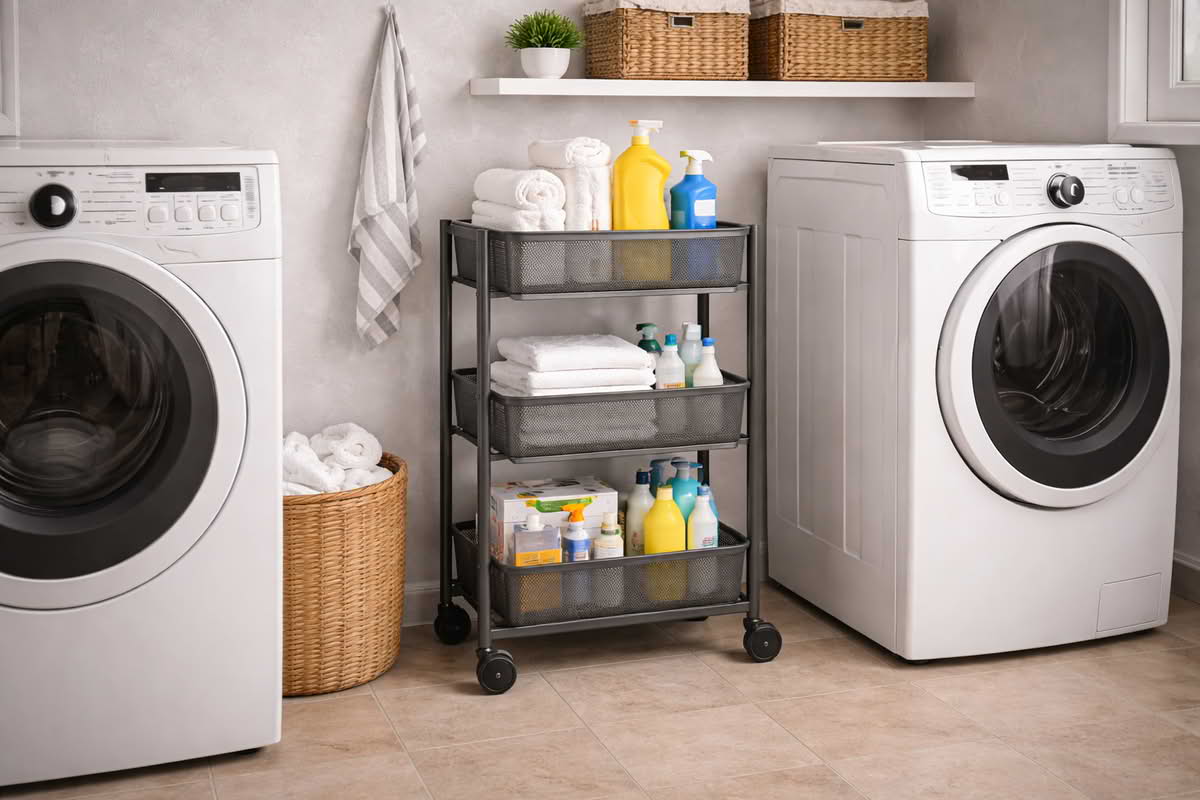
The strongest buying decisions begin with a narrower question: what exactly will this cart do most of the time? In a laundry room, the answer may be detergent, stain treatment, dryer sheets, cloths, and a few small baskets. In a bathroom, it may be towels, toiletries, and extra paper products. In a workshop or utility zone, it may be small tools, spray bottles, and task-specific accessories. These are all reasonable uses, but they ask different things of shelf depth, load capacity, and movement. A cart that works beautifully for lightweight toiletry storage may feel flimsy when asked to hold gallon cleaners and bulk laundry products.
Room fit matters just as much as category fit. Utility carts are often chosen for spaces that are already constrained: narrow laundry rooms, between-appliance gaps, small bathrooms, or utility corners that cannot accommodate full shelving. This is where a cart can genuinely help, but only if its footprint respects the room. A cart that technically fits while empty can still become awkward once loaded, rolled, and accessed from the side. In smaller rooms, a slightly narrower cart with better daily usability usually outperforms a larger one that maximizes tier space but makes the room harder to move through.
Choose a utility cart for a clearly defined job instead of assuming a generic cart will organize itself after purchase.
Choose cart size around the room's usable movement space, not just the open footprint visible on the floor.
Choose shelf depth and category size together so the cart supports real items instead of vaguely “more storage.”
Another common issue is misunderstanding whether the cart truly needs to move. Some buyers are drawn to wheels because mobility sounds helpful in theory, but many utility carts spend most of their lives parked in one place. That is not automatically a problem. A cart can still be a smart choice if its compact vertical storage fits the room better than fixed shelving. But if the cart is never meant to move, then stability, shelf usability, and cleaning access may matter more than caster quality. The better choice depends on whether rolling is central to the job or simply a nice extra feature.
It is also worth deciding whether the cart should remain open or function more like contained storage. Open carts are strong for visibility and fast access, which is valuable in laundry and utility spaces where supplies are used often. But visibility can also expose clutter quickly if the categories are too mixed or the shelves lack bins. A well-chosen cart should not merely hold supplies. It should make the categories on it feel more understandable and easier to maintain.
Utility carts work best when they are chosen for a specific job and a specific room rather than as general-purpose extra storage on wheels.
Mobility, Size, and Shelf Layout Determine Whether the Cart Is Actually Convenient
Once the role is clear, the next question is whether the cart's design supports the way it will actually be used. Mobility is the obvious feature here, but not all mobility is equally valuable. Rolling utility carts can be genuinely helpful when supplies move between tasks, such as carrying laundry products to a folding area, shifting cleaning supplies through the house, or moving bathroom or utility items to wherever they are needed. In those cases, good wheels and a balanced frame reduce the need to carry multiple items by hand. But mobility only works well when the cart rolls smoothly, feels stable while moving, and fits the pathways it needs to travel.
Slim gap carts solve a different problem. They are useful when there is a narrow unused strip beside appliances, cabinets, or fixtures that cannot support a full shelf. Their advantage is obvious: they turn underused slivers of space into storage. Their weakness is just as obvious once real items enter the picture. Narrow shelves can become inefficient if the products are too wide, too tall, or awkwardly shaped. A gap cart may be perfect for bottles, boxes, and slim tools, but frustrating for folded linens, bulk cleaners, or mixed utility supplies that need more flexible shelf dimensions.
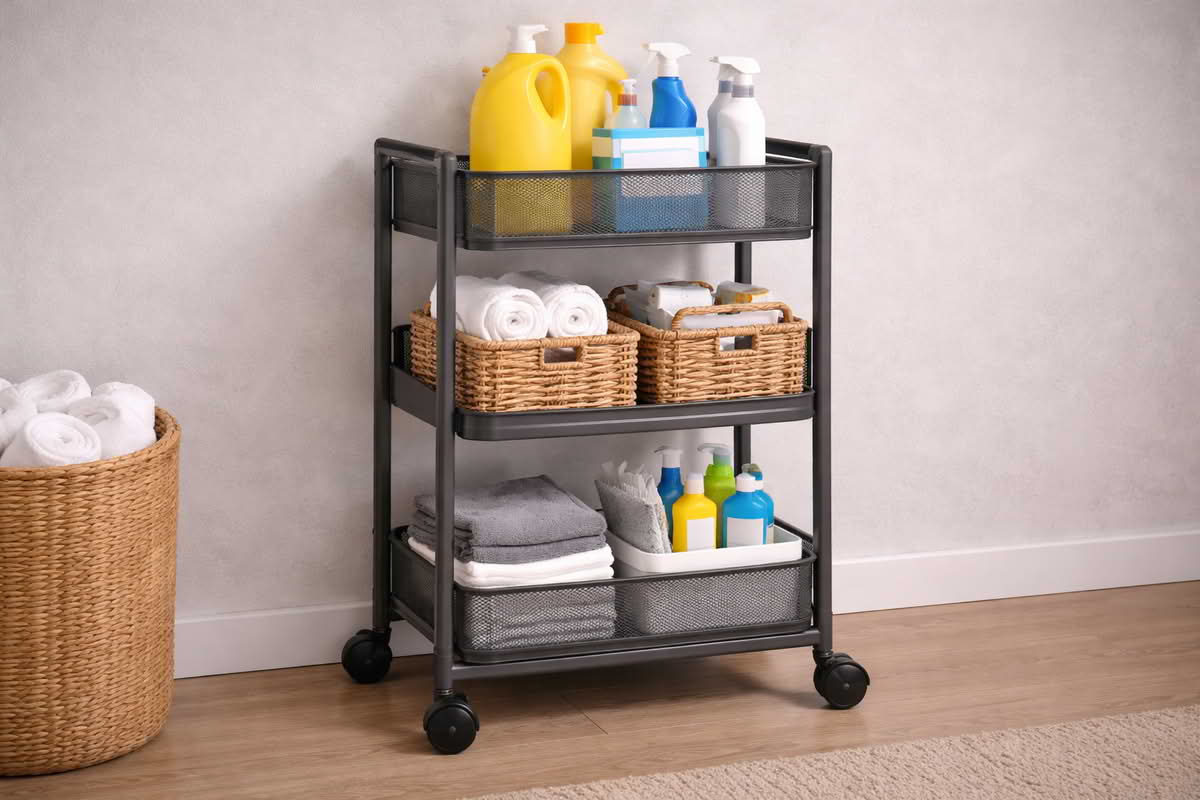
Multi-tier organizer carts offer more balanced storage and usually make better sense when the cart needs to hold mixed categories. The question then becomes shelf spacing and access. Deep basket-style tiers can prevent items from falling out, which is useful for loose or irregular supplies, but they can also hide products in the back. Shallower open trays make scanning easier, yet they may require more restraint or smaller container grouping to keep things from looking messy. The right shelf style depends on whether the cart is holding grouped bins, individual bottles, folded items, or loose supplies.
Choose truly mobile carts only when the storage needs to move often enough to justify wheels as a daily-use feature.
Choose slim gap carts when space is extremely limited and the categories are narrow enough to fit that format cleanly.
Choose multi-tier carts when the room can support a slightly broader footprint and the storage categories need more flexible tier space.
Height deserves more attention than buyers usually give it. A taller cart may add useful vertical storage, but it can also make upper tiers harder to use and increase the risk of top-heaviness when loaded unevenly. A lower cart may feel more stable and easier to access, especially in laundry spaces where you are already reaching around machines, baskets, and countertops. The better height depends on whether the cart is meant to maximize compact storage or act as a more active task-side organizer.
Handles and shelf edges matter too. A cart that is awkward to steer, difficult to grip, or irritating to load from one side may still look organized while quietly failing as a working tool. Likewise, shelves that are too open can let bottles tip or small items slide during movement, while shelves with overly high sides may make it harder to retrieve supplies quickly. These are small design choices, but they strongly affect whether a cart feels helpful or flimsy in routine use.
Another important point is category separation. Utility carts almost always work better when each shelf has a defined role. One tier for laundry chemicals, another for cloths and small tools, another for backup products or grouped containers. Without that structure, the cart quickly becomes a stack of mixed-use surfaces. This is one of the most common reasons people stop liking their cart over time: the product did not really fail, but the storage logic was never specific enough to keep it working.
Shelf layout matters as much as mobility. A useful cart supports clear category zones and keeps common items easy to reach without hiding them in deep cluttered trays.
Durability, Cleaning, and Long-Term Use Matter More Than a Flexible Look
Utility carts often live in rooms where surfaces get dusty, damp, or splashed, which makes durability and cleanability much more important than they appear in product listings. A cart that holds up in a calm office corner may not feel nearly as satisfying beside a washer, near cleaning supplies, or in a busy bathroom. Metal carts can be a strong choice because they often feel sturdier and more utility-oriented, but they should still be judged by frame rigidity, finish quality, and how well the shelves tolerate repeated loading. Plastic or resin carts can be easier to wipe down and lighter to move, but lighter weight can also translate into less confidence when the shelves hold denser products.
Cleaning is especially important because the kinds of items stored on carts are often messy by nature. Detergent residue, drip marks, dust, and splashes from cleaners or toiletries tend to accumulate over time. A cart with simple surfaces and easy-to-clear corners usually creates a much better long-term experience than one with fussy detailing or too many tight structural elements. This is one reason minimal, practical utility designs often outperform more decorative carts in working spaces. The goal is not only to store supplies. It is to store them in a way that the cart still feels acceptable after months of real use.
Durability also means surviving imperfect loading. Households do not place every item on a cart with balanced precision. A heavy detergent bottle lands on one side, a basket gets overloaded, and the top tier ends up carrying more than it should. A stronger cart tolerates those imperfect habits better. A weaker cart starts to wobble, lean, or feel less trustworthy. Over time, that changes how people use it. They stop moving it, avoid loading certain shelves, or gradually abandon the cart's original purpose.
Choose sturdier carts when the shelves will hold dense products such as detergents, cleaners, tools, or larger bathroom supplies.
Choose easy-clean materials and simple shelf surfaces when the cart will live in damp or residue-prone utility spaces.
Choose structural margin over novelty, because carts are often asked to handle more real weight than buyers expect at first.
Long-term success also depends on resisting category creep. Utility carts are particularly vulnerable to this because they are flexible and visible. Once there is open shelf space on wheels, it becomes tempting to place just one more bottle, one more basket, one more miscellaneous tool there. Before long, the cart is carrying unrelated overflow from several rooms. The better carts are not just the ones with the right structure. They are the ones whose owners keep their purpose narrow enough that the organization remains believable.
Visual calm matters here too, especially when the cart lives in a laundry room connected to a kitchen, a visible bathroom corner, or a multi-use utility space. Open carts can still look controlled if the categories are limited and the containers on them are repeated thoughtfully. They look chaotic when every shelf holds unrelated products of different heights, shapes, and uses. This is why bins and grouped containers often matter more than the cart finish itself. The cart provides the platform, but category discipline makes it feel organized.
In the long run, a good utility cart works because it stays useful without demanding constant correction. It fits the room, supports the task, handles the load, and remains easy enough to clean that it never feels like one more thing to manage. When those conditions line up, a cart can be one of the most effective flexible storage tools in the house. When they do not, the same flexibility that looked so appealing at purchase time becomes the reason the cart slowly turns into clutter on wheels.
Final Recommendations — Choosing a Utility Cart With Less Regret Later
The right utility cart is the one that matches the room, the categories, and the real need for movement. Buyers usually get the best results when they choose a cart for a defined purpose and a realistic load instead of buying a generic rolling organizer and expecting it to sort itself out later. A slightly simpler cart with a clear job usually outperforms a more ambitious one that tries to do everything.
Choose rolling utility carts when the supplies genuinely need to travel between tasks or rooms instead of simply sitting near one work zone.
Choose slim gap carts when the available space is narrow and the stored items naturally suit shallower, tighter shelves.
Choose sturdier multi-tier carts when the load includes denser supplies and the room can support a broader, more stable footprint.
Choose easy-clean, category-based setups so the cart stays useful over time instead of becoming a mobile pile of mixed overflow.
A low-regret utility cart should make storage more flexible without making organization weaker. When shelf layout, mobility, and load support all fit the real job, a cart becomes a practical working tool instead of just another place for household clutter to gather.