Cleaning Tool Storage Buying Guide: How to Organize Brooms, Mops, and Supplies Without Wasting Utility Space
Cleaning tools create a familiar kind of disorder because they are useful, awkwardly shaped, and rarely stored well by accident. Brooms lean into corners, mops fall behind machines, spray bottles collect on the floor, and cleaning caddies get buried under unrelated utility clutter. Many buyers respond by adding a holder, shelf, or bucket system that seems close enough, only to discover that handles slip out, larger tools do not fit, or the new organizer simply moves the mess onto the wall. Good cleaning tool storage should do more than keep long handles upright. It should support the actual mix of tools you use, fit the wall or utility space you have, and make it easier to grab, return, and maintain supplies without turning a laundry room or utility closet into a crowded hardware zone. Whether you need a wall-mounted broom holder, a compact utility organizer, or a better way to group handheld supplies, the best system is the one that makes everyday upkeep easier rather than adding another storage layer that only looks tidy at first.
Tool Mix and Space Planning Matter More Than Extra Hook Count
The biggest mistake in this category is assuming all cleaning tools can be treated as variations of the same long handle. Buyers often shop for a broom-and-mop holder based on hook count or overall length, then find that the real mix includes bulkier mop heads, dusters, spray bottles, scrub brushes, collapsible handles, and small caddies that do not behave the same way at all. A rack that works well for two brooms and a dustpan may work poorly once a spin mop, extension duster, hand vacuum attachment, and spray cleaner join the system.
This is why planning the tool mix comes first. Some households only need wall storage for a few vertical tools. Others need a broader cleaning zone that includes long handles, refill bottles, cloths, gloves, and spot-cleaning supplies. The wrong organizer often fails not because it is badly made, but because it was chosen for a simpler job than the room actually requires. Cleaning tool storage works best when the buyer knows whether the problem is tool parking, supply grouping, or a combination of both.
Space planning matters just as much. Utility rooms, laundry areas, and cleaning closets are often narrow and interrupted by machines, doors, shelving, or plumbing. A wall organizer that seems compact in isolation may still sit in the wrong place if it interferes with door swing, blocks access to a washer, or forces long tools into awkward angles when removed. Good cleaning storage should reduce the tendency of tools to lean and slide around, but it should not make the room harder to move through or maintain.
Choose cleaning tool storage around the actual mix of long tools, handheld items, and refill supplies you need to manage.
Choose a system that fits the real wall and floor conditions of the room instead of assuming any open strip of wall is equally usable.
Choose with retrieval in mind, because a tool organizer should make cleanup faster, not more awkward.
Another overlooked issue is tool length and head shape. A broom, flat mop, string mop, and handled scrub brush all hang differently. Clamp-style holders may grip some handles well and others less securely. Hooks may work for loop-ended tools but not for smooth handled ones. This is one reason apparently generous capacity claims can feel misleading in practice. The true capacity is determined by the spacing, tool bulk, and how easily one item can be removed without dislodging the others.
It also helps to decide whether tools should stay visible or partially concealed. In a dedicated utility closet, exposed wall storage may be perfectly practical. In a more visible laundry room, buyers may prefer a tidier combination of wall holders plus a small shelf or cabinet for related cleaning supplies. The best choice depends on how exposed the area is and how much visual order matters in that space.
Cleaning tool storage works best when the wall layout is planned around the real mix of handles, attachments, and nearby supplies rather than around a generic hook count.
Wall Mounts, Caddies, and Utility Organizers Solve Different Problems
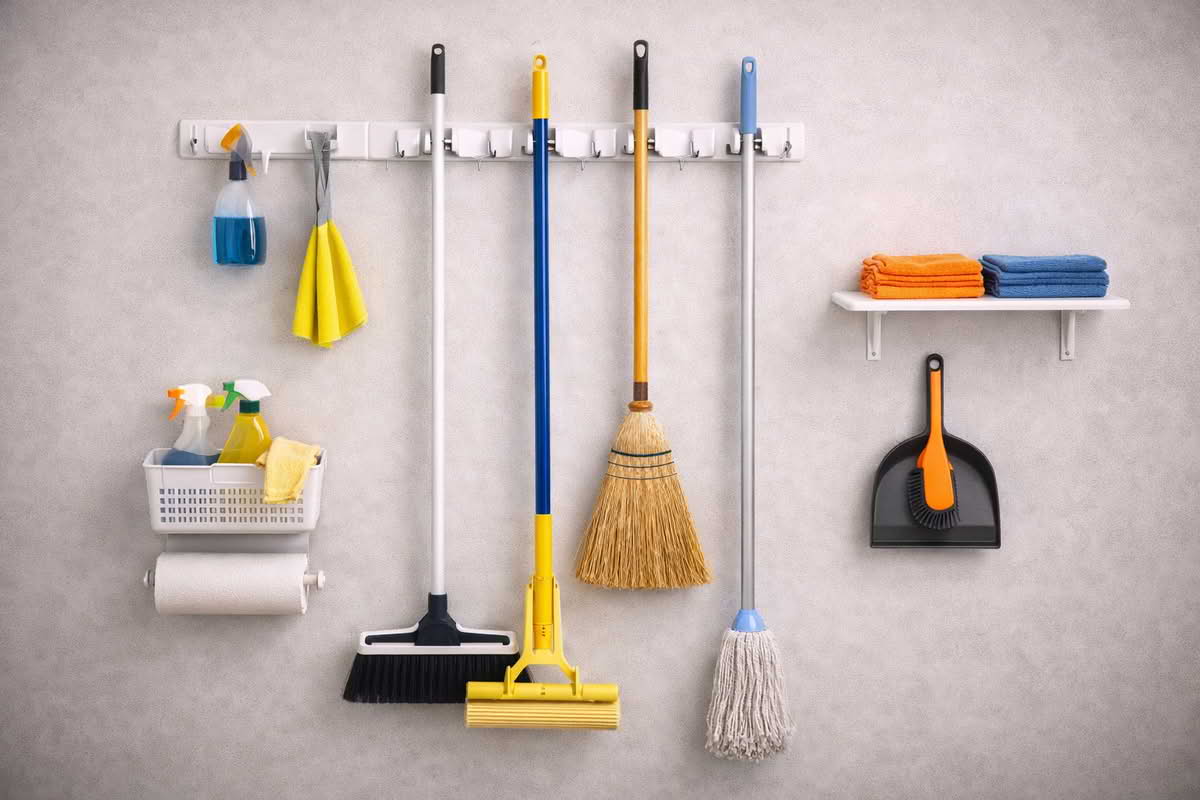
Once the tool mix is clear, the next question is which storage format actually matches it. Wall-mounted broom and mop holders are often the most efficient solution when the main problem is long-handled tools sliding around the floor. They can keep brooms, mops, and dusters upright, free floor space, and create a cleaner utility zone in a relatively small footprint. Their weakness is that they are only one layer of a full cleaning storage system. If the household also needs somewhere for sprays, gloves, cloths, and small accessories, a wall holder alone may solve only the visible part of the clutter.
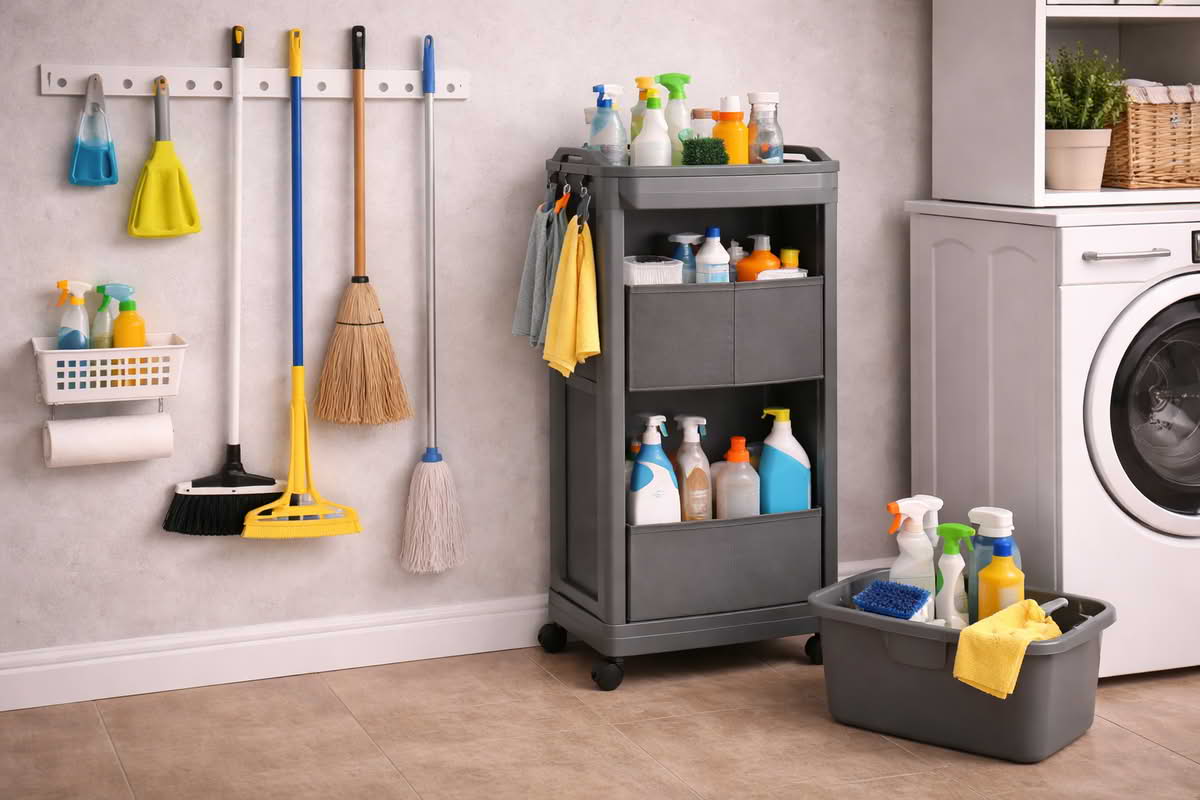
Utility organizers with a combination of clamps, hooks, and a small top shelf can work better when the cleaning routine includes both vertical tools and smaller handheld supplies. These hybrid systems are useful because they group related categories together, which reduces the tendency for the room to scatter cleaners and attachments across multiple unrelated shelves. The tradeoff is that combination organizers can become overcrowded if buyers try to make one unit serve every cleaning product in the house. They work best when supporting a focused set of daily-use tools and nearby essentials.
Cleaning caddies solve a different problem entirely. They are valuable when supplies need to move from room to room, or when the household wants cleaning products grouped by task rather than by storage location. A caddy is often the smarter solution for sprays, cloths, scrubbers, and gloves than a fixed wall shelf because it supports the real act of cleaning. But caddies are weaker as primary storage for long tools and can still become cluttered if the categories inside them are poorly managed. They are a strong companion solution, not usually the whole answer.
Choose wall-mounted holders when the main issue is long-handled tools leaning, falling, or taking up floor space.
Choose hybrid utility organizers when the space needs to store both long tools and a limited set of nearby cleaning supplies.
Choose cleaning caddies when portability matters more than fixed utility-room storage for smaller products and accessories.
Hook-based storage deserves a closer look as well. Hooks are simple and can be very effective for dustpans, loop-handled brushes, reusable bags of cloths, and small accessory tools. But hooks are only as useful as the items hanging from them. They are often less effective for smooth-handled tools without loops, heavier spray bottles, or bulky mop heads. Buyers sometimes overestimate how much a row of hooks can truly organize because hanging something and storing it well are not always the same thing.
Compact wall-mounted systems can be excellent in laundry rooms and narrow utility corners where a full cabinet or tower would feel too large. But compact should not mean cramped. The best organizers leave enough room between tools that one can be removed without disturbing the whole arrangement. That matters more than it first appears. A cleaning tool system that is slightly annoying every time you need a broom tends not to stay tidy for long.
Another practical question is whether the storage should live inside a closet, on a visible wall, or behind a door. Behind-the-door organizers can be useful in tighter utility closets, but they also limit tool length and door clearance. Visible wall storage may be more convenient and easier to maintain, especially if the room is already utility-oriented. The right choice depends on whether concealment is worth the compromise in retrieval and fitting flexibility.
Different cleaning storage formats solve different problems. Wall mounts control long tools, while caddies and hybrid organizers manage smaller supplies and daily-use accessories.
Durability, Access, and Long-Term Use Matter More Than a Neater-Looking Wall
Cleaning tool storage lives in one of the more demanding zones of the home. Tools are grabbed quickly, returned wet or dusty, and often handled without much precision. That makes durability more important than many buyers first think. A tool holder that seems acceptable in a product photo may start to disappoint once clamps loosen, hooks bend, or the unit shifts slightly under repeated use. Cleaning storage is not used delicately. It should be chosen for that reality.
Access is just as important as strength. A well-mounted organizer that holds tools securely but makes them awkward to remove is not a good long-term solution. Cleaning tools are often used in short, practical bursts. People reach for them quickly, often while managing other chores. If the holder is too high, too tight, or too crowded, the room starts to accumulate leaning brooms again because the organizer adds one step too many. The best systems support a simple behavior loop: grab the tool, use it, return it without thought.
This is where spacing becomes critical. Buyers often focus on how many tools a holder claims to store, but a densely packed layout usually feels worse in real use than a slightly lower-capacity setup with better breathing room. Wet mop heads, wide dusters, and fuller cleaning tool heads all need more clearance than a narrow line drawing on a box suggests. A cleaning storage system should respect the bulky ends of the tools, not just the handles.
Choose sturdier mounting and grip systems when the tools are heavier, wetter, or used frequently enough to create wear over time.
Choose enough spacing that tools can be removed and returned without tangling or knocking each other loose.
Choose organizer height around everyday reach so the system stays easy to use instead of becoming another thing to work around.
Cleaning also matters. Utility and laundry rooms gather dust, lint, drips, and occasional chemical residue, so storage should be easy to wipe down and easy to clean around. Wall-mounted systems often help by lifting tools off the floor and making sweeping easier. But if the organizer itself has too many tight parts or stores products in hard-to-reach corners, it can add maintenance. The better designs are usually the ones that improve floor clarity without creating a fiddly new surface to manage.
Long-term satisfaction also depends on whether the storage zone stays selective. Cleaning tools are easy to overaccumulate: extra spray bottles, duplicate scrubbers, worn-out attachments, spare mops, half-used cloths. A good organizer should help define what belongs in active rotation and what should be stored elsewhere or discarded. Otherwise, even a strong organizer eventually becomes overloaded. Cleaning storage works best when it supports the current tool set rather than becoming an archive for every cleaning product the household has ever tried.
In the long run, the best cleaning tool storage systems do something more valuable than making the room look neater. They make the tools easier to use and easier to put away, which means the system has a chance to survive ordinary household behavior. When access, durability, and category control all align, cleaning storage becomes part of the routine instead of just a wall-mounted reminder of how quickly utility spaces can drift back into clutter.
Final Recommendations — Choosing Cleaning Tool Storage That Holds Up in Real Utility Spaces
The right cleaning tool storage is the system that matches the actual tool mix, the available wall or closet space, and the level of access the household needs every day. Buyers usually get the best results when they separate long-handle storage from small-supply storage and choose a focused solution for each instead of expecting one organizer to solve every utility-room problem at once.
Choose wall-mounted broom and mop holders when the main goal is reclaiming floor space and stopping long tools from leaning in corners.
Choose hybrid utility organizers when daily-use supplies and long tools need to live together in one practical work zone.
Choose cleaning caddies when portability matters and the smaller supplies need to move from room to room during actual cleaning.
Choose sturdier, more spacious layouts when the household uses bulkier tools, wetter mop systems, or a broader cleaning kit over time.
A low-regret cleaning storage purchase should make utility spaces easier to work in, easier to clean, and easier to keep from sliding back into floor clutter. When tool fit, wall fit, and daily access all align, cleaning tool storage becomes a genuinely useful part of the room instead of just a neater-looking place to hang the same old mess.