How to Choose a Knife Sharpener for Everyday Kitchen Maintenance
Knife sharpening tools are often bought after frustration has already set in. A once-reliable kitchen knife starts crushing herbs, slipping on tomato skins, or making prep feel slower and more tiring, and the natural reaction is to look for the fastest fix. That is where many buyers make the wrong choice. Some sharpening tools promise simple results but remove more metal than necessary, while others are capable but too demanding for the way most home kitchens actually operate. The better decision is not about chasing the most technical sharpening setup or the easiest-looking gadget. It is about matching the tool to your knives, your patience, and your maintenance habits. A good sharpener should make edge care realistic enough that you keep doing it. A poor one either creates mediocre results, unnecessary blade wear, or enough friction that sharpening gets postponed until the knives are dull again.
Start with your maintenance style, not just your knives
The most useful starting point is not the sharpener category. It is the kind of maintenance routine you are realistically willing to follow. Many buyers begin by asking what professionals use or what method produces the best theoretical edge. That can be informative, but it often ignores the bigger question: what will actually get used in an ordinary kitchen on a regular basis? A sharpening tool only creates value if it turns edge maintenance into a repeatable habit instead of an occasional chore.
A good sharpening tool should make routine edge maintenance feel practical enough to repeat before kitchen knives become badly neglected.
Some households want the simplest possible system. They do not want to learn angle control, soak stones, or think about grit progression. They want a tool that can restore a serviceable edge with limited effort and a low chance of user error. Other buyers are comfortable with a more hands-on process if it gives them more control and better long-term results. Both approaches can be valid. Problems begin when buyers choose an advanced sharpening system they will rarely use or a convenience-first tool that feels disappointing every time a knife needs real help.
It also helps to understand the difference between maintaining an edge and rescuing a neglected one. Some kitchen users sharpen a little and often, which usually keeps the process easier and less aggressive. Others wait until the knife is noticeably dull and then want a fast reset. The right sharpener may differ depending on which pattern is more likely in your home. A household that routinely lets knives get very dull may need a tool that feels accessible enough to bring them back without much hesitation. A household that is willing to maintain edges more consistently may benefit from a system that trades speed for greater control.
Buyer regret in this category often comes from mismatch between intention and behavior. People imagine they will become more disciplined about knife care after buying sharpening gear, but many do not. A sharpener that requires setup, cleanup, and concentration may deliver excellent results and still fail as a household tool if it stays in a drawer untouched. The best buying decision usually starts with realism. If convenience is what keeps maintenance happening, that matters. If precision and edge quality motivate you to maintain knives properly, that matters too.
Choose a sharpening system you are realistically willing to use several times a year or more.
Think about whether your knives usually need light maintenance or full edge recovery.
Be honest about your patience for setup, technique, and cleanup.
Do not buy for an imagined future routine if your current kitchen habits are much simpler.
The type of knives in the kitchen also matters, but not in isolation. A starter knife block, a few everyday stainless kitchen knives, or a more refined chef knife collection each creates different sharpening expectations. Yet even here, the household routine still matters more than broad tool prestige. A very capable sharpening method is not automatically the best choice if the knives are modest, heavily used, and likely to be maintained casually. At the same time, better knives deserve a sharpening approach that does not treat them too aggressively or reduce edge quality just for convenience.
Another important distinction is between sharpening and honing. Many buyers confuse these tasks and then end up disappointed in the tool. Honing helps maintain alignment on a working edge, while sharpening removes material to restore the cutting edge itself. A sharpening system should be chosen with that larger maintenance picture in mind. If the household wants only one solution, the tool needs to cover real sharpening needs, not just quick edge touch-ups that delay the problem.
A good sharpener decision usually feels practical rather than ambitious. It fits the knives, the users, and the level of effort the kitchen is actually willing to sustain. That fit matters more over time than whether the tool sounds advanced or looks more serious on a countertop.
How sharpener types change results, control, and risk
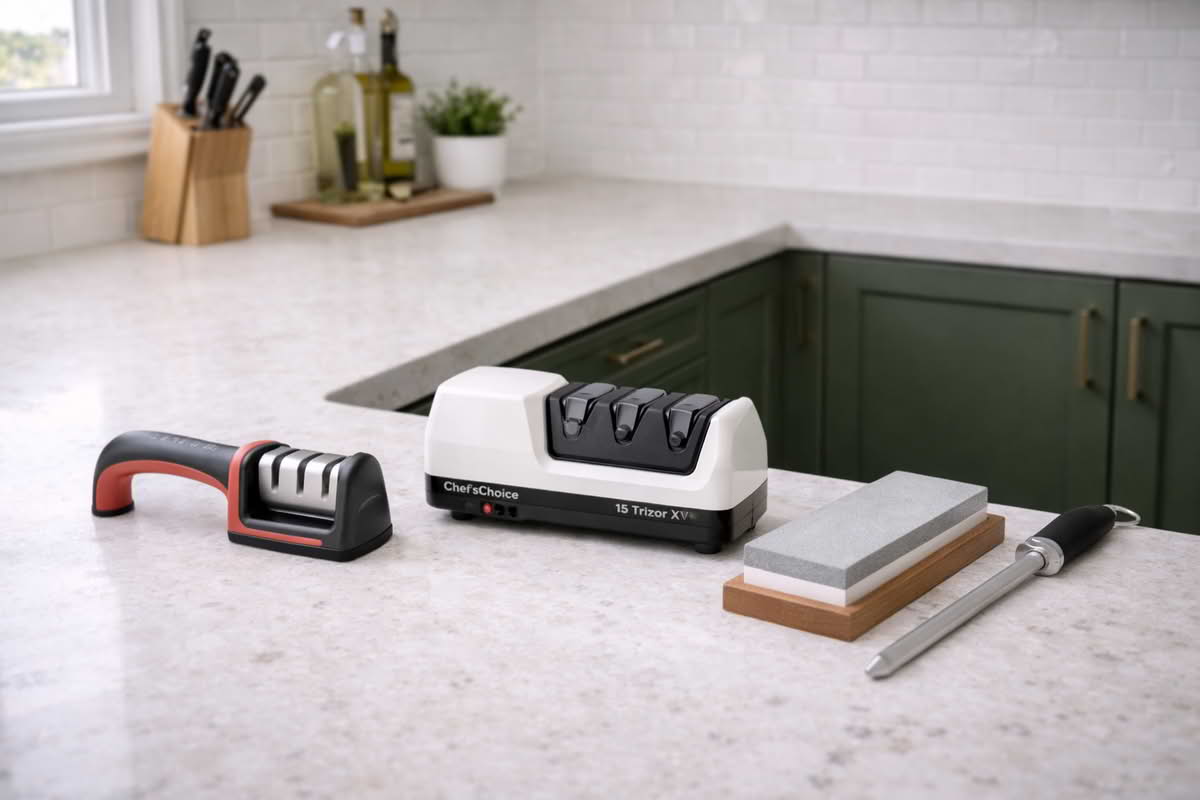
Once maintenance style is clear, the sharpener categories make more sense. Manual pull-through sharpeners, electric sharpeners, sharpening stones, and rod-based systems all solve the same basic problem in different ways. The real differences are not just speed and sharpness. They are control, repeatability, learning curve, and how much risk each method introduces when used by an ordinary home cook.
Knife sharpeners differ most in control, speed, learning curve, and everyday usability rather than in marketing claims alone.
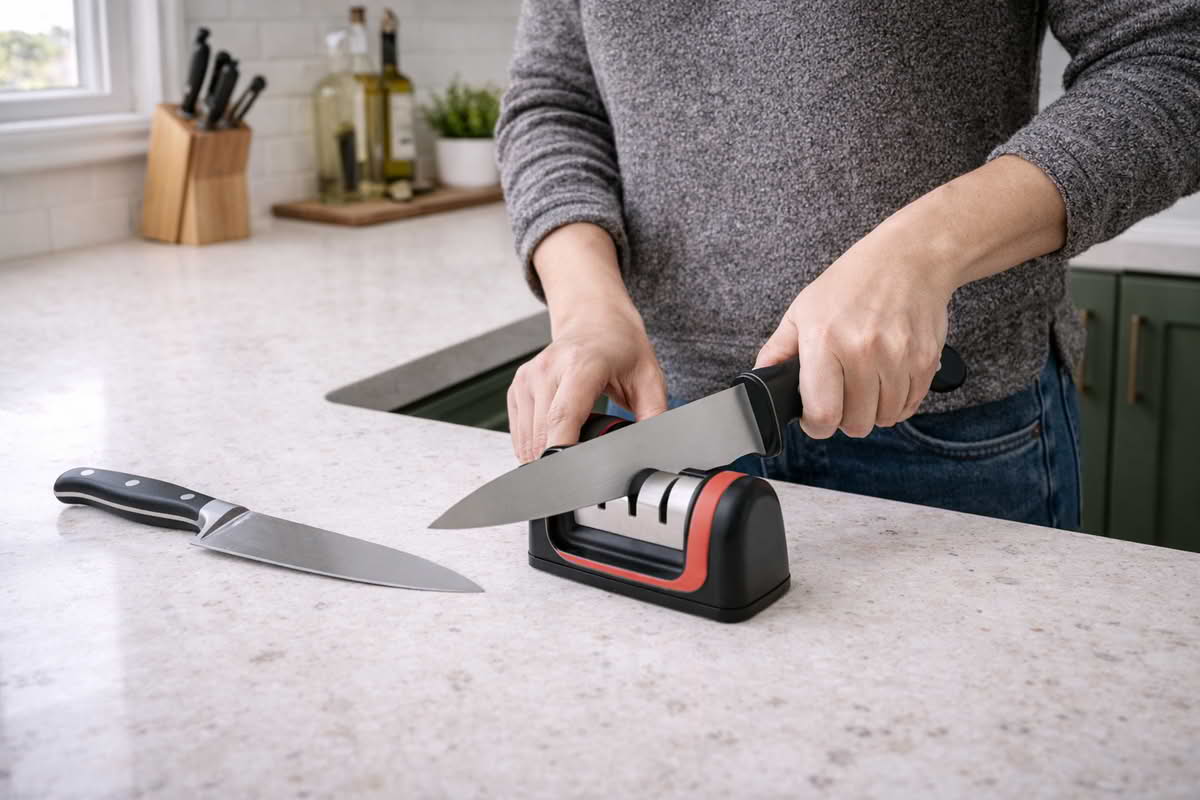
Manual sharpeners usually appeal because they are approachable. They often feel like the easiest entry point for households that want something faster and less technical than stones. Their main advantage is reducing the number of decisions the user must make. Angle guidance and a simple pull-through process can make them accessible to buyers who would otherwise avoid sharpening altogether. The downside is that convenience often comes with less flexibility and less nuance. Some manual tools work best as routine household maintenance tools rather than precision edge systems.
Electric sharpeners push convenience even further. For some kitchens, that is exactly the point. They can restore dull knives with relatively little physical effort, and that can matter in busy homes where edge care only happens if the barrier to entry is very low. But the tradeoff is that buyers need to think carefully about control and compatibility. A fast tool is not always a gentle one, and the right balance depends on whether the household values maximum ease, blade longevity, or more tailored results.
Sharpening stones sit at the opposite end of the spectrum for many buyers. They offer a higher degree of control and can be rewarding for anyone willing to learn how pressure, angle, and grit work together. This usually makes them attractive to buyers who want better refinement and a more intentional sharpening process. Their weakness is not performance. It is friction. Stones take more time, more technique, and more consistency. For some users that is part of the appeal. For many others, it becomes the reason sharpening gets postponed.
Guided systems and rod-based sharpeners occupy a useful middle ground in some kitchens. They can offer more angle consistency than completely freehand sharpening while still giving more control than a simple pull-through tool. That balance can be appealing for buyers who want to avoid both extremes: not fully manual and technical, but not entirely convenience-first either. As with every other type, the right fit depends on whether the extra control actually justifies the extra setup and attention in your kitchen.
Manual sharpeners usually favor convenience and lower learning demands.
Electric sharpeners usually make the most sense when speed and ease are the main priorities.
Sharpening stones usually make the most sense for buyers willing to trade time for control.
Guided systems can work well when you want more consistency without going fully freehand.
Risk should also be part of this decision. Every sharpening method removes some amount of material when restoring an edge, but not all tools feel equally forgiving in inexperienced hands. A system that seems easy can still be a poor fit if it makes the user overconfident and rough with knives that deserve more careful treatment. On the other hand, a more precise method can still be the wrong household tool if the fear of making mistakes means it rarely gets used. The safest choice is not always the most technical or the most automated. It is the one that creates reliable maintenance with a level of risk the user can manage comfortably.
Another overlooked factor is the quality of results required. Many home kitchens do not need a highly refined edge for everyday prep. They need knives that cut cleanly, feel predictable, and are easy to maintain. That practical standard is very different from chasing the sharpest possible edge. Buyers who confuse those goals often overspend or overcomplicate the problem. A useful sharpening setup should match how the knives are used, not the most extreme performance demonstration the category can offer.
This is why broad category advice is often incomplete. There is no single best sharpening type in the abstract. There are only better or worse fits for different kitchen habits, knife collections, and tolerance for technique. Understanding that makes the choice much easier and usually leads to fewer regrets.
Ease of use, blade compatibility, and long-term value
Long-term value in a sharpening tool comes from repetition. A sharpener that gets used consistently is usually a better purchase than a more advanced system that sits unused because it feels annoying to set up. That is why ease of use matters so much. It is not a minor convenience feature. It is often the difference between a kitchen that maintains its knives and one that keeps cooking with dull edges while promising to fix them later.
Ease of use includes more than the sharpening motion itself. It includes storage, cleanup, stability during use, and how much mental effort the tool asks from the user. A sharpener that requires water, flattening, setup space, and focused technique may be worthwhile in the right kitchen. In another kitchen, that same process can become enough of a barrier that even good knives stay neglected. Convenience is not shallow in this category. It is operational.
Compatibility also deserves careful attention. Not every sharpening tool is equally suited to every knife shape, blade style, or household collection. Some homes mainly use standard Western-style kitchen knives. Others may have thinner, harder, or more specialized edges mixed in. A sharpening setup should make sense for the tools already in the kitchen, not just for a single idealized blade. Buyers often focus on the main chef knife and forget the rest of the drawer or block. The better question is whether the sharpener supports the actual knife ecosystem in the home without becoming too broad and compromised or too narrow and fussy.
Another issue is the difference between occasional restoration and ongoing support. Some sharpening tools are better thought of as periodic fix-it tools. Others work well as part of a regular edge-care routine. A household that wants one all-purpose purchase should think carefully about how often the tool will be used and what problems it needs to solve. A fast tool that restores dull knives but does little to support lighter maintenance may still leave the kitchen in a cycle of neglect and rescue. A more flexible setup can interrupt that cycle, but only if the users are willing to keep up with it.
Storage fit matters here too. A sharpening stone system that lives in a high cabinet behind other equipment will feel different from a small manual tool stored near the knives. Accessibility changes behavior. This is one reason simple tools often outperform more impressive ones in ordinary households. They ask less, so they get used more. That does not mean simpler is always better. It means the friction cost of ownership should be treated as part of the purchase decision.
Choose a sharpener that is easy enough to reach for before knives become severely dull.
Make sure the tool fits the kinds of knives you already use most often.
Consider storage and cleanup as part of usability, not as separate afterthoughts.
Judge value by how well the tool supports repeated maintenance, not just one-time sharpening performance.
Cost should be viewed through the lifespan of both the sharpener and the knives it supports. A lower-cost sharpening tool can be a smart choice if it keeps ordinary kitchen knives functional and reduces replacement pressure. A mid-range setup often makes the most sense for many households because it improves consistency without demanding an enthusiast-level learning curve. Higher-priced systems are easier to justify when the kitchen contains better knives, the user values more control, and the sharpening process itself is likely to become a regular habit rather than an occasional experiment.
One of the most common forms of regret in this category is buying the wrong level of tool. Some buyers go too basic and remain frustrated by mediocre results. Others go too advanced and discover that the sharpening process now feels like a separate hobby they did not want. The best purchase usually sits at the point where the household gets enough control and enough quality without creating a maintenance burden that exceeds its interest level.
The sharpener should ultimately support a healthier kitchen rhythm. Knives should stay usable enough that prep feels efficient, safe, and less tiring. When the sharpening solution matches the household, it stops feeling like a specialty purchase and starts feeling like part of normal kitchen upkeep. That is what makes it valuable over time.
Final Recommendations — choosing the sharpening system you will actually keep using
A good knife sharpener should be chosen for realistic use, not just maximum theoretical performance. Buyers who want a straightforward maintenance solution usually do best with a tool that lowers friction and makes sharpening easy to repeat before knives get badly neglected. Buyers who care more about control and edge refinement may benefit from a more involved system, but only if they are genuinely willing to learn and keep using it. In both cases, the goal is not sharpening as a hobby. It is a kitchen where knives stay effective without turning upkeep into a constant project.
Choose the sharpening method that fits your maintenance habits, not the one that sounds most advanced.
Match the tool to the kinds of knives you own and the level of control you actually want.
Prioritize repeatable edge care over occasional dramatic rescue sessions.
Spend for better long-term fit, not just for higher complexity or stronger marketing claims.
The best low-regret sharpening purchase is usually the one that keeps your knives reliably useful with the least avoidable friction. When the tool fits the kitchen, edge maintenance becomes normal instead of postponed, and the knives you already own become much easier to live with for the long haul.