How to Choose a Kitchen Knife Set for Everyday Home Cooking
Kitchen knife sets are often sold as a shortcut to a complete, organized kitchen, which is exactly why they can be easy to misjudge. A boxed set may look polished and practical on the counter, but long-term satisfaction depends on more than appearance or piece count. Many buyers end up paying for extra knives they rarely use, while the one or two knives that matter most feel mediocre in the hand or lose their edge too quickly. Others buy a very small set expecting it to cover everything, only to realize later that the storage, maintenance, or included tools do not match how they cook. The better approach is to treat a knife set as a working system rather than a decorative bundle. Blade usefulness, handle comfort, sharpening needs, storage style, and replacement flexibility all matter more over time than a crowded block full of matching pieces.
What a knife set should actually do
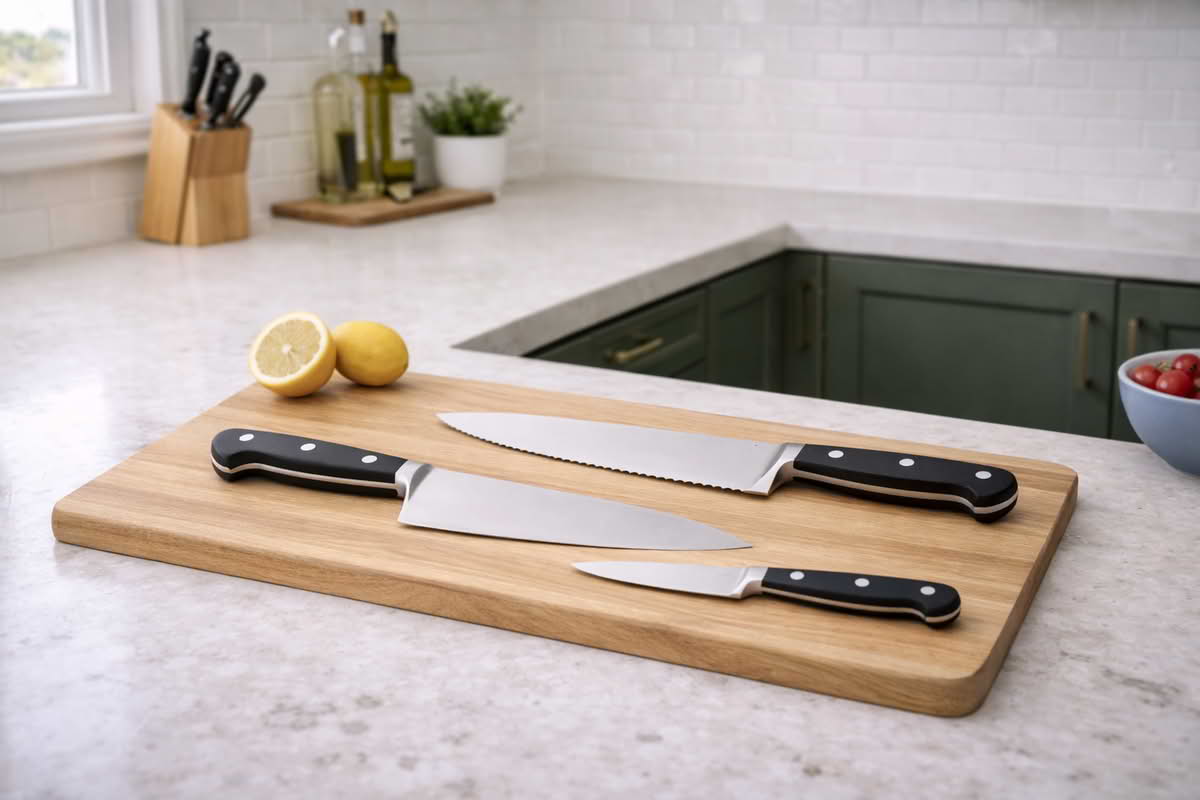
The first question is not how many pieces are included. It is whether the set covers the cutting tasks a home kitchen repeats most often. For many households, the real work happens with a short list of tools: a chef's knife or similar all-purpose knife, a small utility or paring knife, and a bread knife or serrated slicer. Beyond that, the value of additional pieces drops quickly unless the household has specific habits that justify them. This is where many knife sets become less useful than they first appear. They promise completeness, but much of that completeness may be filler.
A useful knife set usually earns its value through a few core knives that handle most everyday prep rather than through a high total piece count.
A larger set can look like better value because the cost per piece appears lower. In practice, a low-regret set is usually the one with a higher percentage of genuinely useful tools. Six thoughtfully chosen pieces can be more practical than fifteen pieces that include duplicates, awkward specialty knives, or extra steak knives that do nothing to improve food prep. Buyers often assume more pieces mean fewer future purchases, but the opposite can happen. A large set built around mediocre core knives may still push the owner to buy a better chef's knife later, which means paying twice.
This is especially important for first-home buyers and gift buyers. A kitchen knife set often feels like a safe, universally useful purchase. Sometimes it is. But usefulness depends heavily on whether the included knives match the cooking level, storage space, and maintenance tolerance of the household. A person who cooks simple meals a few nights a week may not need a dense knife block taking up counter space. Someone who cooks often may benefit from a stronger set, but only if the core knives are solid enough to anchor daily prep rather than just fill slots in a block.
Another common mistake is choosing based on appearance alone. Matching handles, polished blocks, and high piece counts can create a strong first impression, especially in product photos. But knife sets are not decor with blades attached. They are repetitive-use tools. If the set feels clumsy in actual prep, if the handles are uncomfortable, or if the block houses several knives that never leave their slots, the polished look becomes irrelevant quickly. Good knife ownership tends to feel quieter than that. The set does not need to impress at a glance. It needs to make prep easier over months and years.
Focus on the usefulness of the core knives before looking at total piece count.
Be cautious of sets inflated by steak knives, duplicate blades, or specialty tools.
Think about whether the set is solving everyday prep needs or just offering visual completeness.
Match the set to the kitchen's actual cooking frequency and counter space.
It also helps to separate convenience from performance. Some households want a set that feels simple and ready to use, with a storage block and a clear place for every tool. Others may care more about blade quality and be willing to add storage later. Neither approach is wrong, but problems happen when buyers try to optimize for everything at once. A set that looks tidy, includes many pieces, stores neatly, and also delivers excellent cutting performance at every position in the lineup is harder to find than marketing suggests.
Most regret in this category comes from misunderstanding what the set is for. A knife set is not an insurance policy against every future kitchen task. It is a starting system or a coordinated replacement system. The better its core tools match your routine, the more useful the entire purchase becomes. If the set gets that part wrong, no amount of extra pieces fixes it.
Blade quality, hand feel, and maintenance
Once the set's role is clear, the real decision moves to blade quality and ownership experience. A knife that looks sharp is not the same as a knife that stays useful. Edge retention, sharpening behavior, balance, and handle comfort all shape whether the set feels reliable after the first few weeks. This is the point where many buyers realize that the main value of a set is still concentrated in one or two knives. If those do not perform well, the rest of the set cannot compensate.
The chef's knife, or whatever the set uses as its primary prep knife, deserves the most scrutiny. This is usually the piece that handles chopping vegetables, slicing proteins, mincing herbs, and general prep. If it feels awkward, too light, too thick behind the edge, or poorly balanced, the set's day-to-day usefulness drops immediately. Buyers sometimes spend too much time comparing accessory pieces and too little time evaluating the main blade, even though that knife usually determines whether the whole set feels good to use.
Handle comfort matters more than many buyers expect because cutting is repetitive. A knife that feels acceptable for one or two minutes can become irritating during a longer prep session. Shape, grip texture, and the transition between blade and handle all influence comfort and control. This becomes especially important in shared kitchens where more than one person may use the set. A handle that suits one user perfectly may feel slippery, narrow, or poorly balanced to another. While no set can be perfect for every hand, obvious ergonomic compromises tend to create long-term dissatisfaction.
Blade style and steel choice also affect the ownership experience. Some knives prioritize easy initial sharpness and light handling. Others lean toward durability and lower maintenance. Neither direction is universally right. A sharper, thinner-feeling knife can be satisfying and efficient, but it may ask for more careful use. A sturdier-feeling knife may tolerate rougher treatment better but feel less precise. The right choice depends on whether the household values easy everyday resilience, more refined cutting feel, or a balance of both.
Maintenance is where common buying assumptions often fail. Many sets are purchased with the quiet expectation that the knives will mostly take care of themselves. But all knives need some level of edge upkeep, and sets differ in how they support that reality. Some include sharpening tools or storage systems designed around maintenance convenience. Others assume the owner will handle sharpening separately. This matters because a knife set that cuts well when new but becomes frustrating after normal use is not really solving the kitchen's long-term needs.
Judge the set by the quality of its main prep knife first, because that piece carries most of the workload.
Prioritize handle comfort and balance over cosmetic matching.
Think about whether you want lower-maintenance durability or a more refined cutting feel.
Do not assume included sharpening features automatically make the set easier to own well.
Dishwasher-safe claims deserve special skepticism in this category. Even when a set is marketed as dishwasher-friendly, that does not necessarily mean dishwasher use is the best path for edge life, handle longevity, or overall appearance. Many buyers are drawn to the promise of minimal maintenance, but knife ownership usually rewards a more realistic standard: easy enough care that the household will actually do it, without pretending the blades are immune to wear. A set that survives rough treatment is not the same as a set that continues to perform well under it.
Another overlooked issue is confidence. Good knives tend to improve prep flow because they feel predictable. They cut cleanly, track where the hand expects, and reduce the effort needed for common tasks. Cheap-feeling knives often create subtle hesitation. The user presses harder, saws more, or avoids certain prep tasks because the tool feels unreliable. That is part of why better core knives can matter so much. They do not just improve cutting performance on paper. They improve the rhythm of using the kitchen.
The practical lesson is simple: a knife set should not be judged only by what arrives in the box. It should be judged by how likely the main knives are to remain comfortable, controllable, and maintainable over repeated use. That is what turns a set from a neat countertop object into a dependable kitchen system.
Storage, piece count, and long-term value
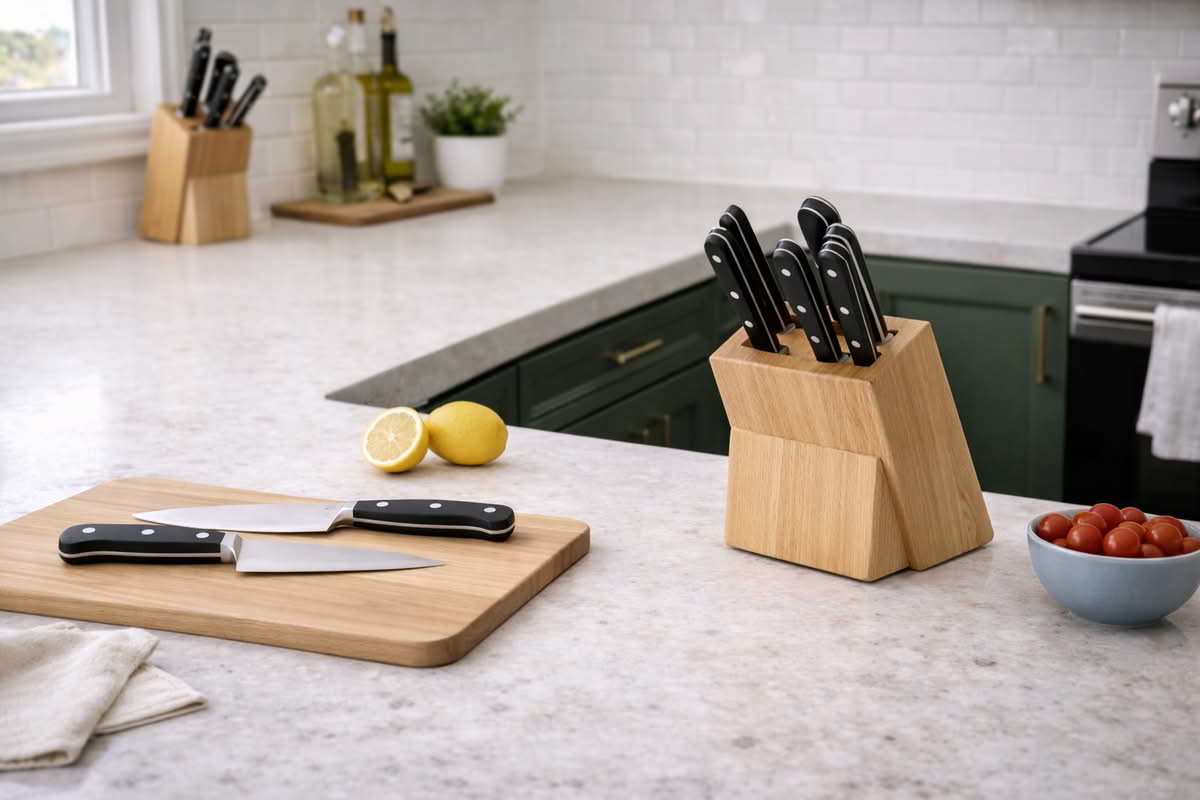
Storage style has a surprisingly large effect on whether a knife set feels like a smart purchase. Countertop blocks are common because they keep knives organized, visible, and easy to access. That convenience is real, especially for households that want a straightforward system and have room to spare. But a block also takes permanent counter space, influences cleaning around it, and locks the set into a certain footprint. In a smaller kitchen, that cost can be more significant than expected.
Knife set storage should support easy access without taking up more counter space than the kitchen can comfortably spare.
Compact sets can make a great deal of sense when kitchen space is tight or when the goal is to cover the basics cleanly. The problem is that some compact sets cut too aggressively, removing not just extra pieces but useful flexibility. A good smaller set still needs a strong core lineup. It should feel intentionally lean, not incomplete. Buyers who want to avoid clutter should look for efficient coverage rather than just the smallest box.
Larger knife blocks create a different problem. They can suggest permanence and value while hiding the fact that many slots are occupied by pieces with narrow use cases. Steak knives are a common example. They may be useful, but they also inflate the piece count in ways that have little to do with prep efficiency. The buyer ends up paying for quantity when the actual kitchen benefit would have come from a better chef's knife, a better bread knife, or more flexible storage.
Replacement logic is another part of long-term value. Some knife sets are best viewed as coordinated starter systems. Others make more sense as broader household kits where matching appearance and unified storage are part of the appeal. In either case, it helps to think about what happens when one knife becomes the weak link. If the set is hard to supplement, difficult to store beyond its original block, or dependent on all pieces aging together, long-term flexibility drops. A good system should leave room for future improvement rather than forcing a full reset when one part disappoints.
Cost modeling in this category is often misleading because the visible bundle feels like immediate savings. Sometimes it is. But value improves when the set reduces future friction instead of simply lowering the apparent price per piece. A lower-cost set can make sense for a first apartment, a temporary kitchen, or a household that prioritizes organization over cutting refinement. A mid-range set often offers the strongest balance for many buyers because it can improve the core knives, storage quality, and overall ownership experience without drifting into luxury pricing. Higher-priced sets are only justified when the performance, comfort, and build quality align with heavy or long-term use.
Choose storage that fits the counter space and kitchen workflow you actually have.
Be careful with large piece counts that add visual value more than practical value.
Think about whether the set can remain useful if you later add or replace one key knife.
Judge price against years of repeated prep use, not just the number of included items.
Long-term ownership also depends on habits around cleaning, sharpening, and daily access. A set that looks elegant but feels slightly inconvenient to return to the block, clean around, or maintain may slowly lose favor. The best sets tend to support repetition. You reach for the same main knives, they feel consistent, and the storage makes sense without dominating the kitchen. That kind of consistency matters more than marketing language about professional styling or complete culinary coverage.
The lowest-regret kitchen knife set is usually not the one with the most dramatic presentation. It is the one that gives the household a clear, practical set of tools, keeps the important knives front and center, and avoids locking too much value into pieces that rarely leave their slots. In other words, the better purchase usually feels efficient rather than impressive.
Final Recommendations — choosing the set that makes prep simpler, not just more complete
A good kitchen knife set should be evaluated as a working prep system, not a decorative bundle. Buyers who want a dependable everyday setup usually do best with a set that puts most of its value into the main knives, keeps storage practical, and avoids overloading the purchase with rarely used extras. Larger households or gift buyers may still prefer fuller sets, but only when the added pieces support real use rather than inflated piece counts.
Prioritize the quality and comfort of the core knives before anything else.
Choose piece count based on real prep habits, not the appeal of apparent completeness.
Match the storage system to your counter space and kitchen routine.
Think about long-term upkeep and replacement flexibility before paying for a large bundled set.
A low-regret knife set usually feels quietly practical. The main knives get used constantly, the extra pieces earn their place, and the storage supports the kitchen instead of crowding it. That kind of fit matters more over time than matching handles, oversized blocks, or impressive numbers on the box.