How to Choose a Chef Knife for Everyday Home Cooking
A chef knife is usually the single most important cutting tool in a home kitchen, which is why a poor one becomes frustrating almost immediately. Buyers often get pulled toward dramatic marketing language, stylish blade finishes, or vague claims about professional performance, but the real question is much simpler: does the knife make ordinary prep easier, safer, and less tiring week after week? A knife that looks impressive online can feel too heavy, too short, too slippery, or too delicate once it starts chopping onions, slicing vegetables, and breaking down everyday ingredients. The better decision usually comes from fit rather than prestige. Blade shape, length, balance, handle comfort, and maintenance demands all influence whether a chef knife feels natural in the hand or slightly wrong every time it is used. A well-chosen knife becomes a quiet kitchen essential. A poor one turns basic prep into repetitive friction.
Start with size and real kitchen use
The most useful starting point for a chef knife is size, because size influences comfort, control, storage, and confidence more than most buyers expect. People often assume there is a universally correct length, but the best fit depends on cutting habits, hand size, kitchen space, and how much prep the knife will handle in a normal week. A longer knife may offer more slicing efficiency and a broader working range, but that does not automatically make it the better everyday choice for every household.
Many home cooks find that a mid-size chef knife covers the widest range of kitchen tasks without feeling excessive. It can chop vegetables, slice meat, mince herbs, and handle routine prep without demanding much adjustment. Smaller chef knives may feel more approachable at first, especially for buyers moving up from basic utility knives or lightweight starter sets. That can be a good thing when confidence matters. But smaller blades can also feel limiting once prep volume increases, especially with larger produce or when the knife needs more board contact and slicing reach.
Larger chef knives make sense when the cook values longer slicing strokes, broader ingredient coverage, and a more efficient feel during bigger prep sessions. Their weakness is not performance so much as practicality. In smaller kitchens, on crowded cutting boards, or in the hands of someone who prefers a lighter, less imposing tool, a large chef knife can feel like more knife than the job requires. That kind of mismatch often leads to avoidance. A knife can be objectively capable and still be the wrong daily tool if it feels slightly cumbersome every time it comes off the magnetic strip or out of the drawer.
This is where buyer psychology often creates regret. People tend to shop for the image of serious cooking rather than the reality of repeated prep. A larger or heavier knife may feel more advanced, but advanced is not the same as useful. If most meals involve moderate vegetable prep, trimming proteins, and simple weeknight chopping, the best chef knife is usually the one that feels easy to guide rather than impressive to describe.
Choose blade length based on the prep you repeat most often, not on what sounds most professional.
Be honest about board size, drawer or strip space, and whether the knife will be used in a compact kitchen.
A smaller-feeling knife can improve confidence, but it should still be large enough for common produce and proteins.
A larger knife only helps if it feels natural to control, clean, and store.
Kitchen rhythm matters too. Some cooks use a rocking motion heavily, while others prefer more direct slicing or push-cutting. A knife that fits one style may feel less intuitive in another. That does not mean a buyer needs advanced technical knowledge before purchasing, but it does mean that comfort should be evaluated in motion, not just by reading specifications. A chef knife is not a static object. It is a repetitive-use tool, and the way it moves through normal prep is part of the buying decision.
Another common mistake is assuming that a chef knife should solve every cutting need. It is the main prep knife in many kitchens, but it is still only one part of a sensible cutting system. Buyers sometimes expect it to replace smaller detail knives, serrated knives, or specialty tools entirely. That can create disappointment because the knife is judged against jobs it was never meant to do best. A strong chef knife should handle most prep confidently, not every single cutting task without compromise.
The best size choice usually feels proportionate. It gives enough edge length for efficiency, enough control for everyday prep, and enough comfort that the knife stays in constant rotation. That is far more important over time than buying the size that sounds most serious on paper.
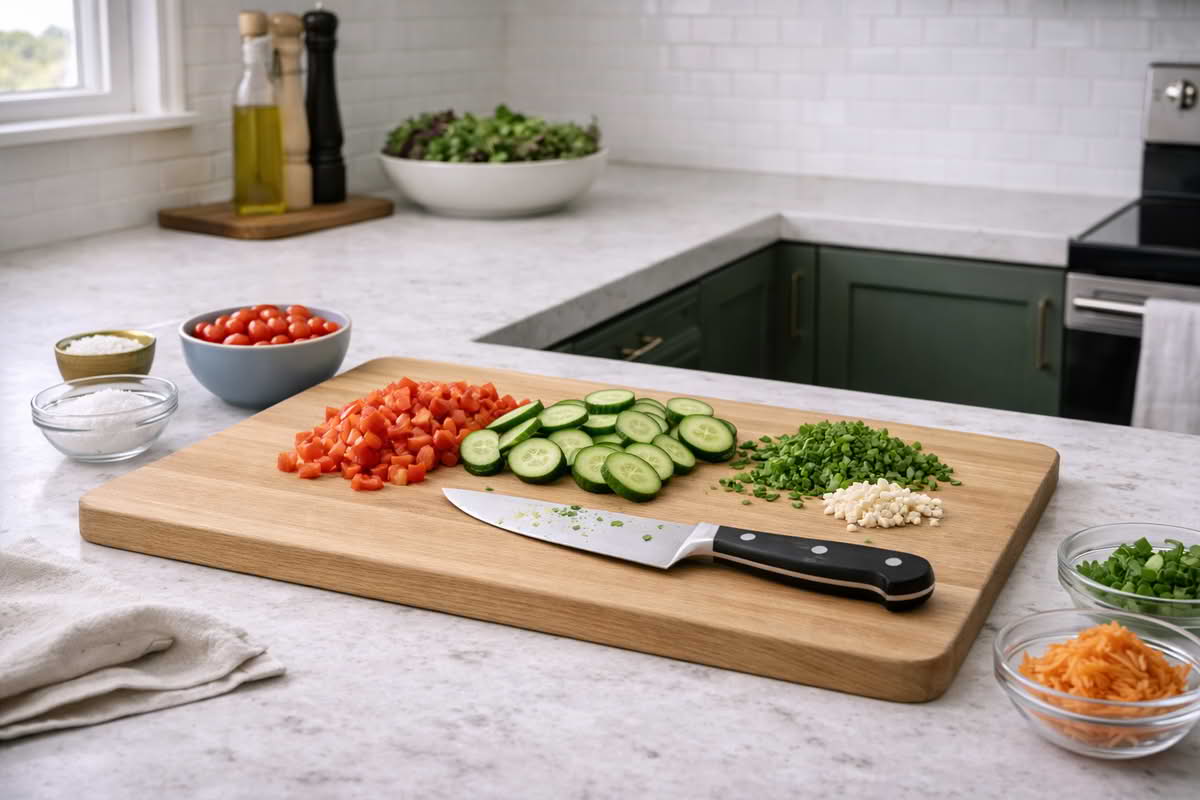
A chef knife works best when its size feels proportionate to the cutting board, the kitchen space, and the kinds of prep repeated most often.
Blade style, balance, and cutting feel
Once the size feels right, the next question is how the knife behaves in use. Blade shape, thickness, edge feel, and balance all influence whether a chef knife feels precise, forgiving, agile, or tiring. These qualities are often discussed separately, but in practice they work together. A knife may be very sharp yet still feel awkward if the balance is poor. It may feel durable yet clumsy if the blade is too thick behind the edge for the kind of food you prep most often.
Blade profile affects how the knife moves on the board. Some chef knives have more belly, which can feel natural for rocking cuts and repetitive chopping. Others feel flatter through more of the edge, which can suit straighter slicing and push-cutting. Neither approach is inherently superior. The better fit depends on how the user naturally cuts and what ingredients appear most often. Buyers sometimes overthink style labels when the more important question is whether the knife's shape supports comfortable, repeatable motion.
Balance is one of the most important and least appreciated features in this category. A well-balanced knife tends to feel easier to guide because the weight distribution supports control instead of fighting it. A blade-heavy knife may feel powerful at first but become tiring during longer prep. A handle-heavy knife can feel oddly disconnected from the cutting action. Since a chef knife spends so much time in the hand, balance affects not just comfort but also trust. Good knives tend to feel predictable. Poorly balanced ones often create subtle hesitation.
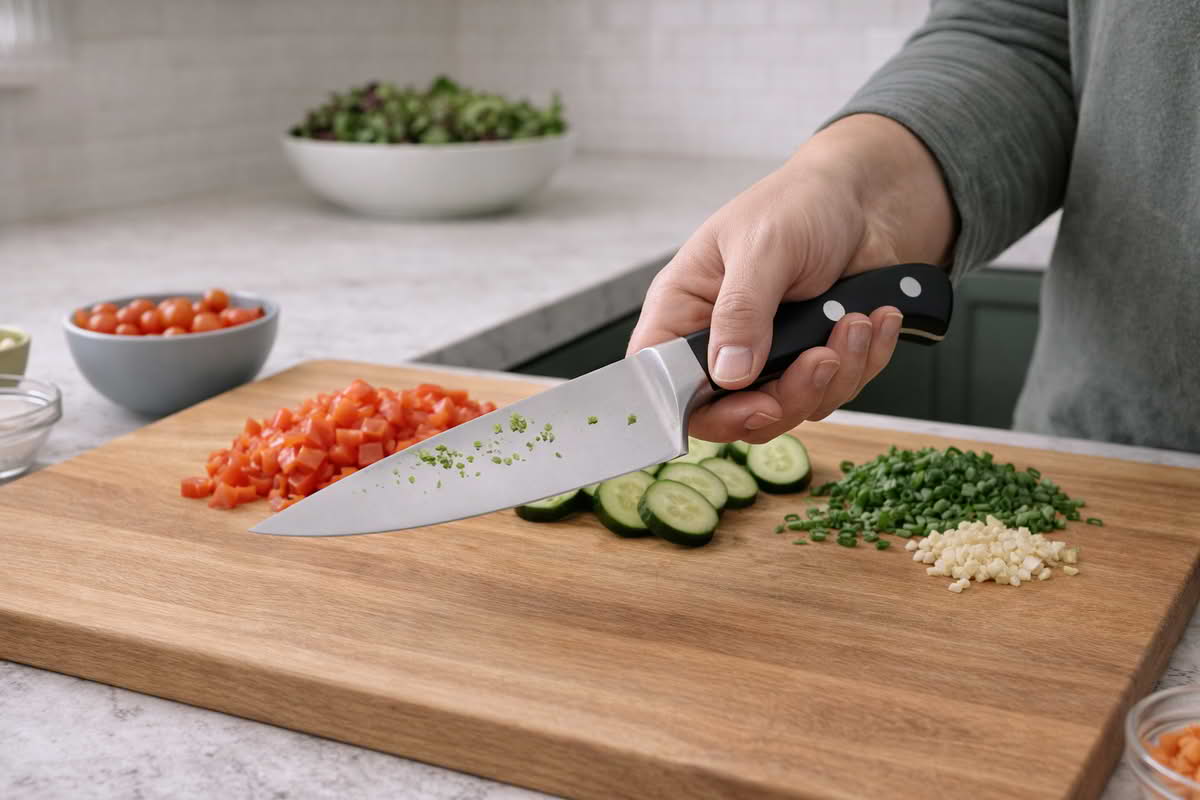
Balance and handle comfort matter because a chef knife should feel controlled, predictable, and easy to guide through repeated prep.
Handle shape also matters far more than appearance. Smooth, polished handles may look refined, but daily use depends on grip security, comfort, and how naturally the hand settles into position. In a home kitchen, the knife should feel steady whether the cook is moving quickly through vegetables or doing slower, more precise trimming. If the handle feels too narrow, too blocky, or slightly slippery when wet, those issues tend to show up every single time the knife is used.
The choice between heavier, sturdier-feeling knives and thinner, more agile-feeling knives is often really a choice about cutting personality. Some buyers prefer a knife that feels substantial and tolerant of rougher everyday use. Others want something lighter and more precise that glides more easily through ingredients. Both can be excellent, but problems begin when buyers chase one set of qualities without acknowledging the tradeoffs. A heavier knife may feel reassuring but less nimble. A thinner, more refined-feeling knife may feel wonderful in use but ask for more care and technique.
Choose blade shape based on how you naturally cut, not on abstract style categories alone.
Prioritize balance because it affects control and fatigue during every prep session.
Judge handles by grip security and comfort, not by matching finishes or decorative details.
Think carefully about whether you want durable heft or lighter agility in daily use.
Another overlooked issue is board feel. Good chef knives often feel smooth and predictable as they contact the cutting board, while poor ones can feel harsh, awkward, or slightly unstable. This matters because prep is built from repeated motions. Small discomforts compound quickly. A knife does not need to feel luxurious. It needs to feel cooperative. That cooperation is what makes a chef knife enjoyable rather than merely acceptable.
Buyers also tend to underestimate how much a chef knife's identity is shaped by its intended user. A knife praised by enthusiastic cooks may still be a poor fit for a household that wants lower-maintenance ownership and uncomplicated control. A knife that feels almost effortless to one person may feel overly delicate or too technical to another. That does not make the knife bad. It means the right buying framework is personal practicality, not broad admiration.
A chef knife earns its place by making common kitchen work smoother. It should feel stable enough for confidence, nimble enough for control, and shaped in a way that supports rather than interrupts the user's natural cutting rhythm. When those things line up, the knife becomes easier to trust, and trust is a major part of good kitchen tools.
Maintenance, durability, and long-term value
Chef knives are often purchased with the hope that one good choice will solve the cutting question for years. Sometimes that is true, but only when maintenance expectations and durability match the buyer's habits. All knives require care. The difference is how much care they ask for, how forgiving they are under ordinary use, and how well they hold their value through repeated prep, cleaning, and sharpening.
Edge retention matters, but it should not be treated like the only meaningful performance measure. A knife that holds an edge for a long time can be helpful, especially in busy kitchens, but edge life has to be balanced against ease of sharpening and the way the blade behaves in daily use. Some knives are built to feel durable and resilient, making them practical for households that want straightforward ownership. Others may offer a more refined cutting feel while expecting a little more attention in how they are used and maintained.
This is why maintenance realism matters so much. Buyers often want a knife that is sharp, durable, low-maintenance, dishwasher-friendly, and easy to store without much thought. In practice, some of those goals conflict. Good chef knife ownership usually involves a modest but consistent care routine: sensible hand washing, safe storage, and occasional edge maintenance. That does not need to be burdensome, but pretending maintenance does not exist often leads to disappointment. A knife can be excellent and still be the wrong choice if the household is unlikely to support the care it needs.
Storage is part of durability too. A strong chef knife can lose much of its practical value if it is dropped into a cluttered drawer or stored in a way that exposes the edge to repeated contact. Magnetic strips, blade guards, and organized blocks can all work well, but the best choice depends on kitchen layout and household habits. A storage method is only good if it actually gets used consistently. The safest or most refined solution on paper does not help much if it proves inconvenient in everyday life.
Cost should be judged against repetition. Because a chef knife is often the main prep tool, it earns its value through frequent use. A budget knife can be completely sensible if it feels comfortable, cuts well enough for the household, and fits a transitional kitchen stage. A mid-range knife often delivers the strongest balance for many home cooks because it can improve comfort, balance, and long-term usefulness without asking for premium-level investment. Higher-priced knives make sense when the buyer is intentionally paying for a cutting feel, refinement, or ownership experience that will actually be appreciated and maintained.
Choose a knife whose maintenance needs match the care routine you will realistically follow.
Think about sharpening, hand washing, and storage as part of the purchase rather than afterthoughts.
Pay more only when better fit, better balance, or better long-term use clearly matter in your kitchen.
Do not confuse broad praise or premium positioning with the right everyday ownership experience.
Another common regret pattern is buying too cautiously and then replacing the knife soon after. This happens when the first purchase is chosen mainly to avoid risk, even if the fit is mediocre. The opposite mistake is buying too ambitiously and ending up with a knife that feels slightly intimidating or too precious for ordinary kitchen life. In both cases, the problem is the same: the choice was not grounded in routine use. The best chef knife usually occupies the middle ground between those extremes. It feels capable, approachable, and worth maintaining.
Long-term value is also about whether the knife encourages better prep habits. A reliable chef knife tends to make cutting more efficient and less frustrating, which means the kitchen feels easier to use overall. That kind of value is difficult to summarize in a product listing, but it is exactly what separates a merely adequate knife from one that becomes central to the cooking routine. The right chef knife is not just sharper. It is more compatible with the way the user cooks.
A low-regret purchase in this category comes from honest matching. The knife should fit the hand, the board, the prep volume, and the owner's tolerance for upkeep. When those elements align, the knife feels useful in a lasting way rather than impressive for a brief moment after unboxing.
Final Recommendations — choosing the chef knife you will actually want to use every day
A good chef knife should be chosen for fit, balance, and repeatable usefulness rather than reputation alone. Buyers who want an everyday workhorse usually do best with a knife that feels controlled, comfortable, and realistic to maintain. A more specialized or refined-feeling option can be worthwhile when the cook knows exactly what kind of cutting experience they prefer and is willing to support it with appropriate care. In either case, the goal is the same: a knife that improves daily prep instead of adding friction to it.
Choose blade size based on your cutting board, kitchen space, and normal prep volume.
Prioritize balance and handle comfort because they shape daily confidence more than styling does.
Match durability and maintenance demands to the ownership style you will actually follow.
Spend for better fit and better use, not just for prestige or broad praise.
The best long-term chef knife is usually the one that disappears into the routine in the best possible way. It feels right in the hand, handles common prep smoothly, and stays practical enough to keep reaching for. That kind of steady usefulness matters more over time than trend-driven features or dramatic branding.